Feeds:
Posts
Comments

Posts Tagged ‘knitting’

I just finished knitting a sweater and hat for my new granddaughter who is scheduled to arrive in February.  In the process of working on this design, I was determined NOT to have seams, as it just adds bulk.  That said, I started with a simple raglan sleeve pattern and had fun from there on.  I wanted a contrasting cable design down the center of the sleeve, which was simple until I was ready to pick up the sleeve stitches to be knitted in the round.  Now, I had that old  “Intarsia” problem, the yarn was on the other side.

OK!  I have tried most the methods thus far out there- Ann Berk’s loops(which works great,but I don’t like fighting with the loops), and other various methods connected with YO’s (loops again), then those knitting or purling “loops” together with the stitch at the end of the round, but I didn’t want a seam.

Then it hit me, I was not looking for a seam at all, I was looking for a “stitch” connection that would mimic the interlocking of any typical color change- and….I found it.

001

The result is that my Valentine Babe will be ready for the Ski slopes in this seamless cable designed hat and sweater.

I have just completed a tutorial that shares my discovery and I hope you try it.  You can also use this method to knit an Intarsia pattern in anything that is seamless.

*The tutorial includes a cable panel, but just for practice you could replace it with a plain panel of any contrasting color.  The technique will be the same.

I will be writing up this pattern soon, and will share it when it comes up the presses, but for now, here is the Seamless Cables Tutorial to learn the technique.

Here is Rebecca’s Seamless Cable Sweater and Hat

Happy Knitting

KT

Read Full Post »

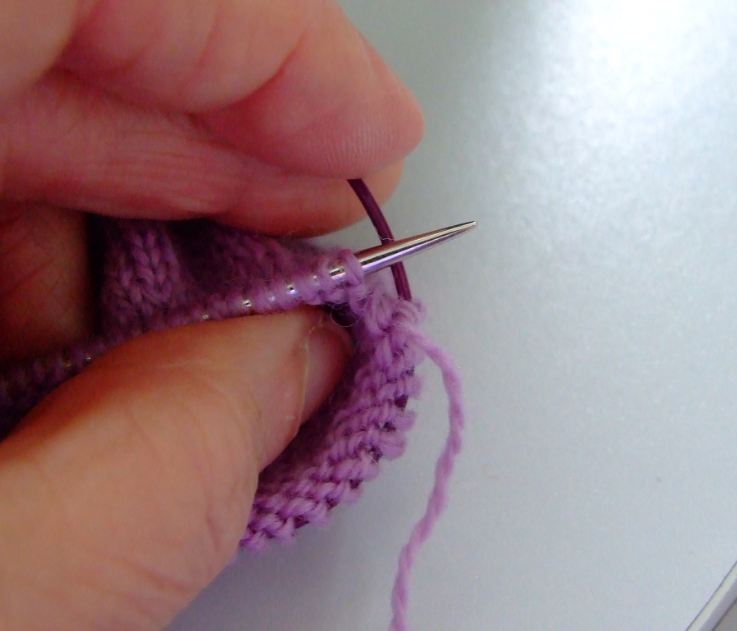
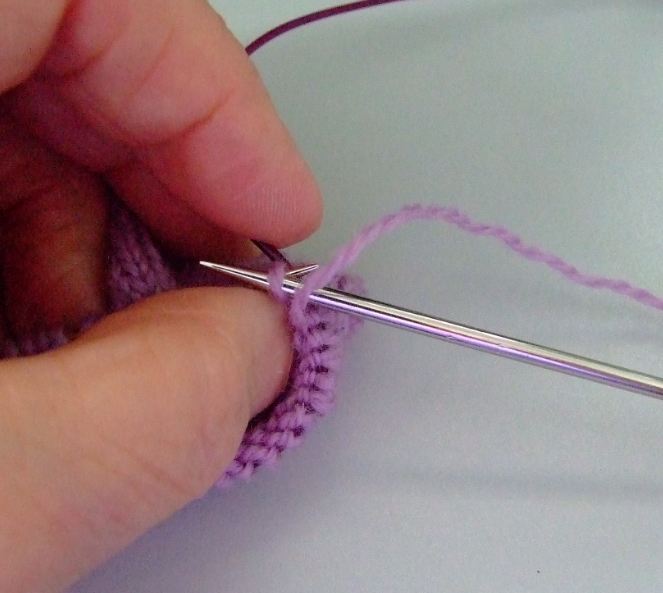
The other day, as I was working on some baby socks for our new grand daughter due on Valentine’s Day, I caught myself pulling the cord of my circle needle around the corner as I started the transition to the back needle tip, of my Magic loop.  I do this to prevent ladders, where the cords of my 47 inch circle needle form loops on each side.  The trick is to pull your cord through long enough so that you can bring it to the left under the left needle tip, then swing it down and around and up over the top to start the first purl stitch of the last section of the round.  That is why I always opt for the 47 inch cord.

cricle needle tip 1-preventing ladders

Here you see cord being pulled to the left and under the needle.  This move takes the stress off the gap between the left needle tip and the cord.

circle needle tip 2 -preventing ladders

The right tip of the needle is then brought around and over the top, then inserted under the yarn in preparation to be purled.

circle needle tip 3  -preventing ladders

Once the stitch is purled, I make sure to release it, allowing the right hand needle to lie parallel to the stitches riding on the cord to the right.  If need be, I take up any slack.

magic loop tip 1

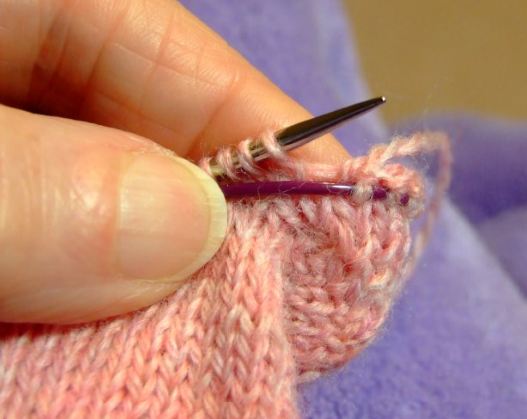
In the above photo, you can observe how I accomplish this on the knit side.  Here again, I swing my cord around to the left and secure it with my thumb before knitting the next stitch.

magic loop tip  2

Once the new stitch is complete I allow the right needle to lie parallel to the cord, then take up any slack that remains before proceeding to the next stitch.

In both cases I  continue holding the cord around the corner for a few more stitches before releasing it to finish my round.

Just passing it on!!

KT

Read Full Post »

Since I learned how to make the short row heel, with all its variations, I have been fascinated with the concept.  It is not at all unusual for someone to find me casting on a number of stitches on to a DPN, to try out a new idea on how to use them.  Recently I have been charting my short row shapes, which  gives me a clearer picture of the end product, and the opportunity to change the stitch groupings as needed to get the desired affect I want.

For example –

Even though the chart clip is small, viewing it from the bottom up, you can see the angle of each side.  This chart leaves a  pair of stitches on the needle with each turn.  Rows 7 and 8, close the gaps and complete the shape.

In this chart, groupings of three stitches are left on each end before the turn, thus changing the angle of ascent.

In the chart above, I have combined groups of 2,3 and 4 stitches to create a more rounded shape.  Here, rows 9-10 close the gaps and complete the shapes.  The possibilities are endless.

How do I close my gaps?  I pick up the stitch that looks like a “collar” around the slipped stitch of the previous row, place it on the left needle, and knit or purl it together with the slipped stitch.

What does that look like?

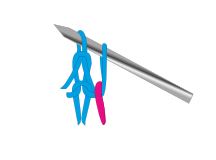
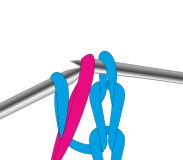
Above, is an illustration of how it looks after you turn, slip one stitch and knit the next.  I have highlighted the “collar” in pink.   You will notice that is actually is the stitch below the slipped stitch that forms this “collar.”  You will also notice that it leans slightly toward the left, as it is being pulled over with the slipped stitch.

This illustration shows you the slipped stitch turn on the purl side.  Here again, the stitch(collar) leans to the left a bit.

What do I do with the “collars?”

I haven’t made a video of this yet, but Cat Bourdhi has, in her Sweet Tomato heel demo on YouTube.  But that aside, I have drawn some illustrations to make my point.

When you have a “collar” (pink) around the stitch just before the gap as in the illustration above, you lift the “collar” (pink) up and onto the left needle, then knit it together with the slipped stitch.

This process closes the gap.  From here you can knit the next stitch or stitches of the next grouping until you come to the next “stitch collar.”  This works the same on the purl side as well.  You will find it is a very smooth transition.  Another advantage of experimenting with the various stitch groupings is that you can shape your toe caps (see my More Toes Tutorial) as desired.   You can combine the various groupings with the single stitch turns normally used in the short row heel ( a 90 degree turn) to finish the cap before picking up your stitches off the provisional cast on to start knitting in the round.  For those of you who already use my method of short row heel, you will recognize this as the SPR.  The only difference is that you are lifting the loop and knitting or purling it with the loop to its immediate left (the slipped st).

I will soon be posting the complete tutorial as a PDF.  So check back soon.  In the meantime, try some different shapes of your own.  Also don’t forget to check out the “Sweet Tomato Heel” tutorial on  YouTube.

Now that I have completely confused you , I bid you happy knitting!

KT

Read Full Post »

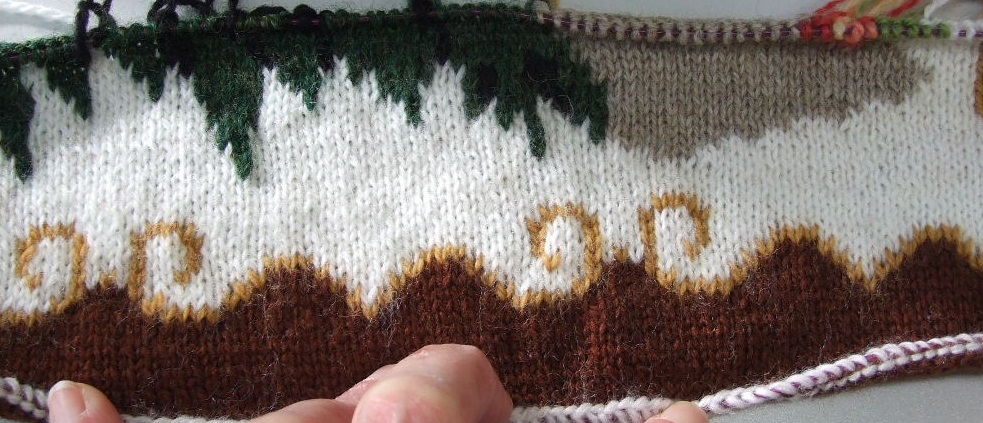
This project has been particularly interesting, as I not only had fun knitting Intarsia , Armenian knitting and Fair Isle, but I also was able to combine three different types of yarns in this design.  The border was done in fingering yarn with lace weight wool and silk strands of  free floating chains riding over the top.

The chicks were especially fun to do with a combination of Aloft mohair, added to a ply of fingering yarn.  Their  3D look was accomplished by adding an additional  two strands of the black mohair to the belly and wing area.  Adding these extra strands automatically increased the gauge without changing the stitch count.  I was able to restore the  gauge around the area by filling the void with poly fill stuffing, then running a few strands of lace weight across the back, side to side, and top to bottom.   Taking up the slack with these strands, allowed me to contract the surrounding stitches back to their proper gauge.  The next move after blocking the top was covering the back with nylon net, (great stuff, by the way) and stitching around the expanded portion of the chicks,so that it would remain securely in place.

The  combination of the Mohair and the 3 D affect  made my chicks look like the little “fuzz balls” they really are.     They are the first thing people touch when they pick up the pillow and comment, ” Oh my gosh!  They look so real!”  And so they do.

The details on the legs, feet, and beak were done with duplicate stitches and crocheted chains of one and two plies of the various yarns.   The various shades on the hen are yarns that have been blended, using  of one ply of each color that have been hand spun back together.   Check out my post on blending yarns if you are interested .

So….the most clarifying  statement I can make about this pillow is that I was never bored knitting it.  It definitely was a challenge to my adventurous knitting spirit.

I also loved working with the free floating chains on the frame of the picture.  Of course as I looked at it more closely I realized this free floating chain pattern would look great on the bottom of a tunic, or the cuff area of a sleeve, or……..  Hummm????  Maybe?   …….

I have included a  tutorial describing the entire process with this  pattern.  I even included charts for practicing the process.  This tutorial is also on my “Fun Stuff”page.  It includes a sample swatch chart of the border for you to practice with.  Enjoy!

At present the pattern is available  in my Ravelry  and Etsy stores.

Again, it was an extremely fun knit.

Happy Knitting

KT

Read Full Post »

I was so glad to get this one done so I could send it to my grandson.  He has been checking on it’s progress the last few months, so now he won’t have to wait anymore.

I had great fun knitting this one.  I even knitted some extra leaves, which I placed in the front of the duck, stuffing them a bit to give it a 3 dimensional look.

One other thing I did differently from the last pillow was to make my own pillow form.  I discovered that most of the forms  (no matter what you pay for them) are made with clumps of fiber fill, often leaving a lumpy surface.  Of course, that is unacceptable when you have spent many hours working on one of these pillow tops.  The only solution-make it yourself.

I began the process with a sheet of Poly-fill quilt batting.   I cut two 17 inch squares, then machine sewed them together on three sides, using a long stitch.   I stuffed the middle with tiny pieces of fill, poked them in place with a #1 DPN, then whipped the open edge shut.  You could even use two thickness (sheets) for each side to unsure an even smoother surface.   Anyway, it  worked great.  It will also dry much faster as there is no cloth on the inside.

I will be making all my pillow forms from now on.

Now it’s time to box it up and head to the UPS store.  My grandson will be a happy camper!

I hope to have this pillow pattern available soon.  I will be starting my J’s Designer Pillow page soon.

KT

Read Full Post »

I just finished another Whitetail Buck pillow.  This one has a knitted cording incorporated into the pillow top, along with the seam allowance to help in sewing it to a cloth back.   I even made my own cording.  It was fun!

The picture below is a “snip-it” of a section of the cord that frames the pillow.  Here you see it in contrast with the cloth back.   I have to say that there is no comparison to the commercial cording available.  I have tried finding complimentary edging for this use, but have always been disappointed.  The fillers they use are mostly cotton, and seem lumpy at best, not to mention that they take a much longer time to dry.  That is why I decided on this approach-make your own.  In addition, there is no better match in color than the actual yarn you are using in your project.

I will be adding this pattern to the Pattern Catalog page, so feel free to upload it.  The pattern contains 18 pages of detailed charts and instructions.  You can use Intarsia, Armenian Knitting, and sections of Fair Isle in this project.

The Basics

1.  Knit the Basic chart.

2. Identify and secure all loose stitches

3. Weave in the ends

4. Block pillow top on needles (This works great!)

4. Pick up stitches to begin tube for cording

5. Knit tubing

6. Close tubing, and make button hole opening for cording.

7. Knit seam allowance

8.  (opt)  Secure pillow top to woven fabric.

9. Prepare fabric back, and sew to pillow top, make cording.

10. Insert cording.  Stitch pillow close.  Adjust cording.  Close cording opening.

10. Decide on some of the options I have for making the pillow cover removable for washing.

The pattern walks you through all the above issues.  Wow!!  And that ALL???  I’m tired just making the list.  But trust me, it was worth it.  My friend Deb at Tempting Tangles ( see link on side bar) has given it her approval.

 You will also be given instructions on making your own cording out of poly quilt batting, which, of course, makes it lighter, and easier to dry when washed.  This particular pattern is backed with fabric that has been pre-washed, so the entire pillow can be “dunked” in Wool wash, squeezed out, then air dried without much fuss.

My hope that you will try your hand at color knitting.  I also hope you will take a look at my “Painting with Yarn” E-book when it comes off the press.  The book contains all my color knitting experience on this project, along with detailed illustrations and how to’s, or what I call, “Technical Tutoring.”  I hope to have it available for you soon.  Would you believe it, I am already up to 60 pages!

As a side note, I will be uploading a couple of new tutorials on my “Multi-color Knitting Tips” page.  Check them out.

Happy Knitting!

KT

Read Full Post »

This week has been the week to finish up some projects- and does that feel good!!!!

I also had time to check out my Score Exchange site, and noticed that everyone is up-loading Carol of the Bells, Jesu, Joy of Man’s Desiring, and some of my other Christmas music.  It set me to thinking that some of you might be interested, if not for yourselves, then for your church, or singing group.  I will tell you that “Mary’s Song” is a great solo for a soprano.  The lady who performed it locally has a beautiful soprano voice and absolutely loved the challenge.   Anna’s Song” is in a lower range, and is a great piece for a Mezzo Soprano.   Both pieces include piano and choir parts.

I have sung Anna’s song many times, and always in costume.  It is amazing what a difference it makes when you actually re-enact those historial moments-besides, I not as nervous when I am pretending to be someone else.  🙂

The original source of these musical vignettes come from the musical I wrote entitled “The Promise,” which tells the story of Simeon and Anna in Luke II.

I just felt led to share this with you, so do with it what you will. If you have any trouble printing them off, let me know and I can send you a PDF.

Of course, my harp music is there, too.

If you will look to the right side of this page under”Blog Roll”

you will see a link that says Music for Christmas, click on it.

Now look for anything listed under “Judith Helms, ” – yes, that’s me.

Now to the knitting part-

I can’t stand it if I don’t have some kind of colorworks project to dink around with, so I started my Whitetail Buck Pillow.  I love the colors.  The pattern combines Intarsia, bobbles, and overlay stitches, and will be finished with cording around the sides.  I haven’t decided what pattern I will do on the back yet, but I will probably opt for a texture stitch of some kind.  This may seem tedious to some, but for me it is therapy.

Happy Holidays

and MERRY CHRISTMAS TO ALL

KT

Read Full Post »

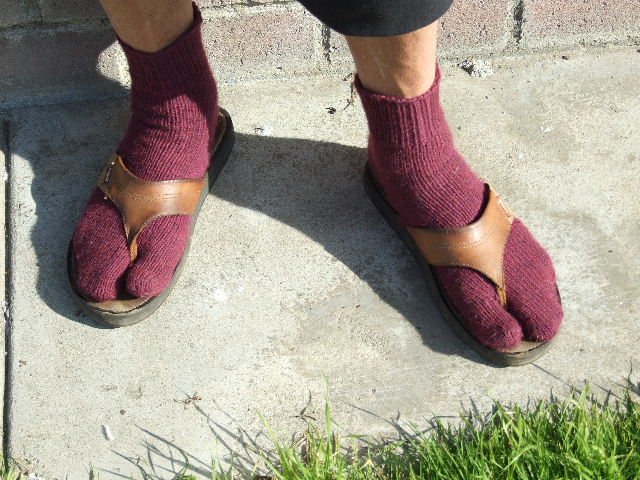
I just finished the Tabi Sock pattern (unisex) and have it available on my Free Pattern Catalog page.   This Tabi sock pattern knitted from the toe-up is constructed using Magic Loop method.  The pattern has detailed instructions, and illustrations, and will be accompanied by the necessary tutorials for your convenience.  Once you have the concept, you can design your own Tabi’s, as plain or fancy as you like.  With the necessary proper measurements done, all you have to do is apply your gauge and away you go.

One exclusive feature of my sock patterns is the toe shape.  I like my socks to “fit.”  For this specific sock, that means that I want the four toe section to fit perfectly, no wrinkles, no gaps.  In this pattern I will illustrate how I make the adjustments needed to help you fit your toe shape.  One of the concepts I introduce in this pattern and in the Foot Glove pattern, is called a CTF (connecting toe fan).   This little addition provides added comfort between the toes and conforms more closely to the actual foot shape where the toes are attached.

The picture below, is of my brothers Tabi socks.  These are done with Sports weight yarn.  With this pattern you can do either fingering yarn (my favorite) or Sports weight.

You can see in the picture above that my toe shape is intirely different than his.

Some might think my patterns are a bit lengthy, but, I like to draw, and love working with my camera.   It is very important to me that you understand the reasoning behind the instructions.  Why?  Because I am one that learns better by doing than by reading.  I need pictures.  I need to know the concept.  Once I do, then, look out!  Get out of my way!  I’m coming through!!!

The creating process is fun for me- it’s not work.  So bear with me, you’ll have to get use to the 15-20 pages of detail. 🙂

Knit-tweaker

Read Full Post »

This past year I was asked by a friend to duplicate a comercial knitted sweater.  Her husband had bought it for her many years ago and it was her favorite, but as all things do eventually, it began to show its wear.  So, I bravely, but reluctantly, said, “OK!”   Boy, was I in for it! 

First off, I had a devil of a time finding a yarn that came even close to the original.  Next, I had to find a stitch that would duplicate the one used in the sweater.  After searching for some time I came across a version of the “Brioche” stitch in an old Burda book that I had.  Now, I had it made- or so I thought. 

So…. what’s the point in this post?  Just because the pattern is in a book doesn’t mean it can’t have mistakes.
This beautiful slip stitch rib pattern instructed me to, ” YO, slip purl, knit two together.”  This basic sequence was to be  repeated every row to form a reversible rib pattern that lies flat.   Well, I did that, but the first time I tried it out on a swatch, the K 2 tog would not lay open like it looked in the picture.  I knew something was wrong, so I changed it to YO, slip purl, SSK.  It worked.  I had it made-well sort of….

Now I don’t know about you but when I see instructions to YO (yarn over) before a knit stitch, I bring my yarn to the front then knit the stitch to the left.  In this case, the instructions were to slip the purl, so I brought my yarn forward and looped it around the needle as I do if the next stitch to the left is a purl.   I will have to tell you that it worked fine accept in this particular case, I had to be very careful that my YO was snug, otherwise the tension of the slip stitch was very hard to control-in other words,  it was definitely NOT a relaxed knitting experience. 

 After finally reaching the arm hole on the back, I began to look carefully, following  the yarn as I knitted,  trying desperately to fine a better way of handling the stitch pattern.   As I did, I realized that the term YO (yarn over) was in error( or at least my interpretation of it), so I tried just bringing my YF( yarn forward), slipping the purl, then working the SSK for one row.  When I turned it around to start the next one, I noticed that the two stitches that were to be knitted together were already in their proper order and I no longer had to SSK them to get them to lay open.  From that point on I was able to yf(yarn forward), slip the purl, then knit the two stitches together.  The tension was also no longer a problem, and the move set me up for the next row.   My nightmare was over.  I could finally relax and enjoy knitting the sweater.

 Why all this blather?  If the pattern you are working on doesn’t look right, it doesn’t always mean that you have made a mistake.  Your knitting instructions could have been written incorrectly.  Terms means things.  Our understanding of them is very important, and I will say that I have discovered that many have different intrepretations of similar terms.  Also as a writer, it is very easy to assume your readers know what you are talking about, and many times the editors don’t catch these things as they are not actually knitting them.    In this case the YO(yarn over) slip purl, should have been written YF(yarn forward) slip purl.   What a difference  two little letters, can make.  Had I only known I would have saved many hours of pulling my hair out. Oh, well, live and learn.

Knit-tweaker

PS:  I also had to figure out how to handle decreases, increases and proper case on for the pattern.  What fun!!!!

Read Full Post »

While starting my new Double Knitting project, I decided to try a new cast on method.  In the picture below you will see my two color cast on. Each color was put on by itself, producing an alternating colored edge.  I think it looks pretty cool.

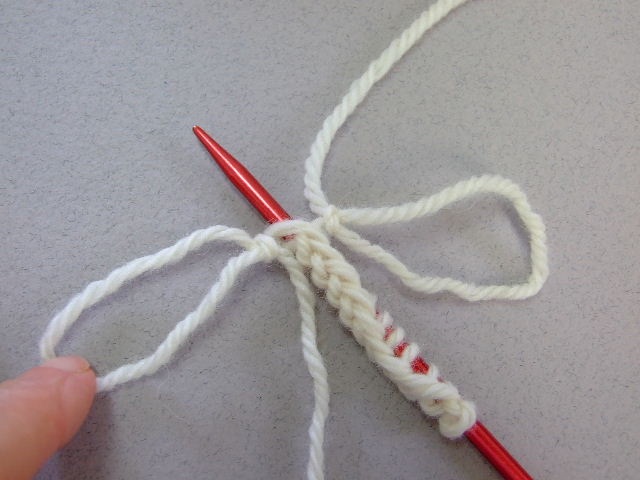
How to do it.  Using the yarn and needles required  for your project, calculate the yarn length for your long tail cast on by making a slip knot, then casting on 10 sts.  Now tie a loop at the end of both pieces of yarn.  See  picture below.

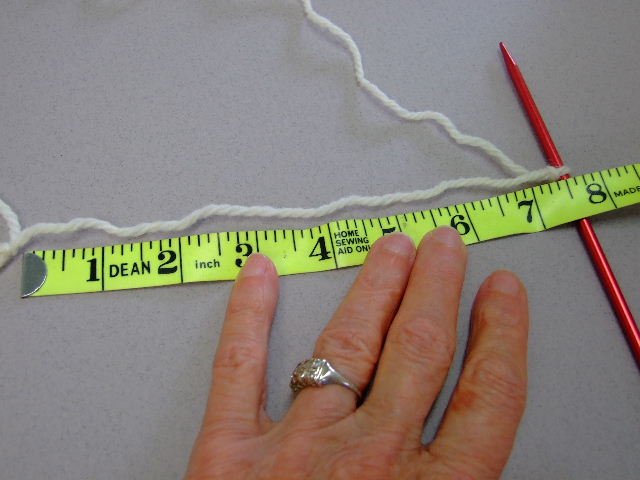
Carefully undo the 10 cast on sts, leaving the original slip st on needle.  Now measure the ( A)  long tail side.

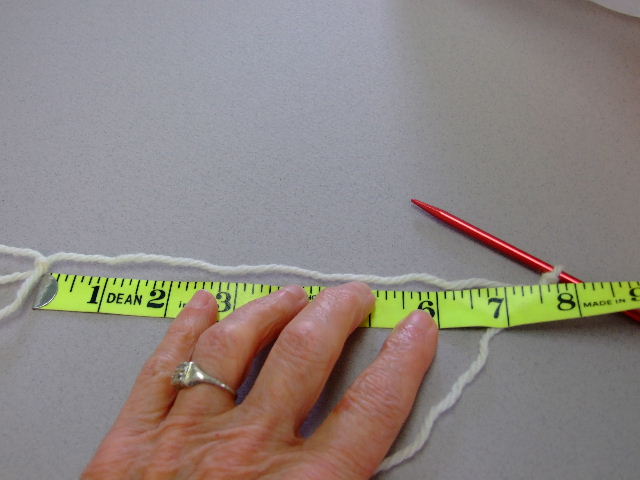
Then measure the ( B)  working yarn side (the one attached to the ball of yarn).

Here you see that the length is about 7 1/2 inches, but I will round it up to 8 inches.  Having determined how much yarn you need for 10 sts,you now can divide the number of cast on stitches required by 10 and multiply it times  the length just measured, then add about 6 inches extra.  

*You may notice that the measurements are about the same.  But don’t be fooled.  That is NOT always the case.  It is important that you write down the numbers.  On my current project, using size 10 1/2 needles, the B (working yarn) was about 1/3 more in length than the A (long tail).

Once you have determined the length of the long tail (A), peel off that length of  yarn for one color then make a slip knot.  STOP!!!!  Before you go any farther, make a loose knot in A.  You’ll thank me later.

Measuring again from the slip knot onward toward the ball of yarn, measure off the length of B.  Break the yarn.  Repeat this process with the other color, placing the slip knot infront of the first one.  Now, with both slip knots on the needle, lay out your B’s (long tails, the one’s you marked- I hope) to your left, and the A’s straight ahead.  Now you are ready to cast on.

In the video below, I will show you the move.  Try it!

Once you are finisned casting your stitches on, just spit slice your working yarn on to the ends left and start knitting your double knit pattern.

You might also like to try this decorative cast on for a Fair Isle project.

Enjoy!!

Knit-tweaker

Read Full Post »

« Newer Posts - Older Posts »