Feeds:
Posts
Comments

Archive for the ‘Uncategorized’ Category

nordic knee highs

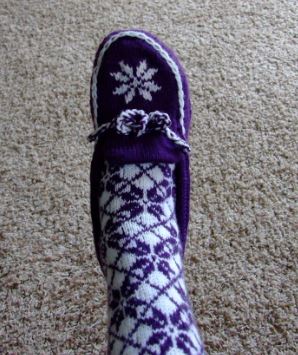
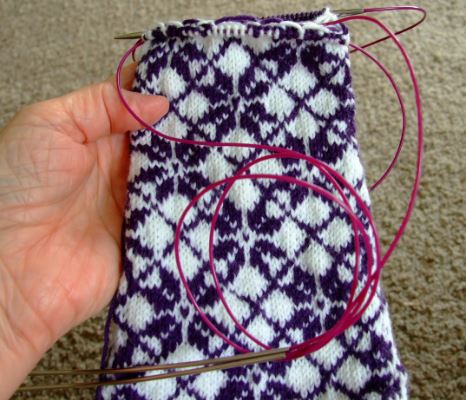
Well, they are finally off the needles and covering my “tooties.”

nordic knee highs 2

I thought I might let you in on my secret of keeping them UP!

I have found that elastic thread crocheted to the inside of the top of the rib does a good job.  You might also notice, if you take the time to look at some of the commercial socks, they also use this method.

nordic knee highs- elastic finish

It is really easy to do.  Using a small crochet hook, make a slip knot in the elastic thread leaving about 6 inches for a tail.  I begin my crocheting about 2 sts down from the top edge.  I use the knit 2 sequence of the rib to anchor the crocheted chain, then chain 2 between the sections of the rib.   Slip stitch you elastic into the right leg of the first selected knit stitch, then slip stitch into the left leg of the knit stitch directly to the left.  The next step is to chain 2(which take care of the purl 2 section), then repeat the 2 slip stitches as before in the next group of knit 2’s to your left.  The tension you use to hold back on the elastic thread will determine how tight it is, so be gentle.  When you have completed the round, leave a 6 inch tail and pull the elastic through the last slip stitch.

DO NOT TIE IT OFF.

Put the stocking on, and see how it works.  If you need to tighten it a bit, then simply release the elastic, pull it out and tighten your tension a bit more.

You can work 1-3 rounds of this elastic chain, spacing the chains about 2-3 stitches apart.  I made my second round 3 stitches below the first round.

  They worked for me.

Give it a try!

nordic knee highs- paired with twine knitted mocassinsHere is a photo of these knee highs paired with my Twine knitted moccasin.

Happy knitting!!!

KT

Oh!  Be sure to check out the pattern charts I uploaded for you in my last post.  Check out “Nordic Boot Sock Ideas.”

Read Full Post »

cozy toes nordic sock

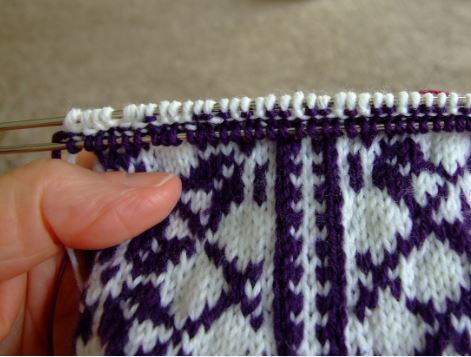
As I was working on the second sock  I decided to take some photos of the double heel set-up.

First, let me say that I have discovered that using a needle  at least two sizes smaller for setting up double knitting, gives a much smooth transition than doing it with the needles designated for the field. So…, since I am using a #3 for the main knit, I will be using a #1 when setting up the double knit for the heel.

cosy toes-heel set upDouble Knit Set-up

Using my #1, I knitted the first stitch with the MC, leaving it on the needle, I brought both the yarns(MC and CC) through to the front; with the CC  I purled into the same stitch.  To repeat, bring both yarns to the back, then knit the next stitch with the MC. Bring both yarns front, and purl in the same stitch.  Work all the heel stitches this way.  You should have twice the amount of heel stitches on your needle. The next step is to pull the #1 through all the way so that the stitches are now on the right end tip of the circle needle.  This puts them in position to be slipped off onto the two tips of the #0 needle.

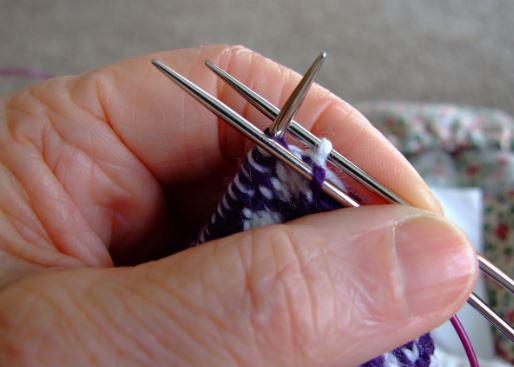
Pick up a #0 circle needle.  Fold your #0  in half so that both ends face the same direction.

cosy toes-dividing sts

You can see that I have positioned the tips between the thumb and index finger of my right hand.

cosy toes-dividing sts-2By rocking my wrist forward and backward, I pick up the MC from back to front, with the nearest needle, the CC stitch is picked up in the same manner, with the farthest needle.  The trick is to keep your right hand thumb on the stitches just picked off.

cosy toes-dividing sts-3

You can see in the photo above how it looks as you progress across the row.
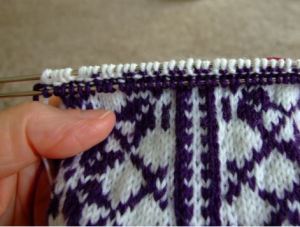
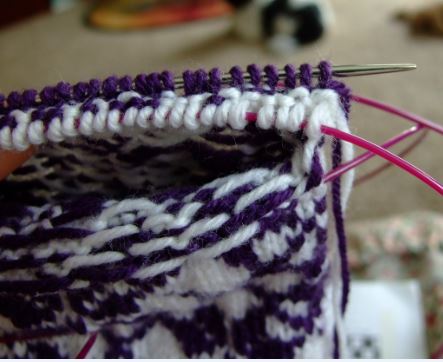
cosy toes-dividing sts-4Once you have them divided onto the two points of the needle, it is time to set up for knitting the MC heel on my #3’s.  To do this just turn the needles around so that the working yarn is on you right.  Now pull the #0 needle holding your CC through, so that the stitches ride on the cord.

cosy toes-dividing sts-5

*Note- you will find that knitting off the #o holder, leaves you ample room for the larger needle and makes a smooth transition.

cosy toes-ready to knit heel

Next, pick up the #3, slip the first stitch, and purl across, beginning your short row heel.  Once the #0 is released from this row, pull it through so both side hang out evenly.  I actually tie a loose knot in the coil and let it hang.  This needle serves as  a stitch holder for the CC stitches of the inside heel.
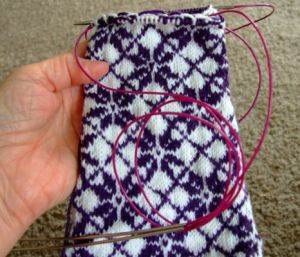
cosy toes-ready to knit heel- keep cc sts out of the way

Complete the MC short row heel, ending on a knit row.  Why?  This will set up our working yarn in the proper order to complete the round that was interrupted when the heel was begun.

cosy toes- picking up cc sts for second heel

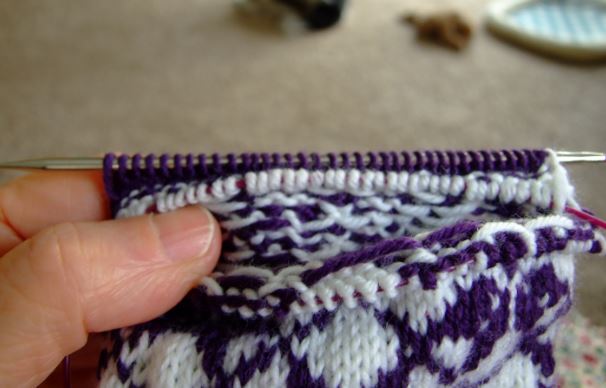
After transferring the finished MC heel stitches onto a spare #1 or #0, beginning at the right edge, with the purl side of the MC heel facing you; with #0 needle, pick up the stitches for the inside CC heel.

cosy toes- photo of inside heel

Here you can see the stockinette stitches of the inside CC heel.  Beginning in the knit side, complete the short row heel, ending with a purl row.  Now both working yarns are in position to complete the original round.

Below are some photos of the completed heels.

cosy toes- photo of opposing heelsYou will notice that the purl sides oppose each other.

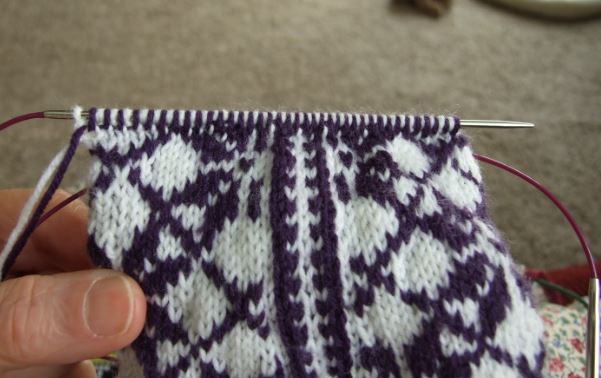
cosy toes- lining up short row turn ridges of inside heelsOnce the two heals are completed, line up the short row turns as shown in the photo, and loosely stitch them together, weaving in the ends of your yarn.  I have found that using a piece of the MC works best.  Now turn the heels inside each other, both sides should be in stockinette.  Slip the stitches alternately back onto your the right tip of your #3 needle. Pull the cord through, in preparation to complete the original round.  The heel stitches riding on the cord should  in the same order as in the first photo in this post.  Now complete you chosen chart for the instep section.

When you come to the heel portion with the two colors, knit the MC and CC together with the MC.  At the same time you will be weaving in the CC behind every other stitch.

From this point on you just complete the charts you have chosen for the instep and sole section until you get to the toe.  Repeat the process as for the heel on the amount of chosen stitches.  Join the two together, and Kitchener stitch the remaining stitches to the matching sole stitches.

* I interlock the first  and last two stitches, before I start my Kitchener in order to eliminate the bulk at the beginning and end. Using 2 #0 DP needles makes this process much easier.  Click on the link to “Techknitter” for instructions.

Here are some additional ideas and instructions.  Nordic Boot Sock Ideas

Chart tips-For this and any other project requiring a chart I have found that “whiteout tape” you can get at Staple or stationary supply, works great for keeping track of where you are.

cozy toes chart tipIt peels off easily and can be moved up the chart as required.  You will notice in this photo that I also have used it to mark the out the section for the heel.  As you can see it great for any application where you need to mark your progress.

Happy knitting!

KT

PS- You can find the original version of these stockings at Knitting Daily.

*The original stocking, uses a Shepherds heel.  It works well, but I prefer the short row version.

Read Full Post »

2013 in review

The WordPress.com stats helper monkeys prepared a 2013 annual report for this blog.

Here’s an excerpt:

The concert hall at the Sydney Opera House holds 2,700 people. This blog was viewed about 17,000 times in 2013. If it were a concert at Sydney Opera House, it would take about 6 sold-out performances for that many people to see it.

Click here to see the complete report.

Read Full Post »

Moving Day

I recently started another website for the purpose of uploading all my “Low Carb” recipes.  The link below will take you to the site should you be interested in uploading my free e-book, or just taking a peek at what I have to offer.

J’s Low Carb Recipes

One of the latest recipe I posted is a doughnut recipe.  I have to say that even people who are not into low carb eating seem to enjoy them immensely.

I will be removing the current page on this site, as I want this to be dedicated to knitting.

Check it out!

K-T


Read Full Post »

cozy toes nordic sock

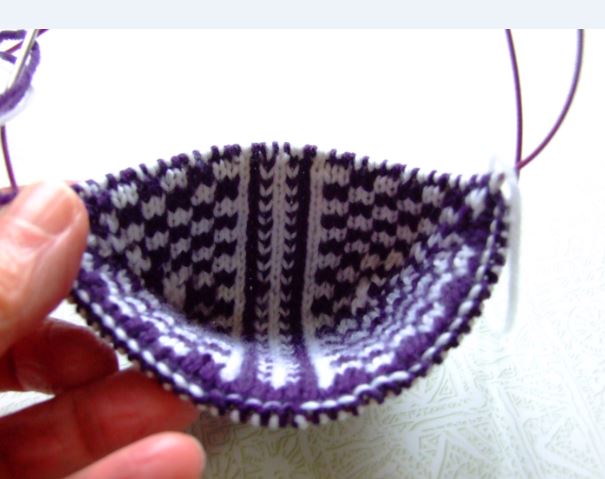
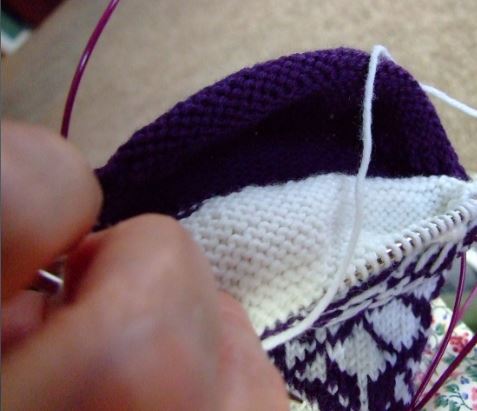
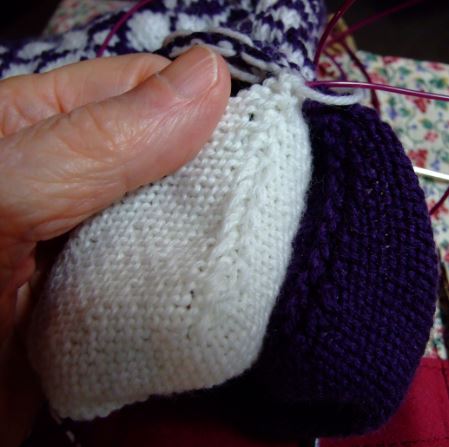
This is my latest knitting endeavor.  This sock is knitted in Fair Isle, with a double heel and toe.

Below is the inside of the sock.  You can see that the toe and heel are smooth, as the knitted side is on the face.

inside of cozy toes nordic sock

I accomplished this by first setting up the heel section for double knitting ( knitting and purling in the same stitch with the appropriate colors).  The next step was to put the white(or inside stitches) on a #0 circle needle, letting them ride on the cord while I knitted the short row heel in purple. Once the outside heel was done, I simply slipped the “white” stitches on to my #3, and completed a duplicate heel.  Next, I matched up the short row turns, connecting them together with one ply of the yarn. I did this to keep the two heels in proper alignment.

** One trick I learned with this experiment was to set up for the double knitting with a size smaller needle.  If you don’t, then you need to take the slack out of the stitches before you start knitting the heel/toe, working from the right to left toward the working yarn end.

The next step was to join knit last row of the heels together.  From here I continued the pattern of the instep and heel.

At the toe portion, I repeated the heel procedure, joined the two toes together as before, then Kitchener stitched the final stitches to the remaining stitching of the sole.

outside of cozy toes nordic sock

The heel and toes are  soft and padded.  The extra thermal layer should give me the extra warmth and flexible room to wiggle my toes in. 🙂

The basic sock is knitted form the top down, and is tapered in to fit my leg. I had the star pattern from another sock.  You could use any of your favorite designs for this sock.

Design your own.

I will be working on a demo for the heel and toe, and will upload it when it is finished.

Knit-tweaker

Read Full Post »

While completing the heel section of my husband’s new pair of boot socks, I played around with different needle arrangements that would take the strain off the short row closures.  What I settled on was the following method.

First the set-up.

I use one 47 inch circle needle to make all my socks.  I always label the top of the sock as riding on NA( needle A), and the heel or bottom of my sock, as NB(needle B).

When I am ready to make the heel, I now pull out a loop of my needle cord in the center of the top of my sock(section A).  I do the same for the heel section B.

repositioning needles

You can see the arrangement above.  As I was working a wedge heel,(or Sweet Tomato heel) I marked the beginning of my short row turns with a marker.  In the picture above I have completed one wedge and it is hardly visible.

This arrangement of needles definitely takes the strain off of the yarn bars between the short rows turns, and makes the closing round much easier to accomplish.

Just thought I would pass along this tip!

Happy knitting!

KT

PS- I have added recipes to my low carb e-book.  Check it out.

Read Full Post »

A Non-knitting Project

I just had to share the project that I worked on today.  As a bit of background, my husband and I eat  basically low carb, and I am always trying to come up with new ways to” have our cake and eat it too.”  That said, my husband is a hamburger lover and he really feels deprived when he has to go without.  So….. to remedy the problem, I have come up with a hamburger bun recipe that has but 2 carbs.  Below is a peek at the result.

001

I have created a PDF recipe for you to upload if you desire.

J’s Low Carb Hamburger Buns

I have to tell you that he was really impressed.  They are light, tasty, and stay together well, even with a juicy piece of hamburger, onion, fresh home grown tomatoes, and the works resting between the layers.  They, of course, cut easily with a bread knife.  I have also used them to make open face grilled cheese, and tuna sandwiches.

I hope you enjoy them.

Now I can go back to knitting his socks. 🙂

KT

Read Full Post »

As I was contemplating the possibility of beginning on one of my latest pillow designs, I thought it might be fun for me to share my thought process with you.

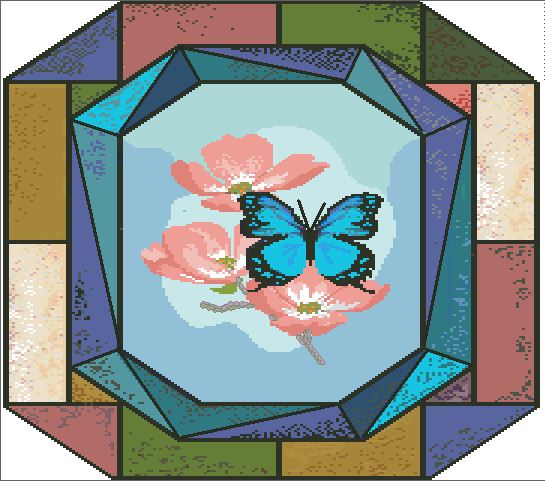
Below is a clip of the condensed chart, which gives me a view of “what you see is what you get,” with a 33 % view.

The design is from a simulated stain glass window that I created for my home in the mountains of Idaho.  I painted the original on plexiglass then mounted it on the window of my kitchen door.  The knitted design incorporates the frame, but I have added a South American butterfly to my Dogwood flowers, instead of the original Hummingbird.

stain glass window designYou will notice that there are 2 separate rings of colors surrounding the center motif.  The first, or outside ring, shapes the pillow.  The black edges will be knitted as part of the design.  The technique I use for this is called Armenian knitting.  I will be using 2 colors in each section and will be weaving the unused color in every other stitch.  This will give me a bit of a textured look, simulating old rough glass.  Any additional colors I might desire will be added using a single ply of the selected yarn, and applied as a duplicate stitch.

The second ring will also be knitted using the same technique, but this time the lines you see with be inserted after the work is finished.  This will give me the option of using an embroidery stitch or crocheted chain to add this detail.

The center motif will be created using the Intarsia knitting technique described in my e-book.

To begin, I roll all my colors into small balls.  Next,  crochet thread, and crochet hook, I make a chain long enough to support the number of stitches on the bottom edge of row#1 on the chart, plus 10.  Breaking the yarn, I leave a 6 inch tail, pull the yarn through and tied a loop in it.  This chain provides me a base for my provisional cast on.

Turning this chain over to the back side, I count in 5 loops from the end before I start picking up the stitches of the first row, inserting the tip of my knitting needle in to the single back loop of each chain stitch.  When all the necessary stitches have been placed on my knitting needle, row one of the chart has been completed.

The next row(purl) begins by adding a stitch.  You can do this anyway you like.  I will be using the following method: knit in front and back of same stitch at beginning and end of row for right side rows, then purl in back and front of stitches at beginning and end of purl rows.  This gives me a more compact addition.

I can’t wait to see the results of my labor.  Once I get started with one of these patterns, it is hard for me to put it down.  I love seeing the picture develop, one row at a time.

I am going to drop this pillow top chart into my Designer Pillow page.  You can also upload this 18 by 18 pillow top chart here.

stain glass pillow design chart

All the yarns are Palette by Knitpicks.  The gauge is 9/12  using a #1 needle

One skein of each color is sufficient.  You can also use fingering yarns from your stash. I have chosen to used  “heathers” for the darkened areas, in the outside ring.    I work with long strands of each color and spit splice yarn additions as needed.

I have not decided what kind of back I will create for this design, but there is plenty of time for that later.  This is definitely not an overnight knitting project.

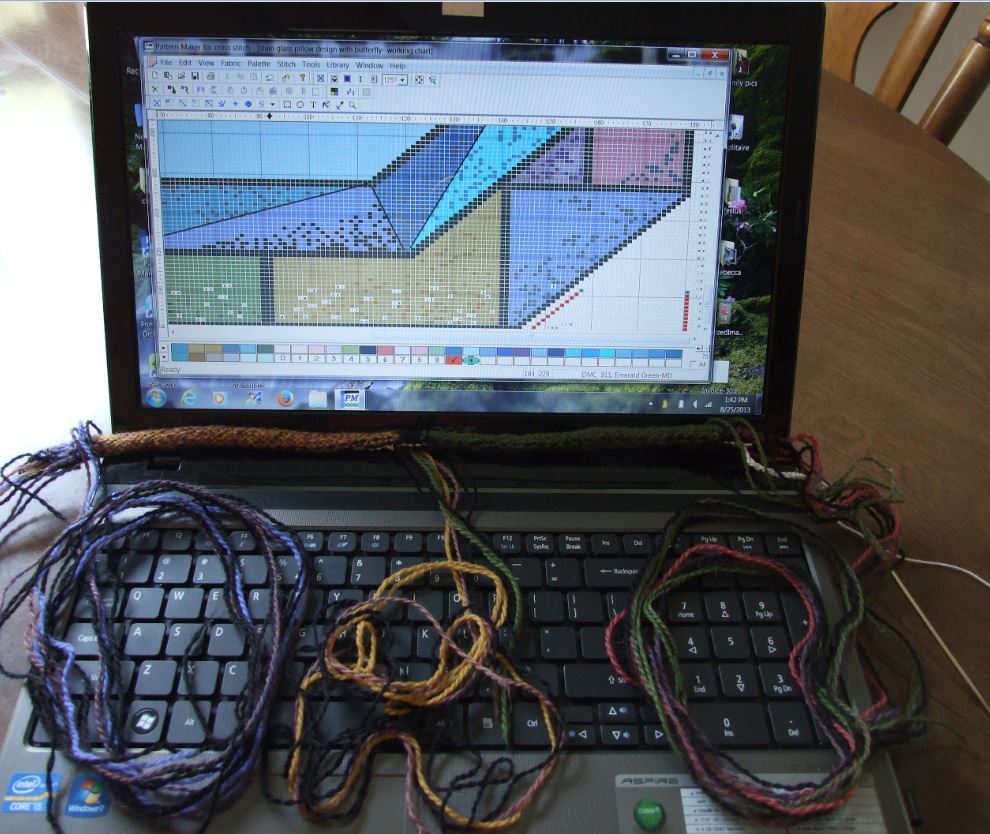
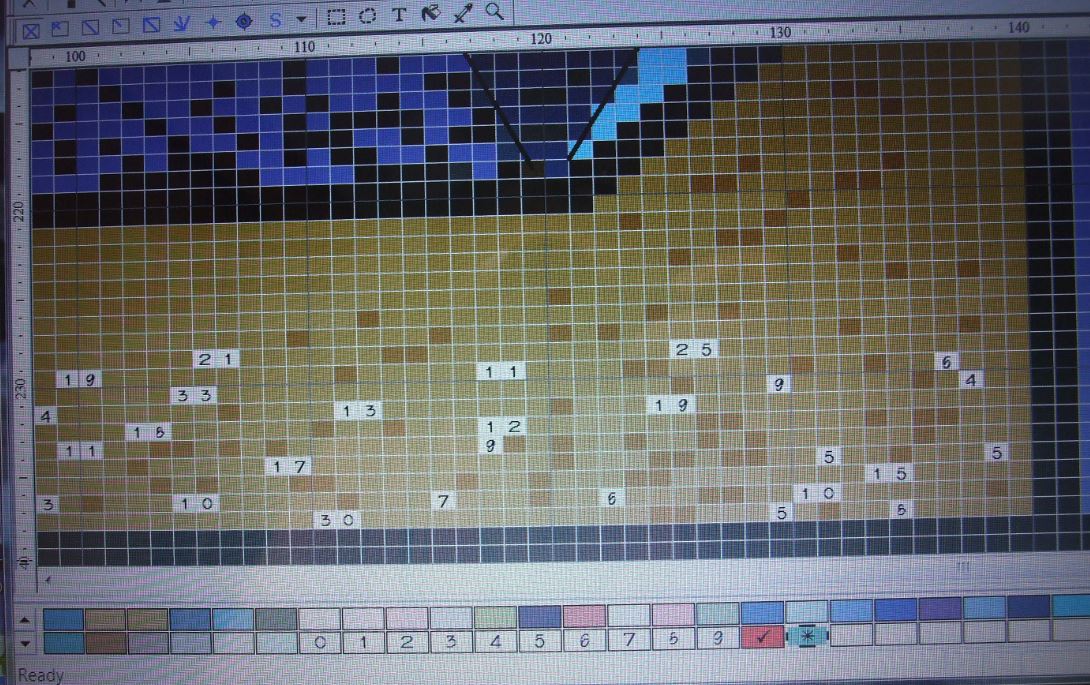
Below is a photo of what I see on my computer screen using my Pattern Maker Pro.

pm screen view 1If you have this program, then I can send you the actual file to work with.

The second photo is a shot that shows how I number the larger areas of stitches, which helps me to read the chart.

pm screen view 2

It may be a bit hard to see, but I have inserted the stitch count of the main color.


Happy knitting – KT

Read Full Post »

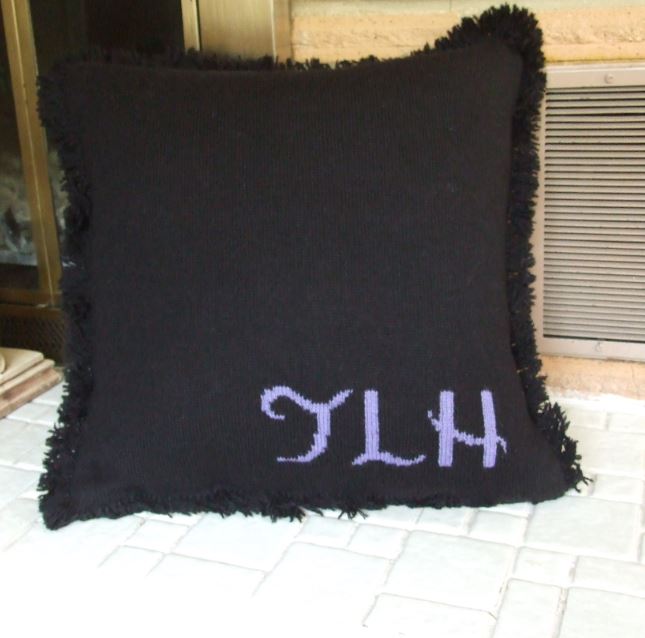
I haven’t posted for a while as I have been in the process of moving to our new home, so as you can imagine, there has been very little time for knitting, but alas, my Equine Sunset designer pillow is finally finished.  As a final touch, I added a short fringe to complete the project.  Below are photos of the front and back.  You can see that I added my grand-daughters initials in the lower right corner to break up the solid black back (I get board easily when knitting solid colors).

taylors pillow - frontFront

taylors pillow - backBack

There are a couple of tips I want to share with you in regards to this design:

1)  When working on the back, check your gauge often.  Why?  Sometimes when you are switching back to a solid color after working with intense color changes there is a tendency to tighten up you gauge.

2)  When trimming your fringe, lay it over your fingers so that the trimmed yarns fall on the solid black back, and NOT on the light portions of the front design.  Why?  You will be picking off the black yarn tips for hours just to clean up your picture.  How do I know???? Guess!!!

Here is the pattern.  equine sunset pillow pattern and notes

In the past I have made and effort to include all the special instructions with every pattern design, however since I have written the e-books for you to download free, in the future I will be only uploading the charts of the designs, the yarns required, and the necessary knitting notes.  However, if I do anything different than what I have previously posted for you, I will include it in the pattern.

In the case of “Equine Sunset,”  the back chart will not be included.  You can work up your own chart, or knit it plain.

Happy knitting – KT

Read Full Post »

In the middle of trying to purchase and move into a new home, I have been working on a  pillow design for my “horse loving ” grand-daughter’s birthday.  I just finished the top last night, and finally have it blocked on my zero circle needles.  Here is a peek.

equine sunset - s

The back will be a solid black, with her initials in the Chickory blue of the sunset.  I will be finishing it off with 1 1/2 to  2 inch black fringe.

By the way, the designed sunset was taken from a photo.  The colors and contrasts were stunning.  Believe it or not, there are those who don’t believe that this is from a photo, but then maybe they haven’t observed the beautiful tapestry of colors that God created in our universe.

As always, I will add this to the charted designs on the “pillow” page as soon as I have time.  It may be a while, as I need to settle in my new home first.

Just sharing- KT

Read Full Post »

« Newer Posts - Older Posts »