Feeds:
Posts
Comments

Archive for the ‘Uncategorized’ Category

Finishing up a project is very rewarding, and for me, is not a “get it done” thing, but more of a “see how neat you can make” thing.  I have learned to take my time, concentrating on the details.

In the case of this Fair Isle design, this means securing those long floats we discussed in my previous posts.  So before proceeding with this part of the task I have a couple of things to remember-

1)  check to make sure that all my loose stitches have been secured

2) check the end stitches of the long float areas to see if they have become loose.  If they have then I will pull the float in the back toward the center of the diamond to take up the slack and secure it close to the beginning or ending of the float first before attempting to secure the middle.

3) use only a single ply or 2 of the background color for stitching down the yarn floats.  In the case of this sock yarn, I am using 2 plies of the red.

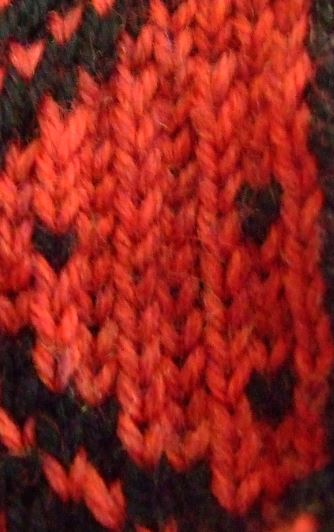
Below is a photo of one of the large rose sections that I am presently working on.

long float tie down

Using a sharp needle, I pick up a few thread of the red background yarn, then stick through the middle of the black float, repeating this move across the desired area, pulling the tie down strand just tight enough so it lays smoothly and stretches with the knitted fabric.

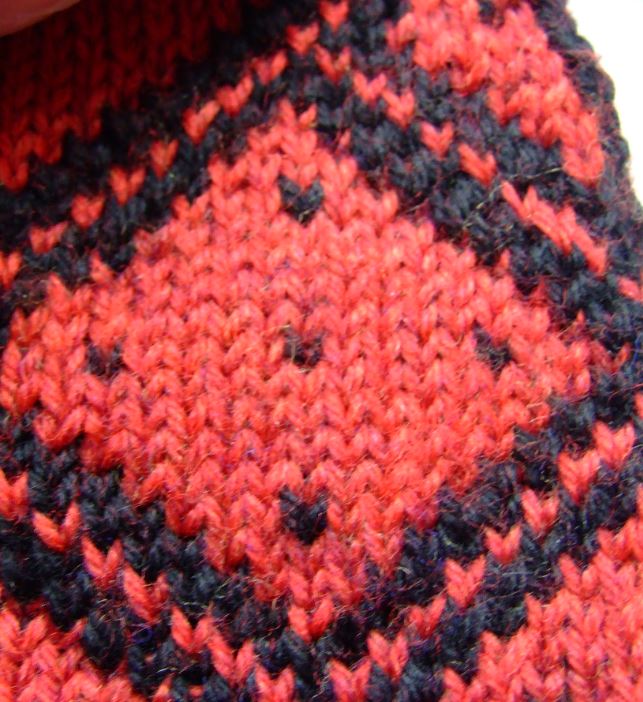
I usually begin at the bottom to the top of the diamond, working about 3/8 inch from the left edge.  After weaving in the ends of my thread, I repeat the process for the right side.  Once the sides are secure then I work on the center area if needed.  Below is a photo of one diamond that I have finished.
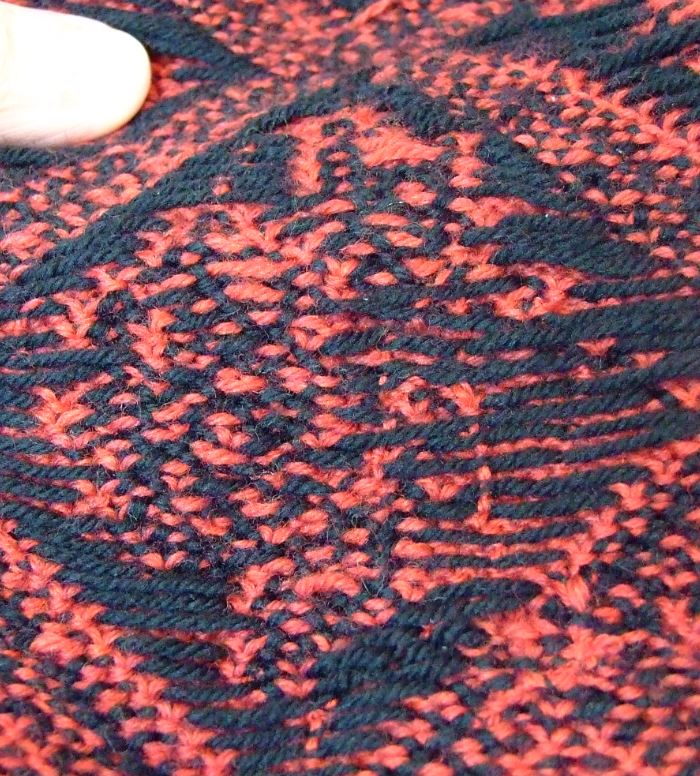
long float tie down finished

You can see that it is very hard to see the tie down yarn, but every black float in the picture is tied down securely, yet will move freely with the stocking.

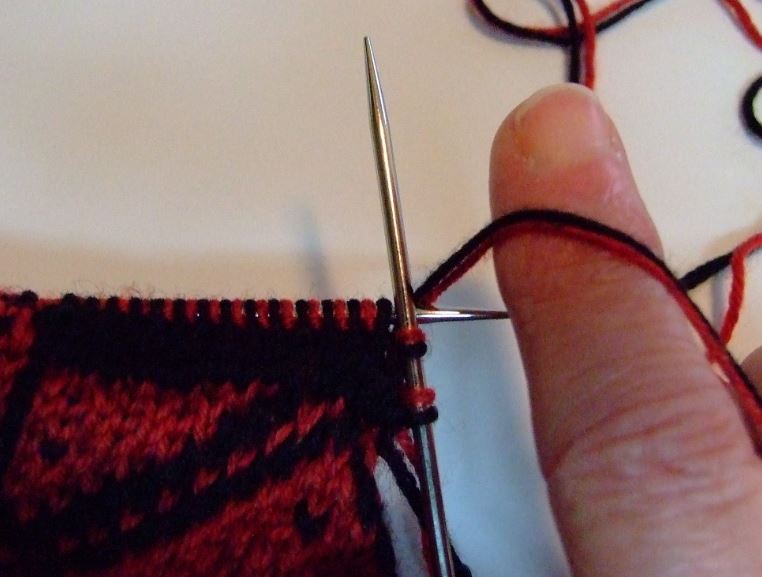
In step #2– if you find that after you have secured your floats about 3/8 inch in from its beginning and end, and still have loops in your float as in the photo below-

loose loops 1

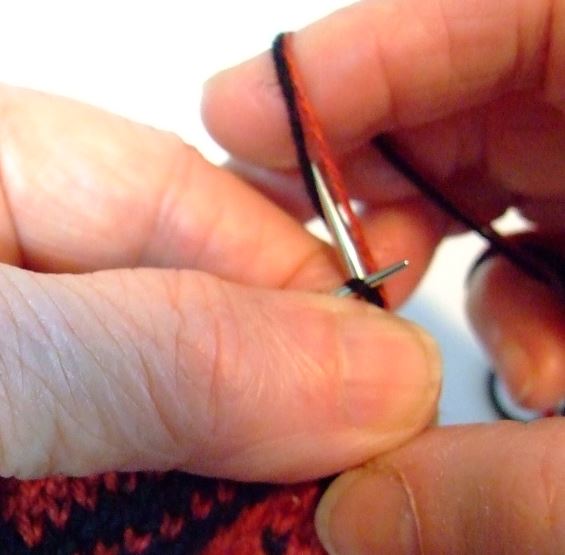
Here is what to do.  First, if possible using a dp needle, carefully equal out the excess across the span.  Next, lay the work across you leg, give it a bit of a stretch, then using your needle and single(or two) yarn ply begin weaving across the middle of the affected area, as in the photo below.

loose loops 2

Repeat this process with with each span. You will notice that this time I am using the black yarn.  Why?  I ran out of red. 🙂  But I’m not concerned because I am only picking up a tiny bit of the red yarns in the background, so it will not show through.

Below is a picture of the finished diamond.

loose loops 3

The extra yarn in the loops has been secured and will not be moving back to form loose stitches at the color change on the right side.

Happy Knitting-

KT

Read Full Post »

In my last post I illustrated in photos my understanding of one-handed  double knitting- meaning carrying both yarns in one hand.  That say,  today I wanted to share with you what other little gem I observed as I was in the middle of finishing up my double knitted heel.

I noticed that if I was careful to move my wrist and index finger as one unit when “throwing” the yarn (English), my yarns stayed in place, making the purl stitch much easier to complete.

keeping the yarns in order 1

As you can see in the above photo, I have just completed making my knit stitch in red.  You will also see that the alternate (black) is to the right, as it should be.  Now in order for this to be in the same order when I bring my yarns forward between the needles, I must lift my index finger up and to the left to go around the needle, but at the same time I need to turn my wrist and follow it, instead of just giving the yarn a toss.

keeping the yarns in order 2

In the photo above you can see that not only my finger, but my whole hand is turned toward the left.  Now when I come down between the needles the yarn is still in the same place, and ready for me to purl the second half of the double knit by slipping the needle tip between the yarns as I demonstrated in the previous post.

I also tried this using Continental style knitting while carrying both yarns in the left hand.  The only difference is that the primary or MC needs to be the one on the bottom.  And… in this case you only need to move straight forward between the needles to pick up the back yarn to create your purl.  Either way, with practice, the even tension in my double knitting has become very evident.

One more thing- if the pattern requires a change in colors, I reach under the previous MC, to retrieve the new one.   In doing it this way, the alternate color falls into its proper position.

It works for me.

KT


Read Full Post »

While double knitting the toe and heel on my Nordic Rose stockings, I decided to try holding the yarns in one hand.  Why?  Because, all methods so far, have always yielded an occasional uneven stitch.  I don’t like that. 😦    There are  instructions on the net for holding the yarns separated on one hand, but for me it was very awkward.

After thinking about this problem for a while, I started really paying attention to how the yarns lay in my right hand, and I discovered that if I made sure that my main color(black) for the knit stitch was to the left of the alternate color on my right index finger(or on top), I was able to move right along, smooth transitioning from knit to purl, while maintaining an even stitch tension.

Below are some photos of the process I used.

dk knitting-setting up for new row

In the photo above I have just slipped the knit and purl of the short row of my heel, and am preparing to work on the right side row.

dk knitting with one hand -1

Since black is my main color, I made sure when I picked up the yarns with my right hand that black was to the left of the red, or on top.

dk knitting -knitting the first stitch

You can see in this photo that I am picking off the black for the first stitch.

dk knitting- setting up for purl stitch

Now that the knit stitch is completed, both yarns have been moved to the front in preparation for the purl stitch in red.

dk knitting -picking up yarn for purl

To pick off the red yarn to complete the purl stitch, the right needle tip passed between the two yarns, as my right hand move to the left to wrap it on the needle to complete the purl stitch.

dk knitting - finishing purl stitch

The purl stitch is now completed.  Once done, both yarn are moved to the back, between the needles.

Also- I decided rather than working with the balls of yarn in each pocket of my stranded knitting bag (see free pattern page for upload), I opted for single strands about 2 yards long.  Why?  It makes it easier to refresh your yarn position in the right hand (English), or left(Continental).

When your strands are not attached to their respective balls, they get less tangled, and it only takes a few seconds to pull out a single strand to straighten everything out.  Then the strands get down to about a foot left, I simply “spit” splice on another addition.

*Note- the one thing I noticed when using the “one handed” method is that you need to make sure that the yarn from your knit stitch (MC) is laying over the purl yarn when they are swung to the back in preparation for another set of stitches. If not, then you caught the MC when you attempted the purl stitch.  The solution-take it out and do it over.  I have done this many times.  Now I quickly glance at the yarn position before I move on.

Hope this is of some help.

KT

PS-thought I would upload the photo of my results.

dk knitting - results from one hand method

Quite often when knitting double knitting with two hands, every other row is tighter, resulting in ridges in your knitting.  To me, the method above seems to bring a much better result.

Read Full Post »

As I was working on my second Nordic Rose stocking I decided to experiment with some Armenian knitting in the sole area.  Below are the results.

The first picture is of the area I constructed by “stacking the floats.” What’s that?  I make sure that I weave the  alternate yarn in at the same place( vertically) every round.  The result is a ridge of stacked stitches that are slightly raised above the stitches on either side.

armenian knitting - stacked ridges

As you can see the ridges are quite visible.  Now, this could be a problem if you want a smooth finish, but it could also be used to form a ridged textured fabric if so desired.

The second method, or alternate floats, give you a much more even texture.  This requires that you recognize how to set up the first stitch of the round to off set the floats.  I will see if I can draw up an illustration soon, but for now, the results are in the photo below.

armenian knitting -  alternate floatsYou can see in this (not quite so clear) photo that it is much smoother than the one above.  The alternate floats eliminate the ridges.

Now compare the above methods with using Fair Isle with long floats. Not as sturdy, but definitely the smoothest.

fair isle with long floats

Why did I use Armenian knitting on the sole?  Simple.  It makes a very sturdy fabric.   It provides a way for you to construct your socks so that the areas that have the most wear are reinforced.

Just passing this on-

Happy Knitting!

KT

Read Full Post »

This is actually post script to my last post as I realized that it might be advantageous for me to share my” re-arranging the needles” ritual.

1) Leave yarns lying between the needles.

nordic rose - rp needles 1

2) Pull right needle through, allowing stitches to rest on cord.

nordic rose - rp needles 2

3) Select point of needle exit, usually between the 12-13 stitch, or where the stitches change colors. Pinch needle together to form a small loop between the stitches.

nordic rose  - rp needles 3

4) Pull the right leg of the cord through to form a loop.  Release it.  Pull you needle back to the right to allow the chosen stitches to rest on the needle. Turn work counter clockwise.

nordic rose - rp needles 4

5) Next, bring both yarn over the top and to the back of the right needle, so they are out of the way.

nordic rose  - rp needles 5

6) Now it is time to adjust the left needle.  As it is already resting on the cord, select the section of the pattern you want to work on, then pinch the cord together at this point and gently pull the cord through to form a loop.

nordic rose  - rp needles 6

7) As before, you will pull the metal part of the needle through to the left, so that the chosen stitches now rest on the working part of the left needle.

nordic rose  - rp needles 7

8) Gently push your stitches on both needles into the “go” position.

nordic rose  - rp needles 8

Now you are on your way again.

This is my ritual, I am sure you all have your own.  I hope it helps!

One more thing- I always turn my work clockwise.

Happy knitting!

PS- I uploaded a practice chart on my last post for you to work with.

KT

Read Full Post »

While working on my Nordic Rose stocking I did a little experimenting.  Why?  The pattern for this stocking has large areas of one color, and kind of stretches the Fair Isle method to its limits.  How to handle this problem became my challenge.

The first chart section I constructed using the Fair Isle method with short floats, say at least every 3/4 inch, and established breaks on my one circle needle for NA(needle A-front) and NB(back).

The second portion of the chart I changed my needle positions to suit the pattern, allowing me to work across the design portion without any ladders to worry about.  I also did not weave in my alternate yarn color as before.   The results were stunning.

fair isle comparison

The upper section of the above photo was done in the second method, repositioning the needles as I worked around the chart.  Of course, another benefit of this method is that you yarns don’t get tangled as they remained in the same place all the time(black on the right, red on the left).

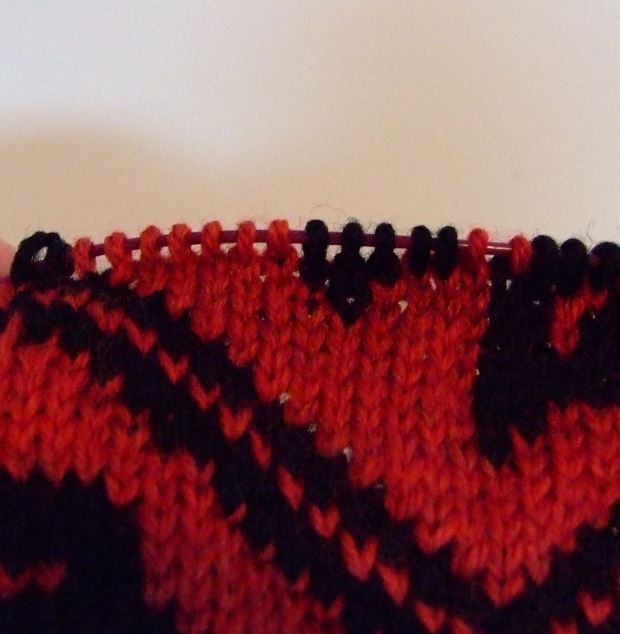
The lower section of the example where the floats were kept shorter, shows slight dimples( see photo below)in the surface. This happens no matter how loose you leave the float.

fair isle with short floats

If you use the second method and leave your float too loose, the stitches at the opposite ends of any section of the color can loosen and affect your gauge.

fair isle with long floats

The remedy-

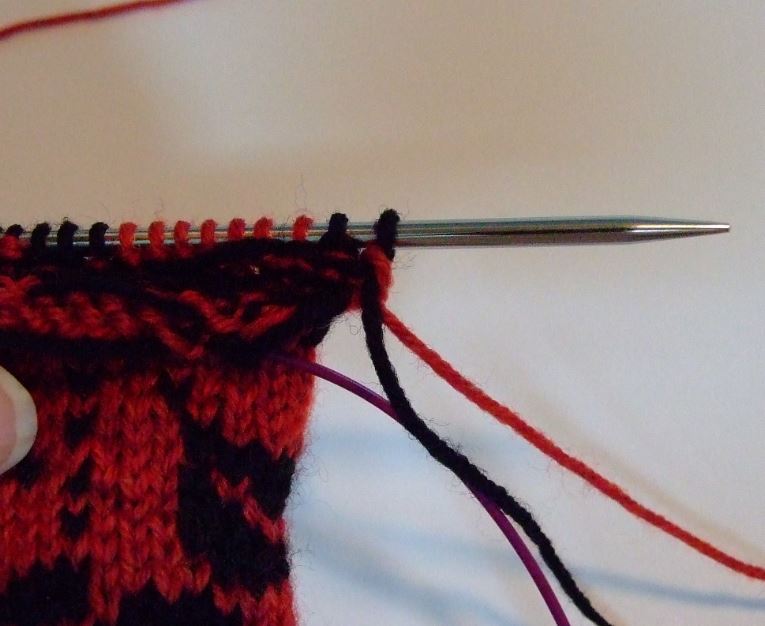
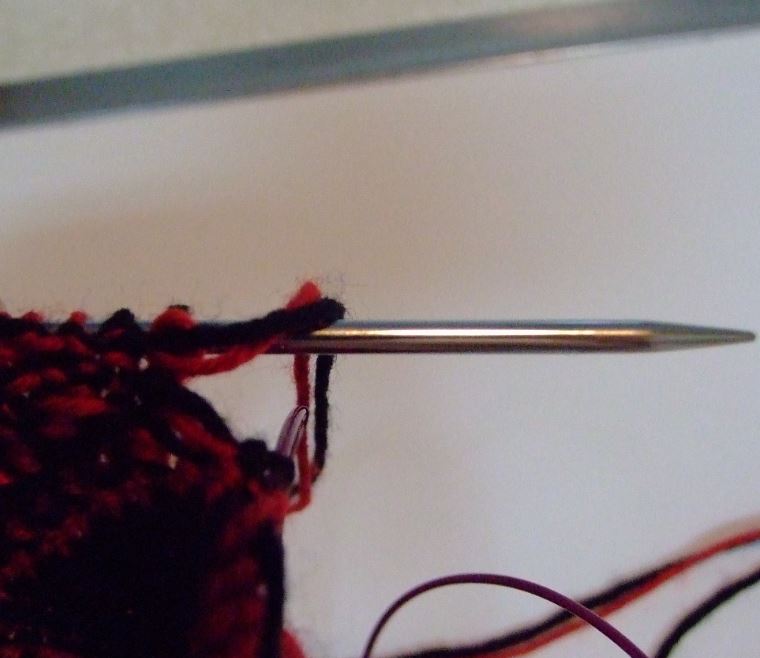
By securing or capturing the alternate yarn at the change of the new color, and then again one stitch before the change at the other end, the float will stay in its proper place.  To make the capture of the alternate yarn on the far end of the float smooth, first stretch out the stitches to the right, then bring your yarn(black) firmly across the expanse-

1) wrap as to knit,

2)wrap main color(red) as to knit

3)unwrap alternate color(black)

4)complete stitch with main color (red).

The next stitch will be the new color (black).  Now the float will stay in place and lay horizontally(with no discernible dip) across the back of the red stitches.  I always tip the work forward to check the tension of the float before proceeding to the next section.  I make sure that everything stretches out equally.  Taking the time to do this will save you lots of headaches later.

You will notice that the diamond above is very smooth.  The long floats on the inside that I deem might pose a problem when sliding on the stocking will be tacked down with a needle and one ply of the background yarn ( in this case, red).

The process of moving the needles as I go has  eliminated the need to deal with the “ladders” of  circle needle knitting.  One thing that makes this easy is that this pattern always has a center back pattern, and the last stitch of the round completes the right side border of this section.  This lets me know where the round starts without using a marker.

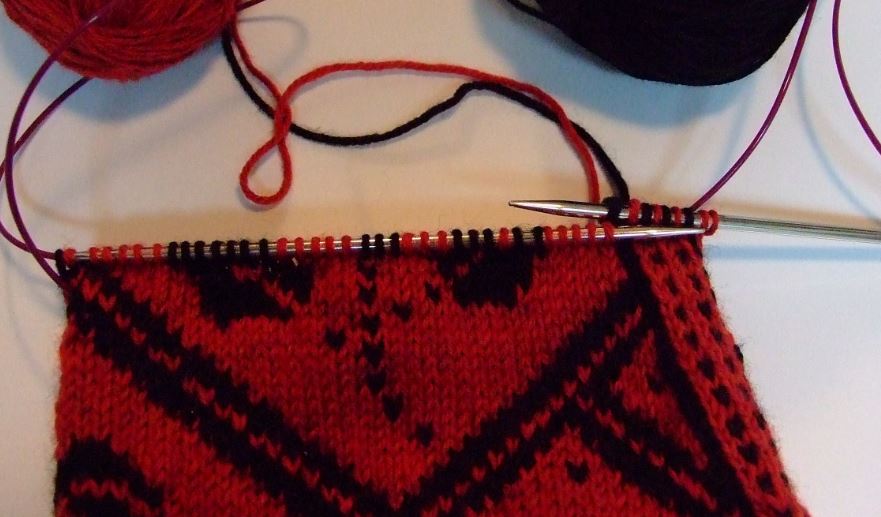
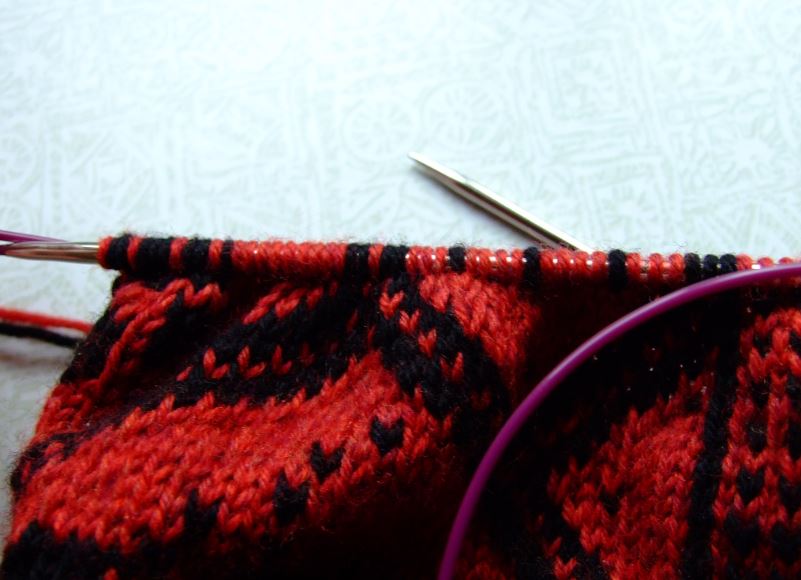
Below is a photo of a new needle position, as I retain about 10-12 stitches on my right needle, and prepare the left one to knit across the rose diamond section.

nordic rose-repositioned needles

It works for me!  Give it a try. Below is a practice chart for you to try.

Nordic Rose float Practice Chart

Of course, I could do this pattern in Intarsia, as the center back stitches make an excellent point for a turn around.  Hummmmm????

Happy knitting!

KT

Read Full Post »

nordic rose knee  high for website I just finished the first sock of my new pattern.  I had originally planned to make the field black and do the roses in red, but these old eyes just couldn’t handle the dark background, so I opted instead to reverse the colors.  I like it.

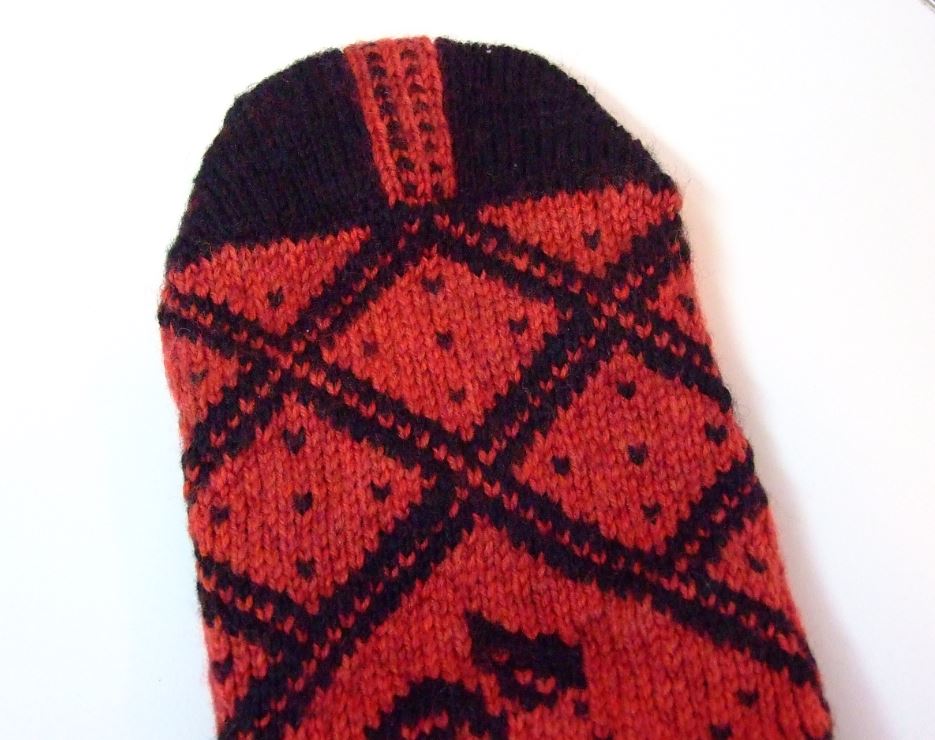
This knee high pattern consists of tubular 2 by 2 cast on, fair isle knit pattern on leg and instep and a double knit heel and toe.  I also retained the center stitch down the back, sole and toe.  Below is a close up of the right side toe cap. You can see how the reverse center stitches come round to meet the top, where the unit is joined together with the Kitchener stitch.

nordic rose toe cap

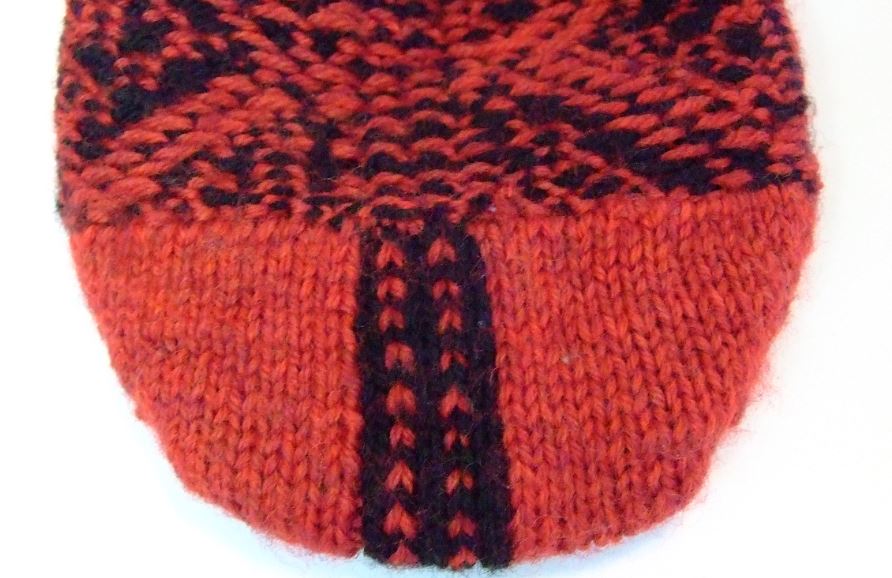
Here is the wrong side view.

nordic rose inside toe cap

Here is the inside of the heel.

nordic rose inside heel

This was definitely an interesting knit.  I am at present completing the pattern instructions and will be uploading them soon.  The pattern will include several design options for the toe and heel.

The one thing that stood out to me was the necessity to break you yarns at the conclusion of the last round before setting up for the heel, and toe.

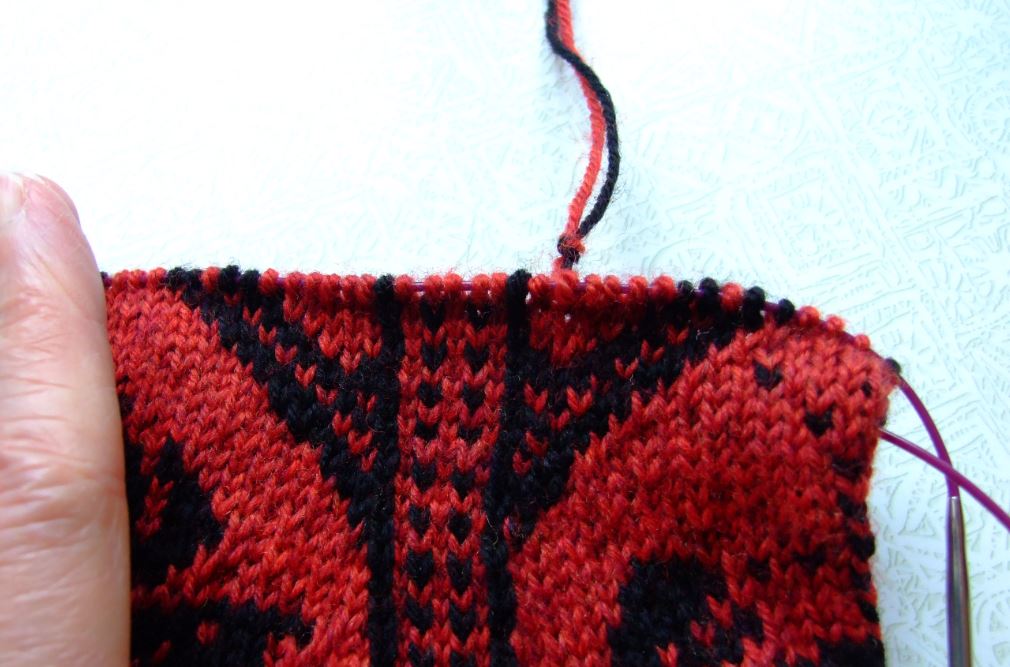
nordic rose set up for heel

The above photo shows the center stitches I have set up to begin my DK heel.  The black stitch border, just to the right of the center stitches is the last stitch of the round.  Here is where I broke off my yarns, leaving a 6 inch tail to weave in later.  I begin the DK set using 2 new yarns and #1 circular needle( which is 2 sizes smaller than the #3’s I used for the main stocking).  These new strands will complete the instep when the heel is finished, and move right on to the toe section, where the process is repeated again.

Why?  As most patterns have to do a partial round to set up your heel, this method allows you to keep the rounds even, as you will be centering your heel on the sole stitches and when finished you will be able to move right on to the next round of the instep as if you never stopped.  It also doesn’t off set your center stitches as the last round is totally completed.  You can also opt for any pattern you like on the sole-I simply used the leg chart.

It’s been fun!

Happy Knitting!

KT

Read Full Post »

While I was working on my latest sock design, I began to pay particular attention to my color change where NA(needle A) and NB (needle B) meet as I start a new round.  Normally, I make this back seam design lie in the center of NA, but this time I decided to put it at the beginning of the round.  Why?   Since these few stitches involve changing colors more often, it forms a firmer, less stretchy surface; therefore it is a great place to hide and secure any loose floats that happen to be hanging around.  By working your extra yarn across to this area, from either side, you can tuck them under and stitch them down, with no one the wiser.

Below is a photo of the area in question.

nordic rose back seam transition

You will notice that there are 5 red stitches between 2 black ones, this is the center back pattern of my Nordic Rose knee high.  These stitches are riding on NA.  NB is laying on the counter to the right, with its cord pulled across the surface of the knitting to the left.  You can see how this move frees up the stitches to lie closely together, just as if you would be working on a straight needle.   However, there is another move that is just as important, freeing the stitches at the other end of needle A to ride on the needle tip.  See photo below.

nordic rose back seam transition 2

You can see that I have pushed the stitches onto the needle tip so that they might ride smoothly on the needle itself and NOT on the cord.  With these two moves completed, I can make a smooth transition when starting my next round, eliminating any loose stitch at the beginning.

I use the same procedure when I make the transition from NA to NB in the middle of the chart.

Give it a try!

Happy knitting!

KT


Read Full Post »

One of my discoveries in dealing with the “yarn over” issue is the uneven holes that are created by the traditional method.  If you are working in a lace pattern, it is not hard to see that the YO purls are a bit larger.  Why, because they are really “not” a yarn over,  they are in fact a “yarn around needle,” creating a full loop.

Since I am a bit picky about my knitting, I tried some experiments.  The easiest answer, was to mirror the traditional yarn over.  Yep, that fixed the problem.   From that point on, when instructed to make a YO purl, I bought my yarn to the back, and purled the next stitch.  Now, my holes in the lace pattern were the same.

Next, I experimented with the “yarn around ” needle.  It works just as well.  The key is to have the lengths of yarns creating the yarn overs, or around needle, the same.

I use the “yarn around needle” to increase stitches.  It makes a very nice transition.

Below are some demos illustrating both methods on the knit side.  For the purl side you would just reverse the process.

yarn over demo


This first demo shows the yarn being brought forward in preparation to accomplish the , YO(yarn over) knit.   This is the traditional method, but actually creates a half loop between the two stitches.

yarn around needle demoThe second demo illustrates creating a yarn around needle by bringing the yarn over the top of the needle and then again to the back in preparation to knit the next stitch.  This method make a complete circle around the needle, creating a full stitch, or loop.

Either way, I get the best results by doing a swatch of each type of yarn over before getting into a complicate piece of work.  The goal is always to make you stitches look even.

Hope this helps.

KT


Read Full Post »

After completing the Nordic socks, I ventured to come up with a double knit heel to replace the two I knitted in the original design.  Below is a photo of the results.

double knit short row heel-1I began this heel “test” with a provisional crocheted chain of waste yarn, ( as I do all my experiments),then picked up 37 sts using the MC, then set up my double knitting row.  Setting aside the 5 stitches in the center, I worked a alternate checker board design for the rest of the heel.

I treated the short rows the same as I would if I were working with a single thread, except for the fact that I brought both yarns to the back when slipping the front knit stitch, and both yarns to the front, before slipping the back purl stitch.

Below is a photo of the inside.

double knit short row heel-2

Here is a photo of the completed turns.

double knit short row heel-4

double knit short row heel-5

Both sides are completely finished and ready to complete the rest of the sock.  You can also use this method to make you toe section.

double knit short row heel-6

I closed the short rows in the same manner as I use in J’ Short Row Heel instructions, using the appropriate color to retain the design.  The only difference is that you will be working one side at a time.  After completing the knit side closure, I  bring the yarn to the front, then turn the work around. With the left needle tip, I pick up the slipped st in the row below the stitch to the right of the slipped st, place it on the needle, then turn the work again back to my original knitting position, then purl the two stitches together.  The rest is the same.

I have charted this design, you can upload to practice with in the near future, but for now, it’s something you might think about trying.  The instructional PDF includes several charts for you to choose from. I have also included some illustrations.

Double Knit Short Row Nordic Heel

I definitely will be using this in my next knee high stocking design, and my husbands socks as well.

Happy knitting !!!

KT

Read Full Post »

« Newer Posts - Older Posts »