Feeds:
Posts
Comments

I recently finished designing a ski sweater for my grandson. I charted the back and front, and then the sleeves.  But I wanted to see the finished product first.

1) would I be pleased with the layout of the floating stitches?

2) does the top of the sleeve design flow into the chest panel of the front and back?

What to do?

First task is to condense the charts to 33-25 %.  When you do this in Pattern Maker Pro, the chart becomes a solid picture, allowing you to get a finished view.   Below are clips of my three charts for the sweater.
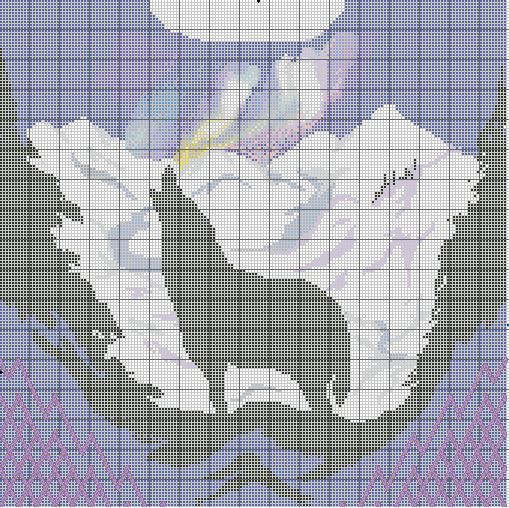
northern lights sweater front chart clip

This first one is of the front panel.

northern lights sweater back chart clip

The second is of the back panel.

northern lights sweater sleve chart cliip

The third is of the sleeve.

I snipped these clips at 33 per cent.

 Once condense to 25 percent they become solid in color, and the chart disappears.
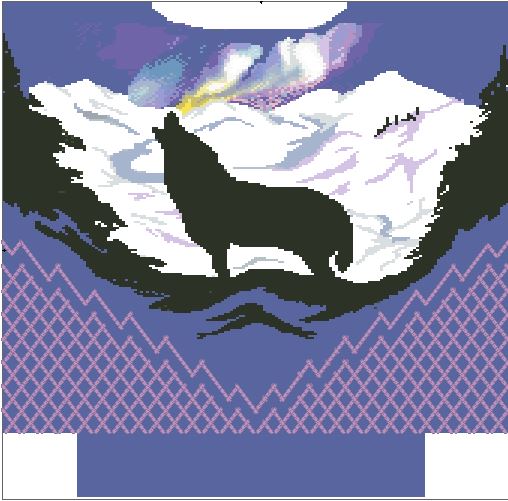
northern lights sweater front

Front

northern lights sweater back

Back

northern lights sweater sleeve

Sleeve

northern lights sweater sleeve, one half

Half sleeve

All these clips are made using the”snipping tool in Window 7.  Once I have these clips, I insert them into my publishing program  (I use Serif, any publishing program will work as long as you can import pictures from files), and arrange them into the form of a completed sweater.  I create white boxes without borders to cover any unwanted sections.  The results are great, and I can see what my sweater will look like when it is finished.

ben's northern light sweater

You can see that I added a collar for another touch of the “real” thing.

I like the floating stitch design at the bottom sections of the front and sleeve.  Of course this is mirrored on the back panel as well.  I have a tutorial on “floating stitches, or wandering cable chains,”  just click on my “fun stuff tutorials.
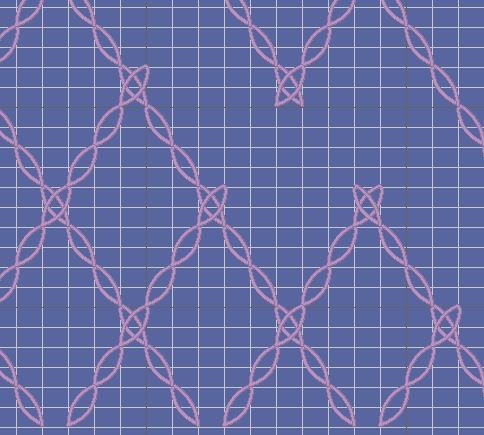
northern lights sweater front chart clip of floating stitches

 In this particular case I will be using a lace weight lavender heathered yarn for these decorative stitches.  These stitches are inserted in between my background stockinette stitches and  lay over the top of my work- they are not counted in the base stitch count.

The next project was figuring out the square inches of each section.  Once this was done, I measured the yarn needed for 10 sts, and began multiplying away.  I will be using Palette fingering yarn, and a #3 circle needle for the main pieces, and a #1 for the rib.

I think he is going to love it!

I will be writing  up the pattern as I go, so when it is finished I will upload the chart, and let you know exactly how much yarn I used.

Just sharing- KT
It has been a long stretch since I have posted, but I have been extremely busy with couple of projects, so I thought I would take a few moments to share them with you.

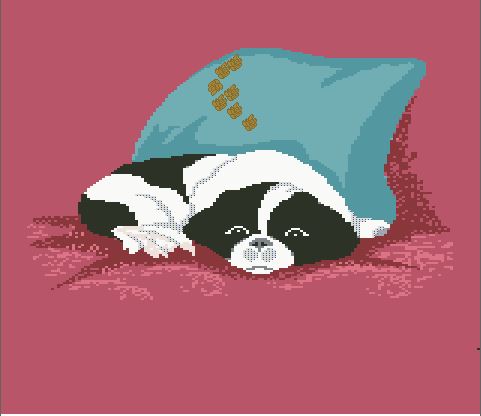
First off, I haven’t quit knitting.  In fact, I have chosen to immortalize my dog with a new pillow design.

sparky pillow 6

Isn’t he adorable.  And…yes, he runs the house around here.  🙂

I will be using white and black kid-mohair for the body, and will incorporate some of my sculpting techniques to give the body a more “real” appearance.  I was thinking that I might even add a bit of silk thread in the eye area, once the knitting is complete.

I will share the process later, when I see how it plays out.

Secondly, if you have read my “about” page or have gone to my harp website, you know that I compose  and arrange music, and it is that project that has me very grateful this Thanksgiving.

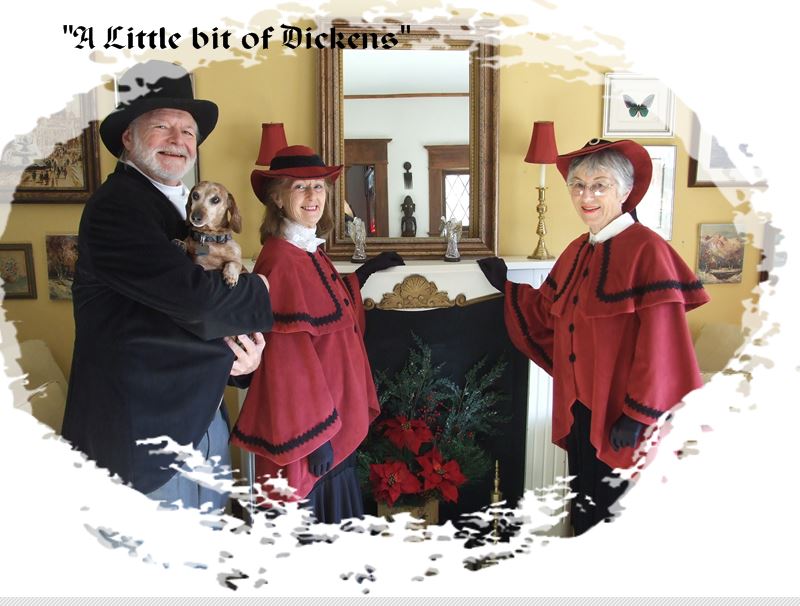
This summer I got together with a couple of my fellow 70 + singers, and started a madrigal group called , “A Little Bit of Dickens.”  This gave me the opportunity to compose arrangements for our trio.  What fun it has been.   To add to my delight, they loved my compositions- it doesn’t get any better than that.

A little bit of Dicken's -with textAbove is a photo of our trio, complete with costumes.  We are all set for the Christmas season, and will be performing in our community.  We all have had a great time rehearsing, and can’t wait to share our traditional style carols with friends and family.

I hope to be back in the swing of things knitted after the first of the year, but until then I wish you all a blessed holiday season.


KY

PS – for those of you interested in a gift for your kids or grandkids, check out “Grandma’s Corner.”  I have two children’s books for you to upload and share.  Feel free to peruse them first.

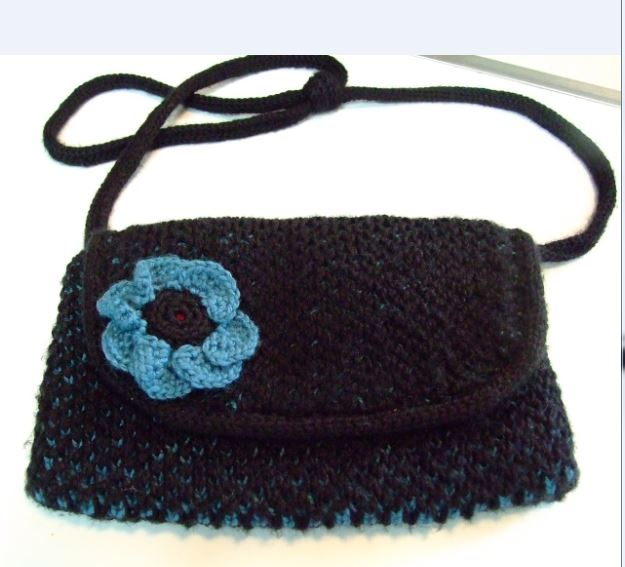
taylors purse

I recently finished the purse I was making for my grand-daughter, so thought I would give you a peek.

This time I knitted the honeycomb stitch in two colors.  You can see the blue peeking out from underneath the black.

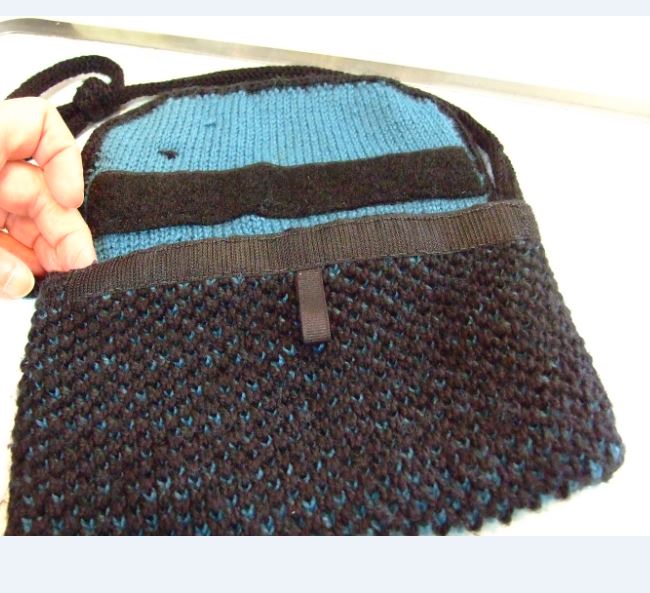
This project was accomplished with a double knit for the body, with the flap knitted in the round.  To keep the gauge equal while knitting the flap, I knitted in the round only on the knit rows.  I will demonstrate how this is done, when I complete the pattern.  Below you can see the smooth result of this method.


taylors purse-flap lining-2


You will notice that I used an I-cord to complete the flap edge.  To keep it from stretching, I ran a piece of satin cord through the opening.  It worked great.

One thing that I have come a conclusion about is that you need to firm up the top of the purse edge with a traditional, non-stretchy bind off.  Next time I make the purse, I will bind off the lining stitches, then pick up new stitch in the bound off edge before proceeding with the flap.  This will insure that my flap will retain it’s shape, especially since the outer edge will be kept in tow with the I-cord.

Below is a photo of the closure.  No button to stretch, just a tab of ribbon to pull it open.

taylors purse- velcro illust

You will notice that the corresponding Velcro is about 1/2 inch above the top edge of the purse.  I find that this assures that the closure doesn’t have to be exact to be secure-especially for a 9 year old.  The tab of ribbon aids in opening the purse.

taylors purse-color close up


I love the two-tone version.  I think it would be really attractive if you used a variegated  jeweled tone under neath, perhaps even one with a bit of sparkle.  Hummmm???????


Just sharing- KT

I have been working on the idea of double knitting my Honeycomb purse design, but ran into an interesting problem.  The Honeycomb stitch I created with my #4 needle and Galileo sports yarn, worked out to have 5 sts to 12 rows per inch, and the stockinette stitch with the same yarn and needles worked out to 6 sts and 8 rows per inch- needless to say,that ain’t gonna work!  So… how to solve the dilemma?  I had to eliminate 4 rows somewhere.

I had to think about that one for a bit, but the answer was quite simple-slip every 3rd row, of the stockinette stitch.  I tried it and it worked.


Below is a sample of a solid color honeycomb pattern.

001 (7)

This sample is knitted in the round.

002 (8)

The above photo is what the inside of the sample swatch looks like.  I have slipped every 3rd round of these Stockinette rounds.

How do I know it works?  When I pulled out the needle the top of both side lined up perfectly.

003 (9)

In this photo, I was working back and forth in rows, and decided to pull out the needle to show you what happens.  both sides are the same.  With this discovery, my purse lining will always fit.  The flap will be flat, and Ican insert a woven interfacing to stabilize the shape before finishing off the edge.

I have charted this process for you to try.  There is a swatch chart for knitting it in the round, so you can make a purse or whatever, and there is a chart for a swatch for practicing using it in rows.  I have also upload a tutorial that illustrates the Honeycomb stitch.

 There are also instructions for a long tail  1 x1 ribbed cast on.  The purl cast on is illustrated here.   The knit stitch is created by the normal method of creating the stitch with a long tail cast.  These two methods are alternated, creating  what I call a “ribbed cast on.”  It works great for setting up double knitting.

I hope you give it a try.  I can see all kinds of possibilities for this technique.  Hummmm??????

Honeycomb Stitch Illustration

Honeycomb Pattern Swatch Charts

Happy Knitting- KT

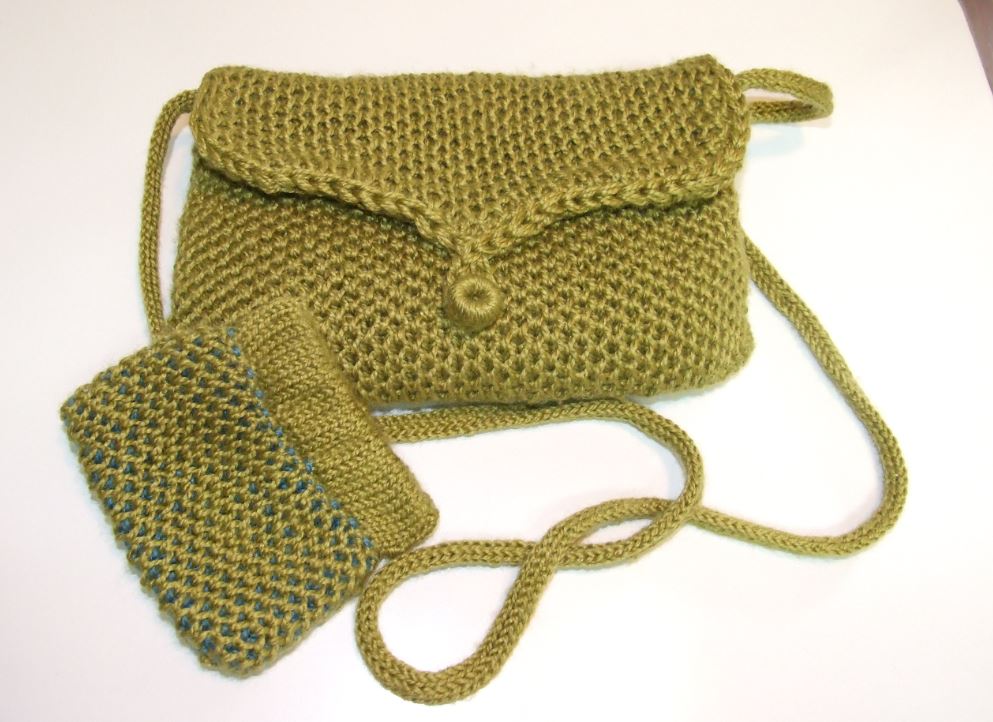
susan's hand bag

Just thought I would let you take a peek at my latest Honeycomb purse set.  This version was made for my daughter.  Unlike the last one, I finished the edge of the flap with a single crochet using  3 strands of yarn.  The coin purse is made of the same yarn, but in a two tone version for the main body.

I am working on a pattern for you to upload, and will post it as soon as it is done.

I love the Gallileo yarn for this project.

Just sharing-KT

Well- I promised I would work on this, so here it is.

cake pan jacket

I used cotton yarn(Peaches and Cream), and 1 inch elastic (non-roll).  I also opted for a variegated MC (main color) and used a solid black for my CC(contrast color).

In the process of working on this I also discover how to make a alternating color cable cast on, which is match on on the top with and alternating color cast off, both edges mirroring each other.  I think it is pretty cool.

The main body of the knit is done in double knitting, which forms the casing for the elastic.  The elastic band is knitted right in, so when you are done-your done!

Below I have uploaded instructions for this project, in which I have included instructions for the “alternate color cable cast on, and off.  There is a swatch practice for you to use for establishing your gauge and practicing both the cast on, and cast off.

If you are not sure why you should make one or two of these “pan jackets”  then check out this post


Cake Pan Jacket

Happy knitting- KT

PS-Because of my discovery, I also can use this method to make straps for my purses.  Having the casing open on both ends will allow me to insert a piece of ribbon into the strap, stabilizing the stretching, and…..I will have two pretty edges to boot.  Yeah!!!!

Oh,just an observation-

I washed my jacket, squeezed it out, put it on my pan, blocked it out and let it dry.   Then  I  observed that the cotton yarn holds the moisture quite a bit longer than wool, so  I finally, tossed it in a low dryer.  It didn’t hurt it a bit.  I can’t wait to bake with it.  I will let you know the results.

black hand bag

The Gallileo yarn from Knitpicks really brings out the beauty of this stitch, even in black.  This particular purse measures 9 by 5.  Unlike the one I posted before, I chose to finish the flap edge with single crochet, stopping at mid point to chain up a loop for the button closure before moving on to the main body of the purse.  I similarly joined the lining and main body together, slipping in the strap ends before closing.  It worked great.  No sewing.

The button was worked on a plastic ring, single crocheting around the circumference, then adding an additional round (with increases) to make it a bit larger.

The strap on this particular purse is 40 inches long, worked as a single I-cord.  I contained the stretch ( to 45 inches)by inserting a strand of yarn through the tube and fastened it to the main body of the purse.  Once set, it seems to hold it’s length very well.  You could also insert a piece of any kind of piping or cording to accomplish the same thing.

I particularly like this length as I can wear it around my neck and drape my purse on the side of my hip, having it available at my finger tips.

black hand bag- lining

You will notice that I used the silver lining yarn as my main color in the two tone coin purse.  This is not as hard as it looks.  It comes down to setting up with the MC (in this case silver), knitting the knit rounds of the pattern in black, and the purl rounds in silver.  Yes, this is a magic loop knit, no seams in either item.

black hand bag and coin purse

 The companion coin purse measure about 4 by 3, and has a squeeze frame closure.

black hand bag coin purse-squeeze frame demo

I found the squeeze frames at “Hardware Elf.”   They have them in large and small for coin purses, and also have them for larger openings, as for the entire top of a purse.

 Everywhere I go with this purse I have had may compliments.  It only weighs 3.6 ounces.

I am working on the pattern and hope to have it available for you to upload soon.

This pattern includes working double knit on the flap, which give you the opportunity to connect the lining with the right side to avoid slippage.  By knitting a dotted lining pattern, your outside flap will hold it’s shape.  I didn’t do it on this one, but I have experimented and found I had better results with the double knitting.

This purse flap was simply stitched together by weaving in between the layers with one ply of the yarn and a sharp needle.  I did try to insert some light weight plastic mesh, but I didn’t like the results-to stiff.

Just sharing-

Happy knitting!

KT

I promised that I would upload this pattern, so here it is.  The instructions are general, as I know most of you knit socks already.  This pattern includes the following techniques – Fair Isle, tubular cast on, double knit short row heel and toe, and Kitchener closure.  I have also given instructions on how to prepare for the inserting elastic in the rib casings.    If you have forgotten what they look like, below is a photo. nordic rose knee  high for website

I have altered the pattern a bit, realigning the roses and adding rose buds at the top.  The pdf’s below are available for you to upload.

Nordic Rose Leg and Instep Chart

Nordic Rose – Knee High Pattern

Nordic Rose Hell and Toe Charts

You might want to check out my post on “Oops Becomes a Blessing.”  This post gives you more info on the elastic insertion.  I am still finding the after several washing, the stockings stay up all day.  The combo of using a larger needle for the calf area, combined with the 1/4 inch elastic rounds enclosed in the ribbing works like magic.

I you have any questions, you know where to reach me.

Happy knitting- KT

There is nothing more disheartening than to be working along with two colors on a double knit and discover that you have an uneven row on one side or the other, creating an unattractive line across the face of your knitted surface.   Some people call this “rowing out.” Who wants that??

As a rule I knit very evenly in stockinette, but when I double knit I have run into this problem.  What’s the answer?

I tried knitting with the yarns carried in one  hand, but soon knew that this was definitely NOT the answer.  Next, I tried using both hands, just as I do when color knitting.  It worked much better, but the purls were still  a bit loose.  Then, I took the time to work just a few stitches (about 16) in a swatch, examining every row.

I soon discovered that I needed to take up more slack when I purled the alternate color.  The results were stunning.  The trick- look for the purl bump.  Raise it up so that you can see it near the top of your needle.  You might even feel the yarn taking up the slack as you make the lift-I did.

If you are knitting Continental, and purling English the “purple” on the right-hand index finger below will be raising the “purl bump” toward the top of the needle.

double knitting tension 1I you are knitting English and purling Continental, then your left-hand index finger will be lifting the purl bump into position before the right hand swings the yarn back to begin the next set of yarns in the sequence.

double knitting tension 2


The results-

double knitting sample 1

No ridges

double knitting sample 2

My advice- practice this.  See what results you get.  I works for me, maybe it will work for you.

One more thing.  I don’t know if you have noticed but when you are double knitting the gauge changes.  In my experience, I find that it usually runs 6 stitches to 8 rows, instead of the 6 stitches to 9 rows that I knit in a flat pattern.  Because of this, I have uploaded both charts, as one can be used for regular color knitting and the 6 by 8’s can be used for DK knitting.  These charts are in on my “Free Patterns” page.

double knitting sample 3

As this is the first block of my “Idaho Memories Afgan”  I did not want to be dealing with this problem for 30 blocks of the design.  Now I don’t have to.  Yeah!!!!

Hope this helps-  KT

I know that many of you who come to my website are multi-talented.  Most of us who are creative do not limit ourselves to one subject, but instead find interest in anything that challenges us to learn a new thing.  To that end, I would like to share a newly discovered baking secret.

Since I started my new website devoted to creating low carb recipes, I have been perusing the web for all kinds of information on working with oat flour, and various forms of sugar replacements.  The results of all of this investment of time has been well worth it, if only for the little secret I am going to share with you.

I don’t know if you have trouble with cakes cracking, or rising more in the middle, but I have, especially with the alternate flours.  The answer to this problem is “baking pan jackets.”   The results of this discovery is the perfect layer you see in the photo below.

choco layer cake 1

If you look closely you will see that I have surrounded my pan with strips of toweling.  These strips slow down the baking process so that the cake batter bakes more evenly, thus producing a layer as seen above.

I have written a tutorial for making these “pan jackets’ so that you can share them with friends and family.  I think they would make a delightful gift.

Baking Pan Jacket

I have more information on my recipe website if you are interested.

At present I am working on a knitted version (dk), made with cotton yarn.  I will upload it when I get it done.  I know once you see these, you will be coming up with designs of your own.  One thought- as knitting stretches, elastic might not be necessary.  Hum?????????? 🙂

KT