Feeds:
Posts
Comments

Archive for the ‘Knitting Tutorials’ Category

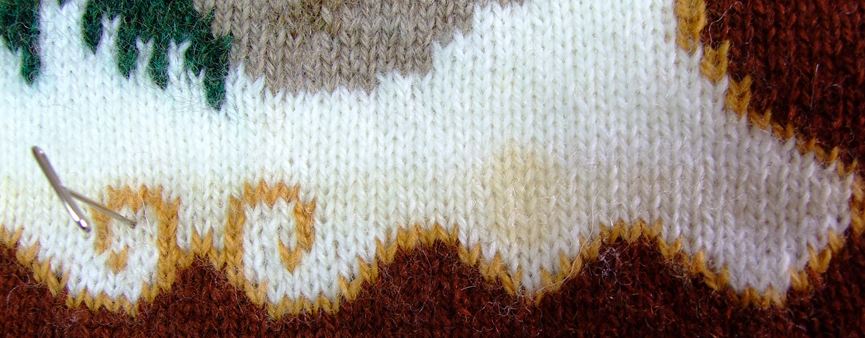
OK!  I finished my Whitetail buck pillow top.  I put in in the wool wash, as I normally do.  Everything looked good.  The colors were sharp, no bleeding,

and then I looked down at the bottom.  Yikes!!!

  What’s this?

There in living color was a lovely yellow stain, just above the scroll.


Yes, I was,  well let’s just say MORE than disappointed, I was crushed!   I worked on it with Woolite, which usually takes out anything, but it would not move.   Thinking back, I remembered the day I brought in the wood, then sat down to work on the pillow.  Bad move-I didn’t wash my hands first.  Talk about dumb, dumb and dumber!   I know better, especially when  working with WHITE.

Lesson- WASH YOUR HANDS!!!!

I can feel OK about this project because I experimented with several techniques, so this latest development is one of many lessons learned working out this pattern.

My husband has claimed it as his own, so instead of my original plan to knit a back, I will get a piece of Corduroy to make the back with.  He says he does not care if it has a small stain, he just likes the picture.  So…. it’s his.

I will call this my “signature” pillow- a yellow signature, that is.

So, on to the 16 inch version.  Only this time I’ll try to remember to wash my hands.

Maybe…..?  If I can remember.


Happy Knitting – KT


Read Full Post »

I was looking over the clicks on my site the other day and noticed that the interest in what to do with leftover yarns was among the most frequent inquiries.  This got me to thinking- Oh God, look out, she’s at it again!!!!

But……seriously, it is a challenge when there’s not really enough to make anything worth while, but you don’t want to waste it.  For me, of course, it can be incorporated into my Needle Point knitting projects, but for others, that don’t care for that intensive color work, it can be a problem.

Needless to say, that within minutes of becoming aware of the issue, I happened to look down on my desk and wouldn’t you know it, there was the Double Knit Felted Chess board swatch I had made.  It was the perfect size for a coaster.

I believe this project would be a great way to use up your “wool” sock yarn.   Using  harmonizing colors, they would make a great gift.  The complete instructions for this project are included in my Felted Double Knit Chess board which you can upload from the pattern catalog page.  Download the coaster chart below.

Here is the chart Felted Coaster Pattern

Happy Knitting – KT

Read Full Post »

One of the premier lessons in working with color is pre-planning.  Instead of just winging it, I have discovered that a few minutes of thinking through the placement of new colors, saves me lots of stress.   Because I chart all my pictures, it only takes a few minutes to go over the color changes and plan my attack.  My focus is always to eliminate  yarn ends that have to be woven in later, and to reduce as much bulk as possible.  Smooth and flat is the goal.

Below is an example of my thinking process –

Marking up the Chart

First, I look for those spots where I can work my new color in two directions.  The box in teal ( the eye) is a perfect example.

The “V”  indicates where I will make my new stitch by picking up the yarn in the middle of my long strand of white.  I will then have two long tails to work with.  One (A) will be used to go up the right side; and the other (B) will be used to go up the left side of the eye.  The “black” or center of the eye, will be worked with one single strand.  Just by using this method to work the white around the eye, I have eliminated 2 yarns ends that would have had to be woven in when the project was finished.

2.  The box in “yellow” indicates stitches that I have marked to be made later as “overlay stitches.”

3.  If you look closely, you can see two more “V’s” in the antler area.  Yes, I have found a couple of more places to use the double long tails.  I have also indicated the direction that I intend to work those ends.

All this is to say that no matter how you decide to work your color project, you will be much happier with the results if you take a little time to do some planning before you start.


Happy Knitting!

KT

Read Full Post »

Working out my “Painting with Yarn” series has challenged me to learn the various methods of using colors.  It is easy to draw the picture, but knitting it is a different story.

Everyone who has knitted Intarsia, and Fair Isle or Nordic knitting, know that it takes practice to get the tension right, especially when  knitting in Fair Isle- keeping those “floats” in the back from getting to tight or causing puckers is a common problem.   The same issues comes up when working in Intarsia, when lifting the yarn from underneath to change color. Keeping the tension on the yarn so it lays flat is the key- at least for me.

All these issues can make it a bit scary for someone who has never worked with color before- that was me about a 2 years ago.  Now, however, I can’t wait to sit down with my charts and knit away.

To that end, I thought I would start a“Colorworks” tip page.  I hope to share my experience with written instructions and illustrations.  The aim is to encourage the timid to give it a try.

Since I am in the middle of working on my Whitetail Buck 14 inch pillow, I will be using that for my illustrations.  When I am done with the project I will put the pattern on my website for you to upload.

OK!  Here goes!!  First tip!

NO- hold it!  I have to clear up a couple of things first.

First off, I dislike using yarn butterfly’s.  I can’t tell you why, but I just do.  I prefer pealing off two arms length of the yarn and just letting it hang around.  I prepare for this method by rolling about 1-1 1/2 inch balls of all the colors I need in the project.  Then I throw them all in a plastic Ziplock bag.

Next- I always use a spit splice to add yarn to my strands if needed.  I do this by unwinding about 2 inches of yarn.  I tear off about 2 inches of one of the plies.  I repeat this with the ends of the yarn I am going to add to.   I wet both ends in my mouth then over lap the two, one ply strands, making sure that they are at least 3/8 inch beyond the tear.  With the strands laying on the palm of my left hand I rub the strands vigorously together, finishing by rolling them in one direction to match the twist of the original yarn.  This method does not produce lumps or bumps that show in your work.  It is worth the time is take to do it.  And… when you get good at it, it just take a few minutes to do.

NOW, here goes!!!

 Colorworks tip #1 –

Let’s start with the scroll edge of the pillow.

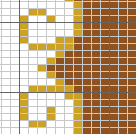
The above sample chart is part of the border around the motif.
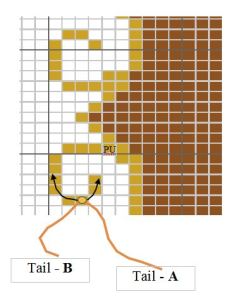
The illustration above shows how I inserted a new gold strand of yarn, picking is up in the middle to make the first stitch. This leaves two  long tails on both ends ( A and B).  The arrows show how I plan to use the tails to created the needed stitches;  tail A goes up and to the right; tails B to the left.   The White yarn is carried across and worked as needed.    I use this anytime I see that I will be working  the yarn in two directions.  I did this a lot in my Tropicana Rose Pillow. I saved me hours of weaving in yarn ends.

Below is the actual stitch illustration.

(X =The gold strand of yarn that I have been working up the side with.)


B/A = the first stitch of the new strand.

Above is the actual layout of this portion of the chart in stitches.  You can see clearly how each end of the tail of the one strand is utilized, then X finishes off the scroll.

The A and B tail ends will be woven in later.

I posted this just to wet your appetite!

Happy New Year!!!!

KT

PS- That little “PU” in the chart, reminds me to pick up the white yarn to be carried across.

Read Full Post »
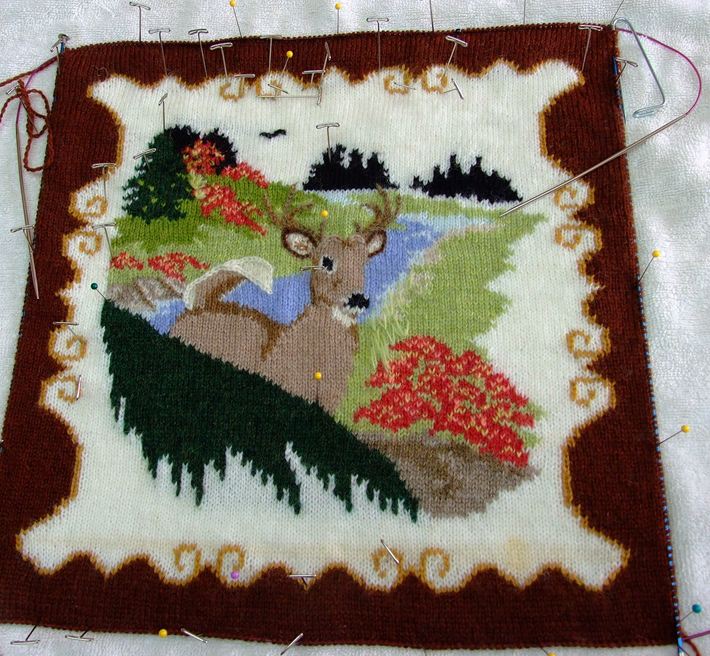
Merry Christmas to All

I had a few spare minutes today, so I decided I would share this pattern with you as a Christmas bonus.

WTB – ski sweater pattern

This pattern has instructions and full charts.  It uses both Intarsia and Fair Isle techniques.  It can be easily shortened or lengthened by adjusting the main color areas.

If you need special help with sizing, feel free to contact me and I will help you.

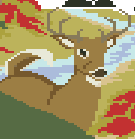
* If you notice that the Whitetail buck in the sample above doesn’t look quite like the one in your pattern, it is because I have been paying close attention to the coloring of the Whitetails that visit us everyday, thus the changes.

You will also notice that this is a pic of the basic knit, and I have knitted my bushes in red only.  I do this because I it reduces the floats and allows me to put in the additional Fall colors later as overlay stitches (whole and half ones).

Right now, I am working on a 14 inch pillow version of this motiff, and will upload it when I am finished.

Happy knitting and Happy New Year

KT

Read Full Post »

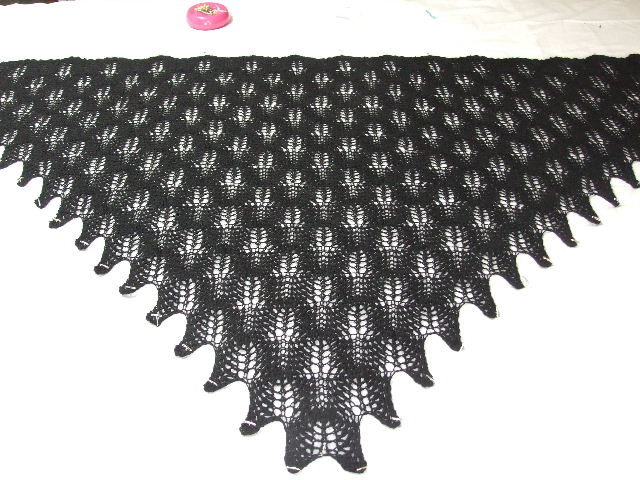
I just finished a lace shawl for my 90 year old mother.  I got the pattern from Heirloom-knitting.  It is an easy to knit, and is especially beautiful made of lace weight kid mohair.  But…. for my purposes, that being stability and warmth, I chose to knit it with Knitpicks “Gloss” fingering yarn, made of wool and silk.

Here is a photo of it on the bed, drying in the glare of the snow outside.

Here is a close-up.

I did modify the pattern on the top, as my mother will want to close it with some sort of button, or frog.  To give it a more stable finish after the finally row of decreases, I just knitted about 4 rows, then worked a Pico edge, to give it the extra stretch that was needed for it to lay out nicely.

As you can see in the photo above, I now have a modified scallop at the top, but it is not as drastic as the one’s on the sides.

The bind off I used was accomplished by casting on one stitch (knitted cast on). Knitting that stitch and the next one, I dropped the first stitch over the second, counting it as one cast off stitch.  Next, I cast off 2 more stitches in the normal way.

Slipping the stitch left on the right needle back to the left needle, I began the process again.   That’s  it!  Cast on one, bind off three.

*Note – Because I didn’t go to a smaller needle, as is sometimes recommended for a pico cast off,  this method created a small scalloped lace edge.  I think it looks great.  It works for me!!

You can get this lovely pattern call “Frost and Ice Shawl”  at Heirloom-knitting.

Happy Knitting –

KT

Read Full Post »

As I was working on my lastest Intarsia pattern, I did some experimenting with duplicate stitches.  I found that when it comes to “smoothing out the curves”  most of the time I only needed to cover one leg of the stitch, NOT BOTH.  This “half” duplicate stitch does not add a lot of bulk to your project, as does crocheted chains or regular duplicate stitches, and it retains the intregrity of the knit stitch.

Below I have illustrated the process.  Give it a try.

You begin as you would for a regular duplicate stitch, bringing your yarn up through the desired stitch.  Next, follow the green arrow,  sticking your needle down over the bar, and pulling your yarn through to the back between the two stitches on your right.

 Here you seen the results.

Work in the opposite direction, if you want to slant a half duplicate stitch to the left.

Below is a photo of the results in the real world.

Happy knitting!

Knit-tweaker

Read Full Post »

I have been dink’n around lately with a new wildlife design that I call, “Quail in the Snow.”  The discoveries I’ve made during the process of developing a bobble for the pine cone have been very interesting.  I have already shared with you some of the info in my recent post about “bobbles,”  but further trial and error has brought me to some new conclusions.

1.  A bobble can be made in one stitch and on one row.

2.  Varying the loops can create different special affects.

3.  If you want the knitting to expand for a 3-D look, be gentle, don’t pull them to tight, and knit them with one strand  of yarn.

4.  If you want your bobbles to lie flat on the backside, you need to work your boobles with two yarns- one to make the bobble, and one to knit the stitch in-between.  This second yarn is pulled tight across the back.  It pushed your bobble out front, and helps to retain a proper stitch gauge- very important.

In the picture below you can see the result of the 3-D affect I acheived with my pine cone.  The cone  and snow just above it, was worked with one strand.  The snow on the other branches was worked with two strands, thus putting it in the background.

You can see that the cone it is raised quite a bit above the surface of the work.  To retain the shape, I simply created a web of yarn across the back, weaving it together so that the backside retained the gauge of the entire piece.

Below is one of my new designs, which includes all four charts to play around with.  I am still doing a bit of fine tuning, but hope to have it ready soon.  This particular design was knitted with Palette fingering yarn from Knitpicks.

Hummmm?  A little glitter in the snowflakes might be nice.

This pattern will give you a chance to use Intarsia ( in the round), Fair Isle, bobbles of various kinds, and the experience of creating the pine needles and details with a crochet hook.

It was great fun to do.    Quail Motif – PDF

Have a great day!

Knit-tweaker

Read Full Post »

I recently shared with you plans for my “Idaho Memories” double knit afghan, and as I was writing up the pattern this week,  I decided that I might offer you some of the charts.  All of them can be used for other projects as well.  Simply changing the yarn weight, will size them down or up as all the charts are designed specifically for knitting.  These specific charts are gauged for 6 spi,(stitches per inch) and 9 rpi (rows per inch), and 6 spi and 8 rpi.  Why the second set?  I don’t know about you, but when I double knit my row count is less.  So  I offer you both sets of charts.

Do your swatch then pick your chart.

These blocks can also be made into pillows, and knitted with Fair Isle or  Armenian knitting methods.

I apologize for the picture, but I was not able to load a larger version.  You can click on it and save it, or use your “snipping tool” to make a copy then enlarge it on your computer.

Anyway…………..,  I was just thinking that you might like to have some of these charts to make your own afghan or a pillow for that someone special for Christmas.  I have created a PDF file of some of the charts for you to download.  Enjoy!!

Memories Afghan Moffit Charts – 6 by 9

Memories Afghan – 6 by 8 charts

Yarns estimates – 15 skeins of sports yarn for each color

Size #4 circle needle  ( 6sts per inch)

Have fun-

Knit-tweaker

Read Full Post »

I have been working on the idea for wildlife designs for Ski sweaters for some time now.  My inspiration for this particular series was the gorgeous change in foliage, harvest time, and “buck fever.”  Yes, in Idaho, Camo gear is the fashion of choice this time of year, as everyone and his brother is hunting for that vension or elk back strap steak to put on the table.

So… with all this in mind, my first set in the series is my “White Tail Buck” combo to use on a sweater for your favorite hunter.  Below is a peak at my digital finished sweater.

I am designing these sets to include charts for bottom borders, shoulders, and Intarsia chest scenes. The gauge is set up for sports weight yarn, but you could use them for fingering weight as well,  the patterns would just be a bit smaller..   Of course all these charts can be used for other things, such as pillows, and socks.(especially the Squirrel border).

I have had a great time creating these, and hope you will enjoy them too.

The method combines Intarsia (in the round), and Fair Isle.  I will include the how to’s and all special affects instructions in the patterns.  The patterns will also include the basic structure of a Ski sweater and application variations.

I originally opted for selling these motifs on Etsy, but since then I have opted to share them with you at  not cost.  If you are interested, email me (see contact page).

Happy knitting-

Knit-tweaker

Read Full Post »

« Newer Posts - Older Posts »