Feeds:
Posts
Comments

Posts Tagged ‘knitting charts’

I was so glad to get this one done so I could send it to my grandson.  He has been checking on it’s progress the last few months, so now he won’t have to wait anymore.

I had great fun knitting this one.  I even knitted some extra leaves, which I placed in the front of the duck, stuffing them a bit to give it a 3 dimensional look.

One other thing I did differently from the last pillow was to make my own pillow form.  I discovered that most of the forms  (no matter what you pay for them) are made with clumps of fiber fill, often leaving a lumpy surface.  Of course, that is unacceptable when you have spent many hours working on one of these pillow tops.  The only solution-make it yourself.

I began the process with a sheet of Poly-fill quilt batting.   I cut two 17 inch squares, then machine sewed them together on three sides, using a long stitch.   I stuffed the middle with tiny pieces of fill, poked them in place with a #1 DPN, then whipped the open edge shut.  You could even use two thickness (sheets) for each side to unsure an even smoother surface.   Anyway, it  worked great.  It will also dry much faster as there is no cloth on the inside.

I will be making all my pillow forms from now on.

Now it’s time to box it up and head to the UPS store.  My grandson will be a happy camper!

I hope to have this pillow pattern available soon.  I will be starting my J’s Designer Pillow page soon.

KT

Read Full Post »

Unable to purchase all the necessary shades I needed to knit up the Wood Duck pillow for my grandson, I decided to make up my own by blending two single strands of colors together.   In the illustration below, the areas where I have used the blended yarns are marked with circles of various colors.

The red circle indicates the Steel grey/ Iris heather mix.


The next combination  in the green circle, is a teal/dark green mix.


The blue circle marks the side of the body.  In this section I chose to blend the Suede color with gold.  This combination allowed me to transition to the single gold color without a definite line.

All this is to say that you don’t have to settle for the color combinations that are out there.  You can blend your own.

HOW ?

1.  Select you colors.  Peel off the amount you normally use in your colorwork ( I use about an arm’s length).

2  Separate the plies.

3.  Tie one end of the two strands together.

4.  Lay the joined end of the two strands in the palm of your left hand.

5.  Lick or moisten the palm of your right hand and rub the two strands together vigorously for about 30 seconds-

inotherwords, “spit splice” the strands together.

6. Wet your right palm again, now push down on the combined strand and roll it away from you about 5-6 time.  This sets the twist.

7.  Move the blended strand to the left, so you can work the same process in the next section of yarn to your right.  Be sure to repeat the same number of rolls when setting the twist.  Continue this process to the end of the strand.

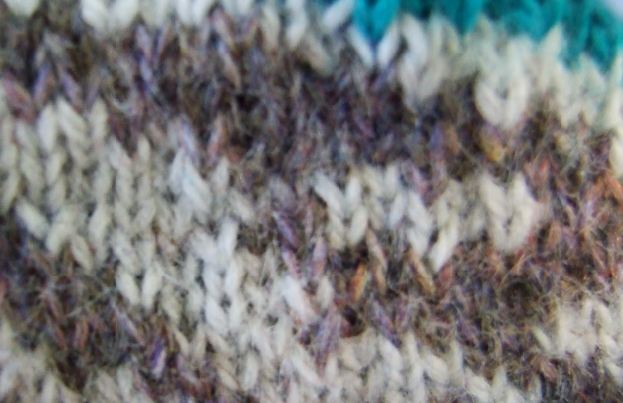
Your finished strand should look something like this-

The above strand is a combination of “Pumice Heather ” and “Iris Heather.”

*  If you find an area that didn’t get twisted enough, just wet you palm and work a few more rolls at that point.

Next time you can’t find the color you need, you might try this out.  It’s fun to see what color combos you can come up with.  When I need larger amounts, I use a drop spindle to re-spin the two strands together.

Have fun- KT

Read Full Post »

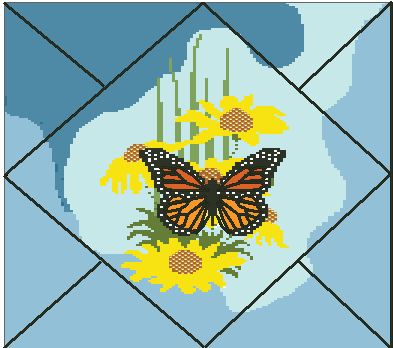
It definitely is Spring around here, as the wild  flowers are blooming and the mountains are turning green.  Add this to the birds singing and the butterflies checking out the blooms and next thing you know I found myself drawing up a new pillow design of daisies and butterflies.

As before, this chart is gauged for 8 stitches and 11 rows, knitted with fingering yarn.  I will be using Knitpicks Palette yarn for this design.  The chart for the detailed crocheted lines and specialty stitches are included in the download.  The knitted cording instructions are in the PDF file listed below.

Of course, you can use the center motif on other projects.  Here is the pattern – daisies and butterfly pillow

For knitted cording instructions, Knitted Cording Instructions   This file includes instructions for joining knitted back.

Give it a try –

KT

Read Full Post »

I just finished another Whitetail Buck pillow.  This one has a knitted cording incorporated into the pillow top, along with the seam allowance to help in sewing it to a cloth back.   I even made my own cording.  It was fun!

The picture below is a “snip-it” of a section of the cord that frames the pillow.  Here you see it in contrast with the cloth back.   I have to say that there is no comparison to the commercial cording available.  I have tried finding complimentary edging for this use, but have always been disappointed.  The fillers they use are mostly cotton, and seem lumpy at best, not to mention that they take a much longer time to dry.  That is why I decided on this approach-make your own.  In addition, there is no better match in color than the actual yarn you are using in your project.

I will be adding this pattern to the Pattern Catalog page, so feel free to upload it.  The pattern contains 18 pages of detailed charts and instructions.  You can use Intarsia, Armenian Knitting, and sections of Fair Isle in this project.

The Basics

1.  Knit the Basic chart.

2. Identify and secure all loose stitches

3. Weave in the ends

4. Block pillow top on needles (This works great!)

4. Pick up stitches to begin tube for cording

5. Knit tubing

6. Close tubing, and make button hole opening for cording.

7. Knit seam allowance

8.  (opt)  Secure pillow top to woven fabric.

9. Prepare fabric back, and sew to pillow top, make cording.

10. Insert cording.  Stitch pillow close.  Adjust cording.  Close cording opening.

10. Decide on some of the options I have for making the pillow cover removable for washing.

The pattern walks you through all the above issues.  Wow!!  And that ALL???  I’m tired just making the list.  But trust me, it was worth it.  My friend Deb at Tempting Tangles ( see link on side bar) has given it her approval.

 You will also be given instructions on making your own cording out of poly quilt batting, which, of course, makes it lighter, and easier to dry when washed.  This particular pattern is backed with fabric that has been pre-washed, so the entire pillow can be “dunked” in Wool wash, squeezed out, then air dried without much fuss.

My hope that you will try your hand at color knitting.  I also hope you will take a look at my “Painting with Yarn” E-book when it comes off the press.  The book contains all my color knitting experience on this project, along with detailed illustrations and how to’s, or what I call, “Technical Tutoring.”  I hope to have it available for you soon.  Would you believe it, I am already up to 60 pages!

As a side note, I will be uploading a couple of new tutorials on my “Multi-color Knitting Tips” page.  Check them out.

Happy Knitting!

KT

Read Full Post »

I was looking over the clicks on my site the other day and noticed that the interest in what to do with leftover yarns was among the most frequent inquiries.  This got me to thinking- Oh God, look out, she’s at it again!!!!

But……seriously, it is a challenge when there’s not really enough to make anything worth while, but you don’t want to waste it.  For me, of course, it can be incorporated into my Needle Point knitting projects, but for others, that don’t care for that intensive color work, it can be a problem.

Needless to say, that within minutes of becoming aware of the issue, I happened to look down on my desk and wouldn’t you know it, there was the Double Knit Felted Chess board swatch I had made.  It was the perfect size for a coaster.

I believe this project would be a great way to use up your “wool” sock yarn.   Using  harmonizing colors, they would make a great gift.  The complete instructions for this project are included in my Felted Double Knit Chess board which you can upload from the pattern catalog page.  Download the coaster chart below.

Here is the chart Felted Coaster Pattern

Happy Knitting – KT

Read Full Post »

This will probable be my final post for a while, because my hours will be filled with making cinnamon rolls, and more cinnamon rolls(check out my post  “Merry Christmas to All”  the recipe is there.   That said, I want to wish all my followers and their families a blessed Christmas.

This time of year for me, at least, is not about shopping, presents and all the hooplah.  It is a reminder of the promise God has made to all believers in John chapter 14.   HE is coming to take us unto himself, that where HE is we will be also.  So it is not just about a baby in a manger, it is also about the promised glory that he prepared for us before the foundations of the world.

To that end, I designed a 16 inch pillow top to express my hope for the future.  I have entitled this work , “The Call.”  It is my version of that moment when the trumpet will sound and King Jesus will call us  home to be with him.

KT’s Christmas  Gift Box

The chart and instructions –The Call

 One Holy Night =- poem

Also, don’t forget to check out “Grandma’s corner.”  There are two free children’s books  available for upload.

MERRY CHRISTMAS TO ALL-

KT

Read Full Post »

This last month as I began working on my Wildlife series I found myself back in the mood to paint some more yarn pictures.  The White Tail Buck motif spurred me on, so here is #2 in the series- I just couldn’t put it aside.  I’m on a roll!!!

I realize that the digital renditions are not the real thing, but it does give one the luxury of seeing what the finished work will look like – almost.  It also gives me an opportunity to judge the balance, and color combinations; besides, never in a life time could I knit up all my ideas, I would have to live to be 200 plus.

All the charts in this pattern are detailed.  They include many variations and applications for you to consider, along with instructions for the special stitches I use in the finishing details.

The charts can be applied to the front of a sweater (Eagle motif options), incorporated into an afghans design (sportweight) and adapted to needlepoint project.  This particular pattern is charted for 8 stitches and 11 rows using a #1 (2.5) needle, knitting with fingering yarn, but I always include the charts for sportweight yarns as well.  All of the patterns are set up for knitting, thus the grids are composed of  rectangles, not squares. There is also a cameo grid applied to each version, which is one of the many options available.

The main pattern is set up for a 14 x 14 and 16 x 16 inch pillow tops, however, I always knit the whole pillow, (see my Tropicana Rose design in the pattern gallery)- I love using texture stitches on the back.

Bottom line for me is the artistic creation.  It’s been great fun, and very rewarding.

Pictured below are version I and II

 “Majestic Eagle”

  It will be on the shelf soon.   I hope you like it!

Happy Knitting!

Knit-tweaker

Read Full Post »

I have been dink’n around lately with a new wildlife design that I call, “Quail in the Snow.”  The discoveries I’ve made during the process of developing a bobble for the pine cone have been very interesting.  I have already shared with you some of the info in my recent post about “bobbles,”  but further trial and error has brought me to some new conclusions.

1.  A bobble can be made in one stitch and on one row.

2.  Varying the loops can create different special affects.

3.  If you want the knitting to expand for a 3-D look, be gentle, don’t pull them to tight, and knit them with one strand  of yarn.

4.  If you want your bobbles to lie flat on the backside, you need to work your boobles with two yarns- one to make the bobble, and one to knit the stitch in-between.  This second yarn is pulled tight across the back.  It pushed your bobble out front, and helps to retain a proper stitch gauge- very important.

In the picture below you can see the result of the 3-D affect I acheived with my pine cone.  The cone  and snow just above it, was worked with one strand.  The snow on the other branches was worked with two strands, thus putting it in the background.

You can see that the cone it is raised quite a bit above the surface of the work.  To retain the shape, I simply created a web of yarn across the back, weaving it together so that the backside retained the gauge of the entire piece.

Below is one of my new designs, which includes all four charts to play around with.  I am still doing a bit of fine tuning, but hope to have it ready soon.  This particular design was knitted with Palette fingering yarn from Knitpicks.

Hummmm?  A little glitter in the snowflakes might be nice.

This pattern will give you a chance to use Intarsia ( in the round), Fair Isle, bobbles of various kinds, and the experience of creating the pine needles and details with a crochet hook.

It was great fun to do.    Quail Motif – PDF

Have a great day!

Knit-tweaker

Read Full Post »

I have been working on the idea for wildlife designs for Ski sweaters for some time now.  My inspiration for this particular series was the gorgeous change in foliage, harvest time, and “buck fever.”  Yes, in Idaho, Camo gear is the fashion of choice this time of year, as everyone and his brother is hunting for that vension or elk back strap steak to put on the table.

So… with all this in mind, my first set in the series is my “White Tail Buck” combo to use on a sweater for your favorite hunter.  Below is a peak at my digital finished sweater.

I am designing these sets to include charts for bottom borders, shoulders, and Intarsia chest scenes. The gauge is set up for sports weight yarn, but you could use them for fingering weight as well,  the patterns would just be a bit smaller..   Of course all these charts can be used for other things, such as pillows, and socks.(especially the Squirrel border).

I have had a great time creating these, and hope you will enjoy them too.

The method combines Intarsia (in the round), and Fair Isle.  I will include the how to’s and all special affects instructions in the patterns.  The patterns will also include the basic structure of a Ski sweater and application variations.

I originally opted for selling these motifs on Etsy, but since then I have opted to share them with you at  not cost.  If you are interested, email me (see contact page).

Happy knitting-

Knit-tweaker

Read Full Post »

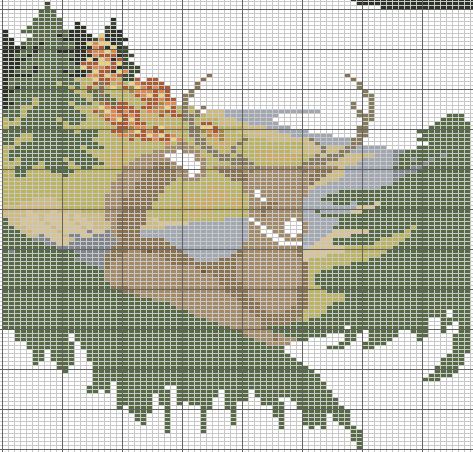
In the last few days, since I posted a snip-it of my afghan design, I have been taking a good look at the pictures I charted.  Then the bright idea came to me that I could use these same picture charts for my ski sweaters or pillow or, etc.  Hummmmmm????

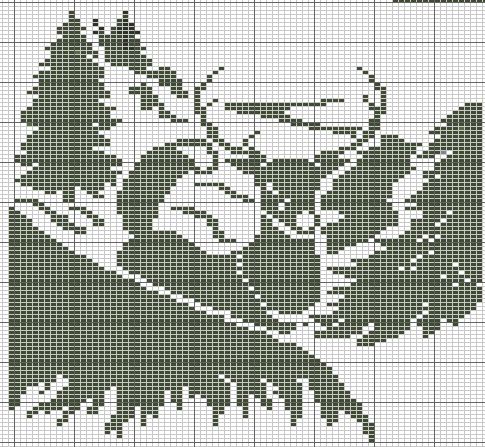
Going one step further, I started with my “stag,” turned him into a white tail buck, then began creating a scene to surround him.  That done, I then thought I might try using the same chart, but doing it in only two colors, which would be great for a double knitting pattern as well.

Below is the result.

This second chart began with the picture  above.  You will notice that it has been simplified, and color has been removed around the objects of most importance.  I decided not to extend the creek behind the buck as it was made the area to busy.  Here again, it is a matter of taste.

This chart is perfect for a DK project, or a Fair Isle knit.  As I told you in the last post, I make all my charts with Pattern Maker.

Although these are MY original designs, I give you permission to use your “Snip-it” tool in Windows to save and study these charts on your computer.  I actually use this wonderful tool to make a pictures of my charts, then insert them in my publishing program (I use Serif) and play with their arrangement.  This technique gives you the ability to see your idea in a completed format, allowing you to change whatever you like before starting on the real deal.  It takes all the guess work out of it- well, most of it anyway.   AND, it’s FUN!

 Thank you God for Pattern Maker!!!

Knit-tweaker

Read Full Post »

« Newer Posts - Older Posts »