Feeds:
Posts
Comments

Posts Tagged ‘fiber arts’

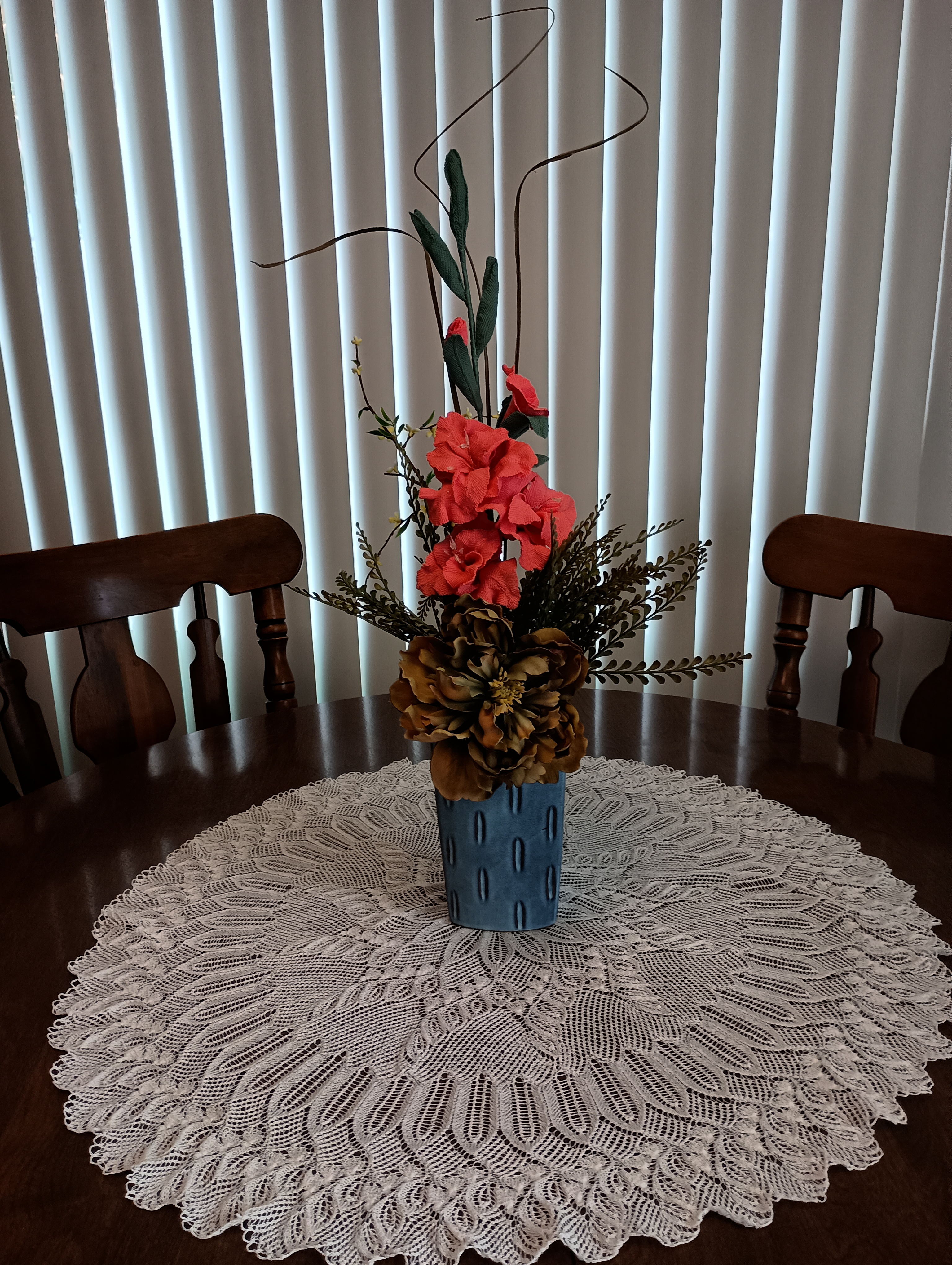
This is the first part of my Basketweave Stitch Gladiola Project. I have placed it in with another arrangement, just to have a place to put it while I work on the tall leaves. I will be using the same method I discussed in the previous post. Once you learn this stitch it will open up as many applications as you can dream up.

I hope you explore the possibilities, and take up the challenge.

Happy crafting

KT

Read Full Post »

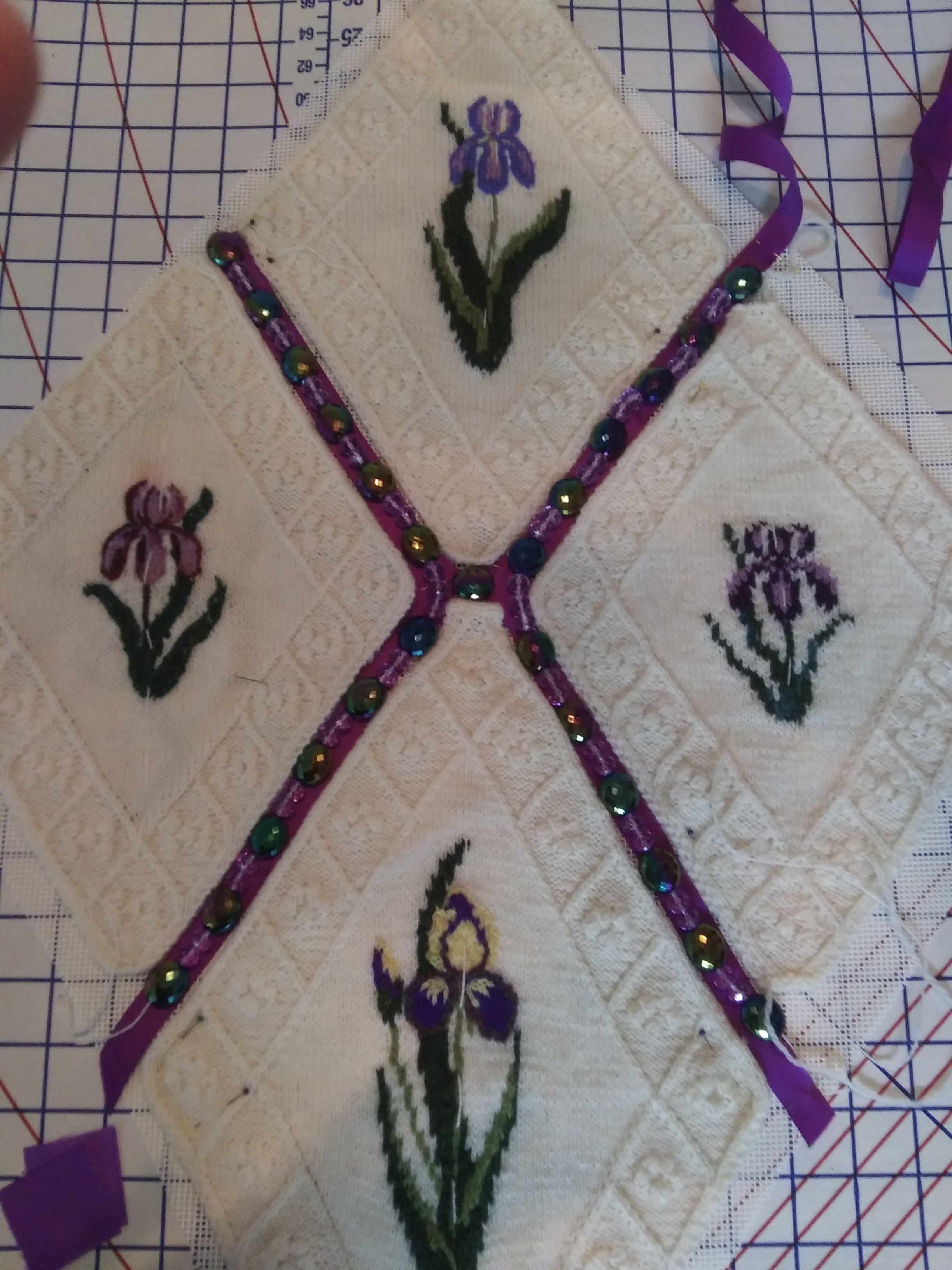
When my grand-daughter visited me this last year, we went through some of the things I had stuck back in my craft boxes. Among the fines were these swatches I had made while learning to design and create knitted pictures. The one on the right was the first Iris I tried my hand at, using my friends cross-stitch design. The left one, was my first upgrade, as I added edging with lace yarn. The top was an attempt at more detail, and the center bottom was the realistic version.

Of course, she wanted them. The problem was how to put them together in an attractive collage she could hang on the wall.

The Solution

I purchased plastic netting, ribbon, and beads. The plan is to attach the ribbon, add the beads, then secure the blocks to the netting. When finished, I will trim the plastic back and crochet the edges together. I might even add a decorative edging if I feel it necessary. I will insert a ring in the top when crocheting the edge.

I will post the finished work, so you can see the results. The first pic above is just a layout, now the work begins.

Read Full Post »

One of my favorite flowers is the Sword Lily, or Gladiolus. Their stunning colors and beauty are without peer. That said, I have been working on a design for creating one stem of flowers to be coupled with one of my butterflies. Below is just the beginning.

Just to get to what you see, has taken me weeks. Each bloom has 6 petals, two smaller ones, two more rounded ones for the top and bottom, and two more pointed ones at the sides. The construction of the stamens was a combination of fine wire, and a glue gun. Then fingernail polish is used to color the tips as desired.

Here is a better view.

This project is done with the Basketweave stitch, and basic single crochet (SC). The entire petal is worked on a single wire, with sc covering the wire. During process of crocheting the petal, the wire is allowed to extend beyond the top of the petal ( making it easy to hang on to). When the petal is complete, the”single” wire is then retracted, to within about a quart to half inch in from the tip of each petal and secured with super glue. This method works great, no corner to turn or cover, no bulk.

When I am finished I will upload some basic instructions and guide for those brave souls who want to make something like this. This petal design can be incorporated into the creation of Iris, Orchids, Hibiscus, anything with a fluted edge.

My next step is to engineer the construction of the central stem, so it is strong enough to handle the four large blooms, and three buds I have planned to make. It’s on the drawing board. We see how that works out.

Just sharing- KT

Read Full Post »

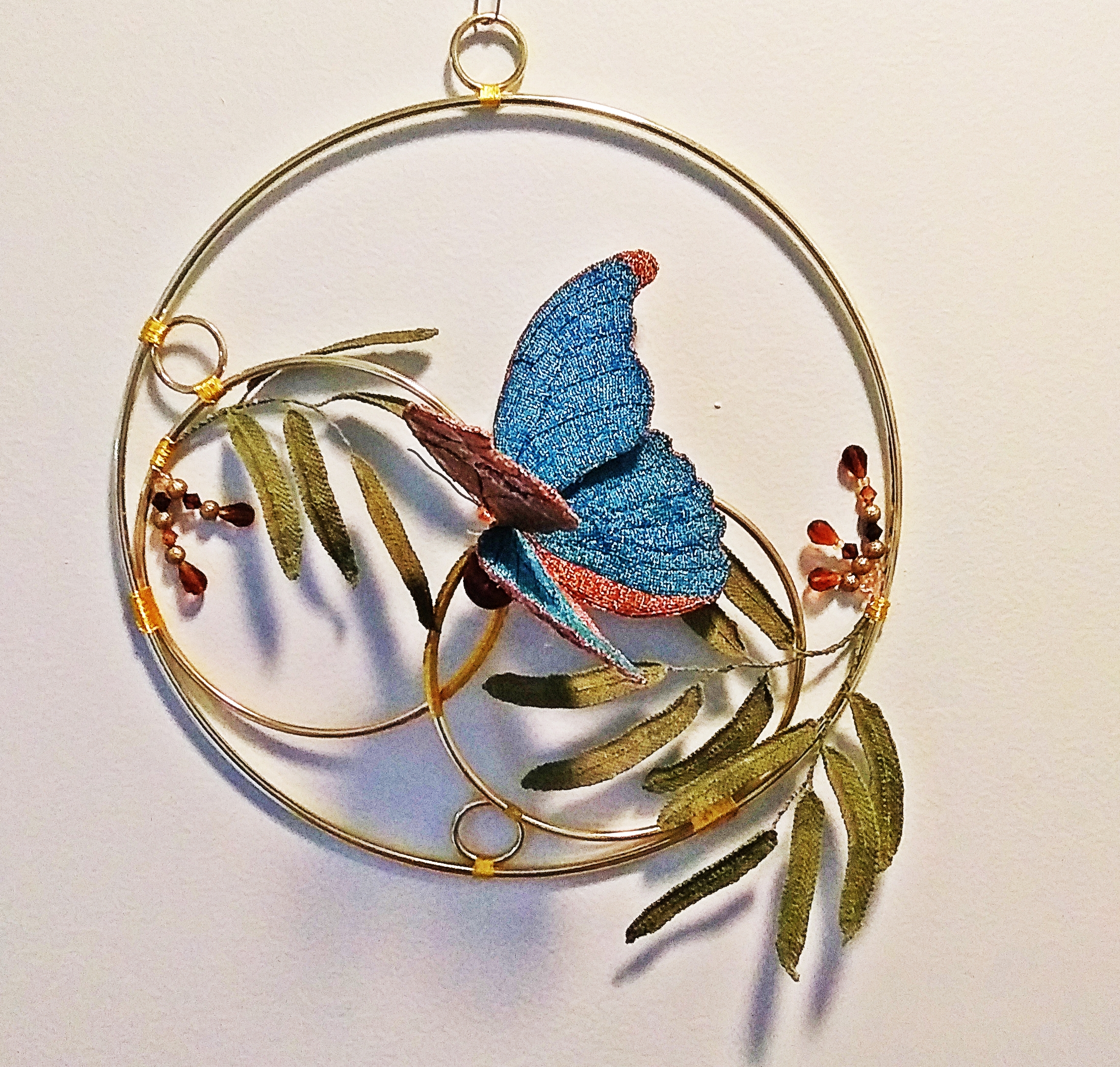
I finally completed this project and thought I would share.

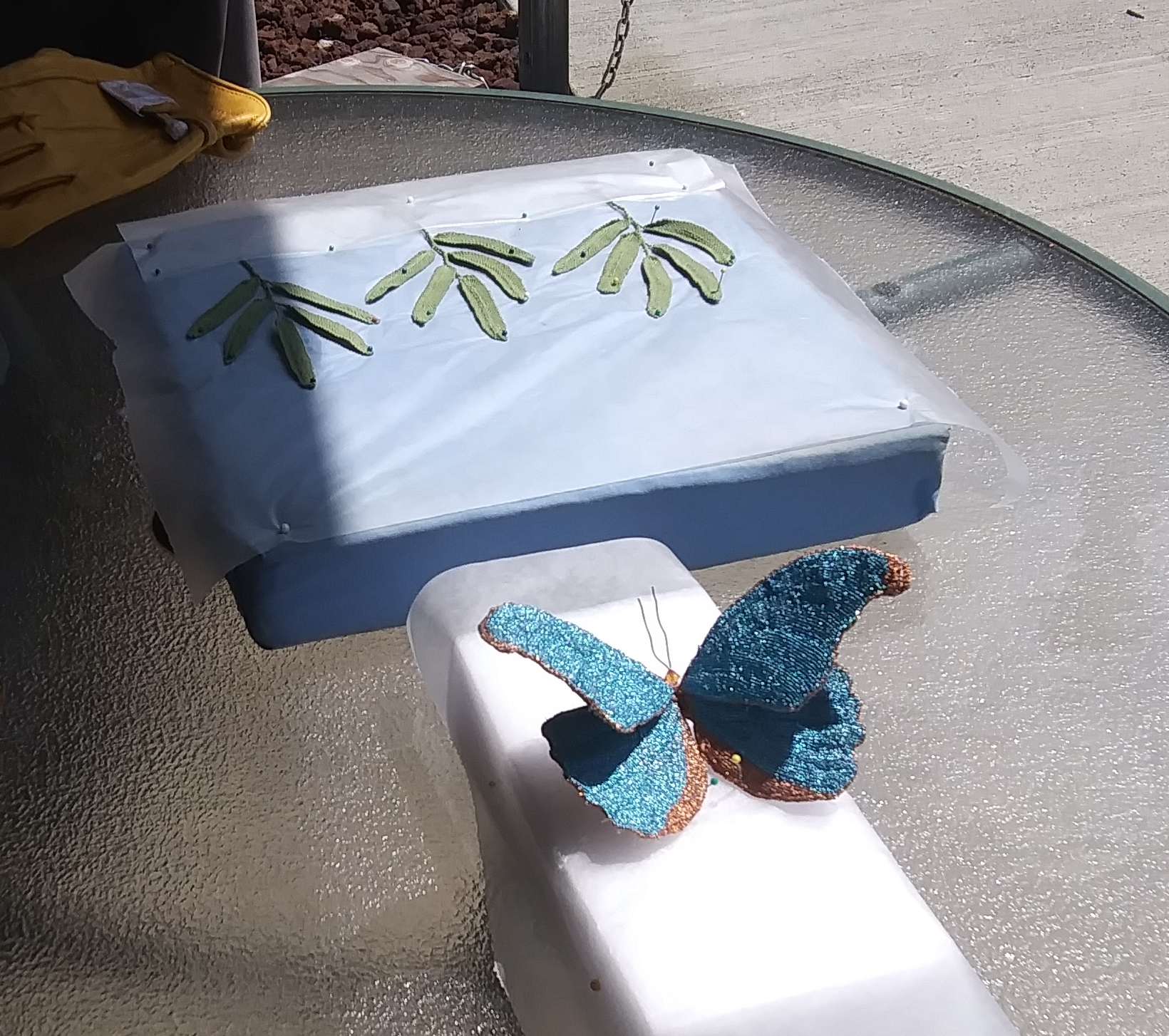
One of the first things I had to determine was if I wanted to just display it, or did I want it to look as it would in nature. To that end, I decided to position it “in flight.” The photo above shows it drying in position after I used finish spray on it. My willow leaves are also drying on the upper foam block.

Here you can see the front view.


Here he is in all his glory. I love the fact that his has two completely different patterns on his wings.

This has been quite an undertaking, but well worth the time. Be sides, my daughter loves it. It will be hanging in her kitchen window soon.

This whole project was accomplished using my “Basketweave Stitch. I find it one of the most versatile stitches for these intricate creations.

Just sharing,

KT

Read Full Post »

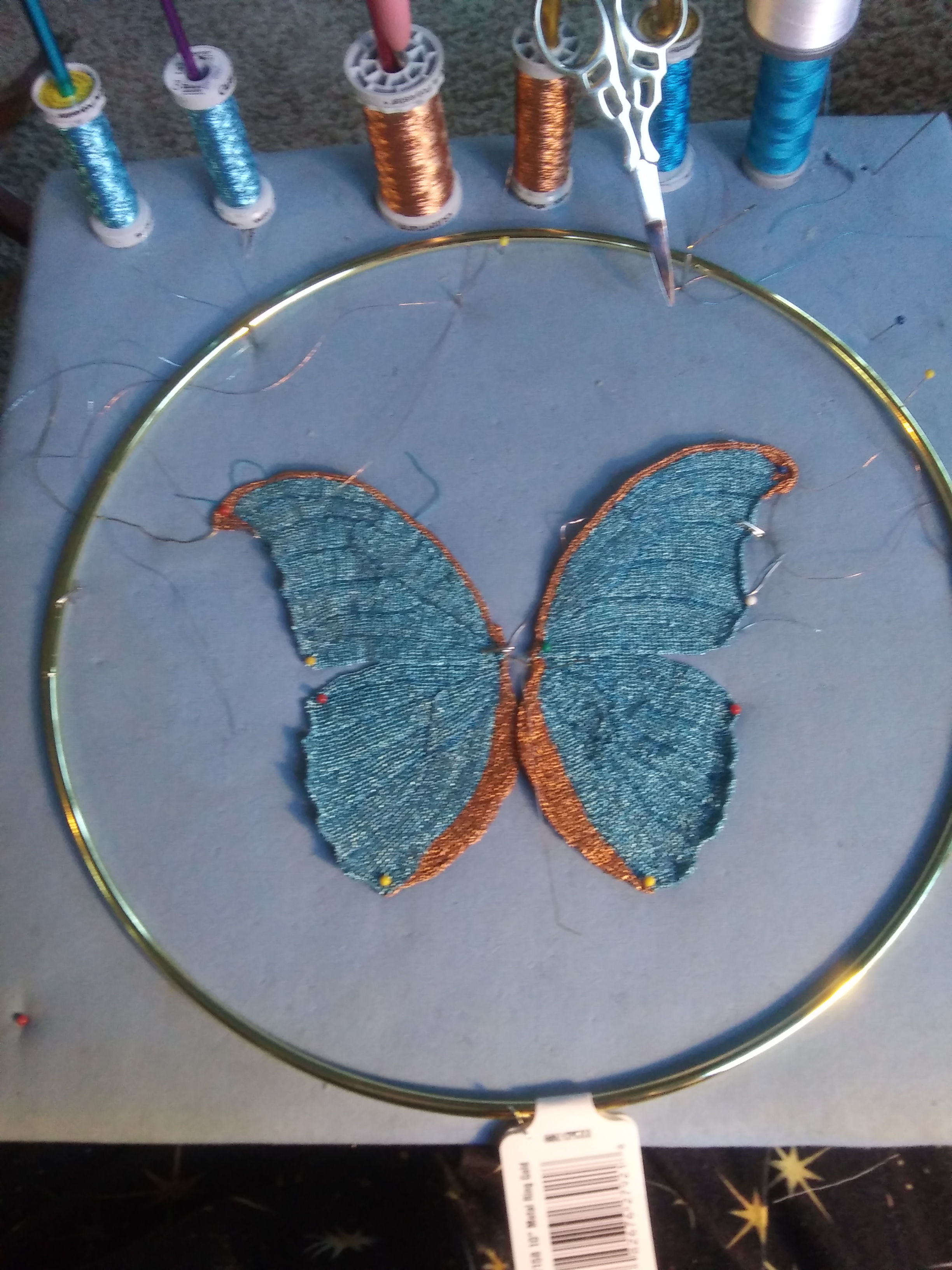
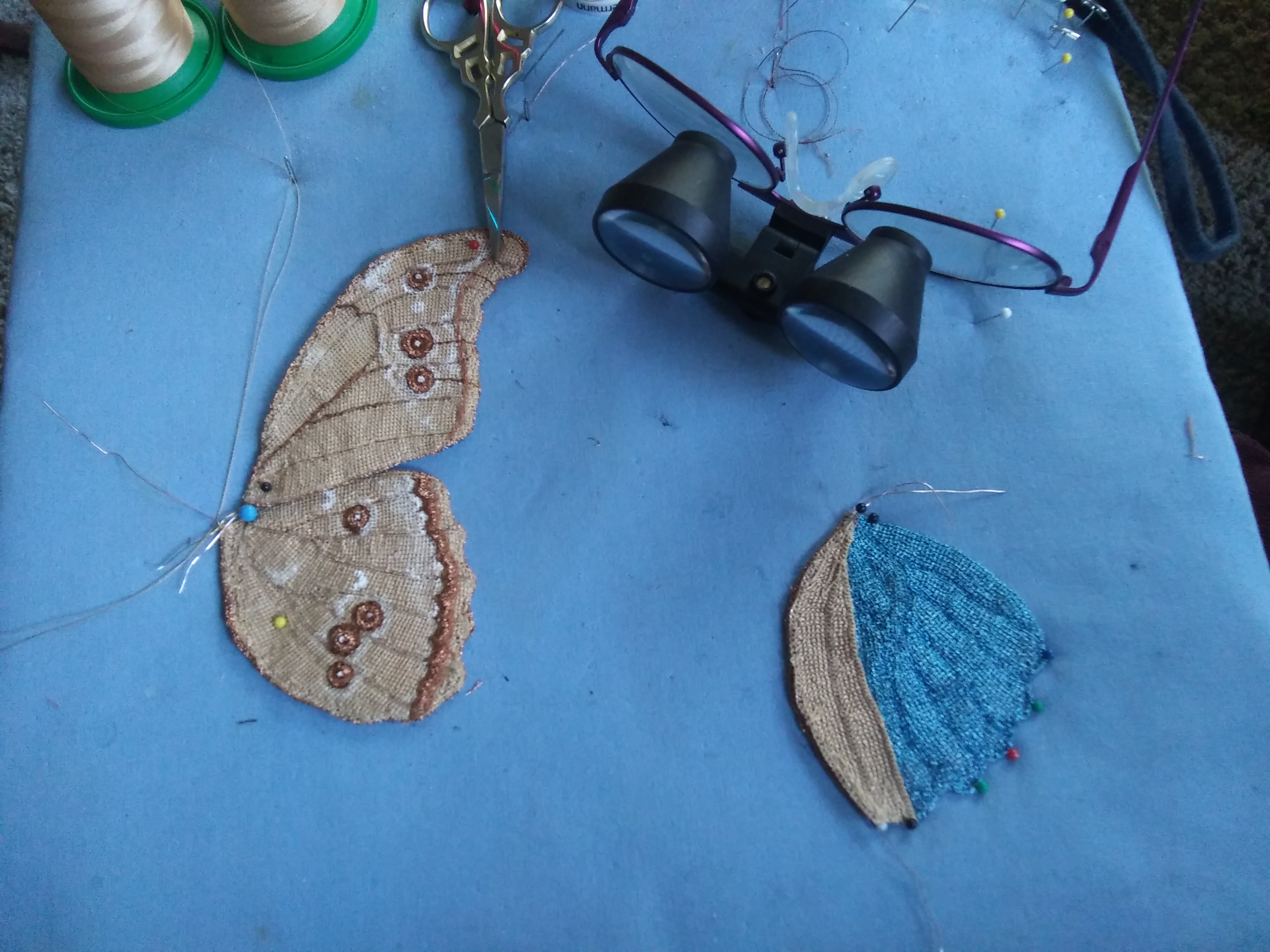
This giant Morpho butterfly is part of another butterfly ring. The photo above is the top side. The photo below is the bottom side.

This spectacular butterfly has two distinct sides. As a result each side has to be made separately. As you can see in the photo above on the right, I am in the process of making the mirror image of the bottom left wing.

All the work is a combo of my Basket Weave crochet stitch, the detail is done with needle tatting, and the closure is the simple blanket stitch. The beauty of the Basket Weave Stitch is that it lies flat, and can be made the base for all sorts of decorative stitches, as well as paints. The white you see on the left finished underside, is simply acrylic paint.

Some think I am a bit “nuts” for doing this detailed work, but it brings me great joy.

Just sharing- KT

Read Full Post »

I have been at this a while, but finally completed the project. This size 44, is made of fingering yarn on a size 3 circle needle. It is designed to go over the top of thermo ski clothing. My thinking was “sweat shirt.”

The overlayed design on the bottom of the body of the sweater is done with lace weight yarn. The stitches are worked in between the stockinette stitches of the sweater. Every other row the black decorative stitches are slipped, then the following row are cabled over in whatever direction I want them to go. They ride freely between the stitches. It has the appearance of crocheted stitches.

You will notice in the photo above that I also worked the same design at the top of the sleeves.

All the ribbed sections began with an invisible cast on.

I made this for my grandson who is in the Navy.

You can be sure I will include washing instructions and moth deterrent in the box.

Happy Knitting!!

KT

Read Full Post »

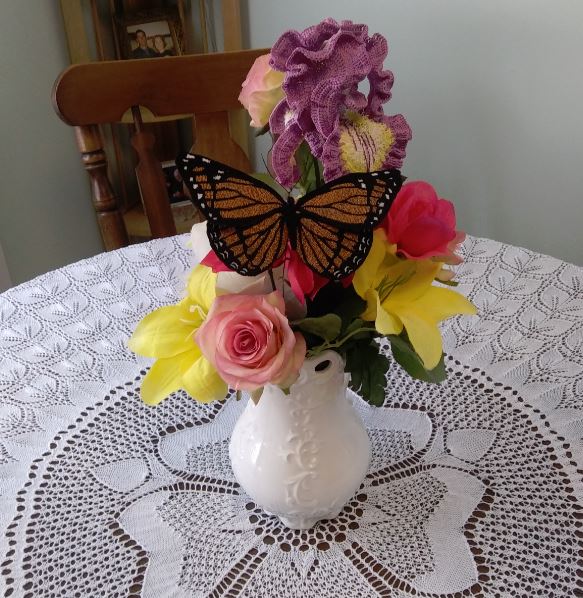
Below is a photo of the completed Viceroy butterfly.

As I was looking at the setting, I realized that the scene incorporates several of my crocheted projects-the English Rose tablecloth of Curio from KnitPicks; the last of my crocheted Iris, after making an arrangements for each of my children, and the butterfly, using metallic sewing threads.

It actually floored me to think of the hours that went into each project; however, each hour was challenging, and rewarding. It also seems to bring a smile from those that pause at the table, leading to many an interesting conversation.

So.. back to the sewing threads, my CraftOptics glasses, and practicing the gift of patience.

Just sharing-KT

Read Full Post »

002

Just thought I would share my latest project.  I received a many a smile and compliment on this hat when I wore it out for it’s maiden debut the other day.  It is amazing what something this simple can do.

No matter how jaded our culture becomes, there are always those who still respond to something pretty.

I really like the idea of the crocheted tape lace crown bands combined with some of my crocheted flowers.  I am able to mix and match them to coordinate with whatever outfit I am wearing.  It’s great fun.

KT

Read Full Post »

bead evening bag flap 2Since my recently knitted purse expanded my knowledge of knitting with beads, I thought I would try and take it one step further-paint with them.  The above photo is of an evening bag flap that will cover the hex frame and lay smoothly to about 1 1/2 inches from the bottom edge of the purse.  The design features the letter”T” in the middle, with various swirls etc to complete the shape.  In order to accomplish this I had to come up with a method that did not interfere with the gauge, and yet allow me to insert beads every stitch if need be.  Hummmm……..?????????????????????

Let see–,using the slip stitch method on YOUTUBE requirew first  pre-stringing your beads onto the yarn; then work to where you want your bead, bring your yarn forward, slip the stitch purlwise, lay the bead at the base of the slipped stitch, then bring the yarn around the back to knit the next stitch.

So what’s the problem with that??  Well, the problem is that you can’t line up your beads together, you can only put them in every other stitch.

The next method uses a crochet hook to go through the bead, and bring the newly knitted stitch through the bead hole before replacing it on the right knitting needle.  This method does not require you to pre-string the beads, however, you can’t stack them or place them every stitch without greatly changing the gauge of your knitting.

Well, that won’t work!  So what to do?????

I want the beads to set on top of the knitted surface, so they will not affect the gauge.

I want to be able to chart my design.

I don’t want to have to count stitches and rows in order to put them in, if I wanted to do that I would do counted cross stitch.

I want to be able to tweek them a bit if needed to make the design.

After playing around a bit, beginning with the idea I shared with you in the lace curtain design, I came up with this.  You can call it whatever you want.  The nice thing is it works, as you can see in the photo above.

Here it is for you to play with- Painting with Beads

I have added some illustrations to make this process more clear.


I know you will come up with your own great ideas.

Go for it!


Happy knitting!  KT

Read Full Post »
I recently finish a lace curtain set I made for my bathroom.  I used Curio from Knitpicks for my yarn.  It is truly a luxury crochet weight (lace)with a softness and sheen that is very lovely.  Below is a picture of the finished project.

lace curtain finished

When I had finished the main panel, I decide to get”cute” and trim the bottom edge  with rose colored beads to add a little contrast.

lace curtain bottom edge of center panel

When it came to the valance, I decided to try replacing the Nubbs/Bobbles with the rose colored beads.

lace curtain, beads for nubbs 3

*I know that there are some who will want to quibble over the terms bobbles and Nubbs, but for me, any time a pattern calls for me  to knit up more than 3sts in one knit, and gather it together in the purl row, I think of it as a bobble.  Maybe that is because I think of a bobble as something that “hangs,” and a nubb, as something that just makes a bump.  Anyway, it is the end results that counts.

It has been fun working with this great yarn, and adding the beads was just an extra bonus.

I have charted this pattern for you, along with instructions on how to replace the Nubbs/Bobbles with beads.  I am sure you will come up with more ideas once you get started.

Please take time to practice and swatch each section.  The cast on will be determined by your window.  I advise adding at least 4 inches in width for ease.

Lace Curtain Pattern

The lace curtain pattern includes instructions and charts for lower panel and valance.

* Note- you do not have to print off the last page of the pdf pattern.  As you will note, it has cross stitch info that is not for knitting-it’s just part of my charting program.

By the way, my window opening was 24 by 36, which is the area I wanted to cover.


Happy knitting- KT

PS – If you are a Ravelry member, you can get the free pattern there.  Just type in “Lace Curtain Set” by Judith Helms


Read Full Post »

Older Posts »