Feeds:
Posts
Comments

Archive for the ‘crochet’ Category

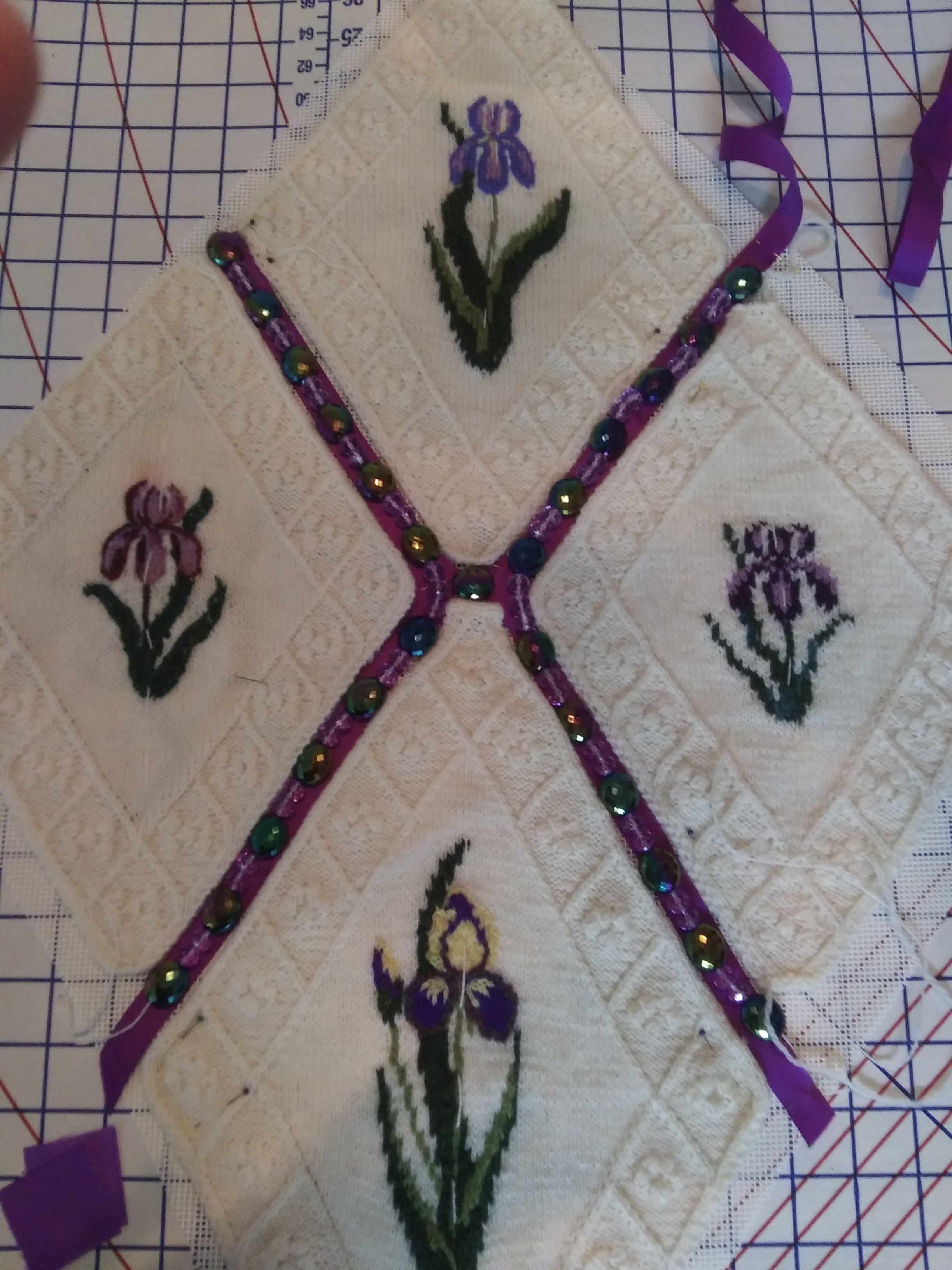
When my grand-daughter visited me this last year, we went through some of the things I had stuck back in my craft boxes. Among the fines were these swatches I had made while learning to design and create knitted pictures. The one on the right was the first Iris I tried my hand at, using my friends cross-stitch design. The left one, was my first upgrade, as I added edging with lace yarn. The top was an attempt at more detail, and the center bottom was the realistic version.

Of course, she wanted them. The problem was how to put them together in an attractive collage she could hang on the wall.

The Solution

I purchased plastic netting, ribbon, and beads. The plan is to attach the ribbon, add the beads, then secure the blocks to the netting. When finished, I will trim the plastic back and crochet the edges together. I might even add a decorative edging if I feel it necessary. I will insert a ring in the top when crocheting the edge.

I will post the finished work, so you can see the results. The first pic above is just a layout, now the work begins.

Read Full Post »

One of my favorite flowers is the Sword Lily, or Gladiolus. Their stunning colors and beauty are without peer. That said, I have been working on a design for creating one stem of flowers to be coupled with one of my butterflies. Below is just the beginning.

Just to get to what you see, has taken me weeks. Each bloom has 6 petals, two smaller ones, two more rounded ones for the top and bottom, and two more pointed ones at the sides. The construction of the stamens was a combination of fine wire, and a glue gun. Then fingernail polish is used to color the tips as desired.

Here is a better view.

This project is done with the Basketweave stitch, and basic single crochet (SC). The entire petal is worked on a single wire, with sc covering the wire. During process of crocheting the petal, the wire is allowed to extend beyond the top of the petal ( making it easy to hang on to). When the petal is complete, the”single” wire is then retracted, to within about a quart to half inch in from the tip of each petal and secured with super glue. This method works great, no corner to turn or cover, no bulk.

When I am finished I will upload some basic instructions and guide for those brave souls who want to make something like this. This petal design can be incorporated into the creation of Iris, Orchids, Hibiscus, anything with a fluted edge.

My next step is to engineer the construction of the central stem, so it is strong enough to handle the four large blooms, and three buds I have planned to make. It’s on the drawing board. We see how that works out.

Just sharing- KT

Read Full Post »

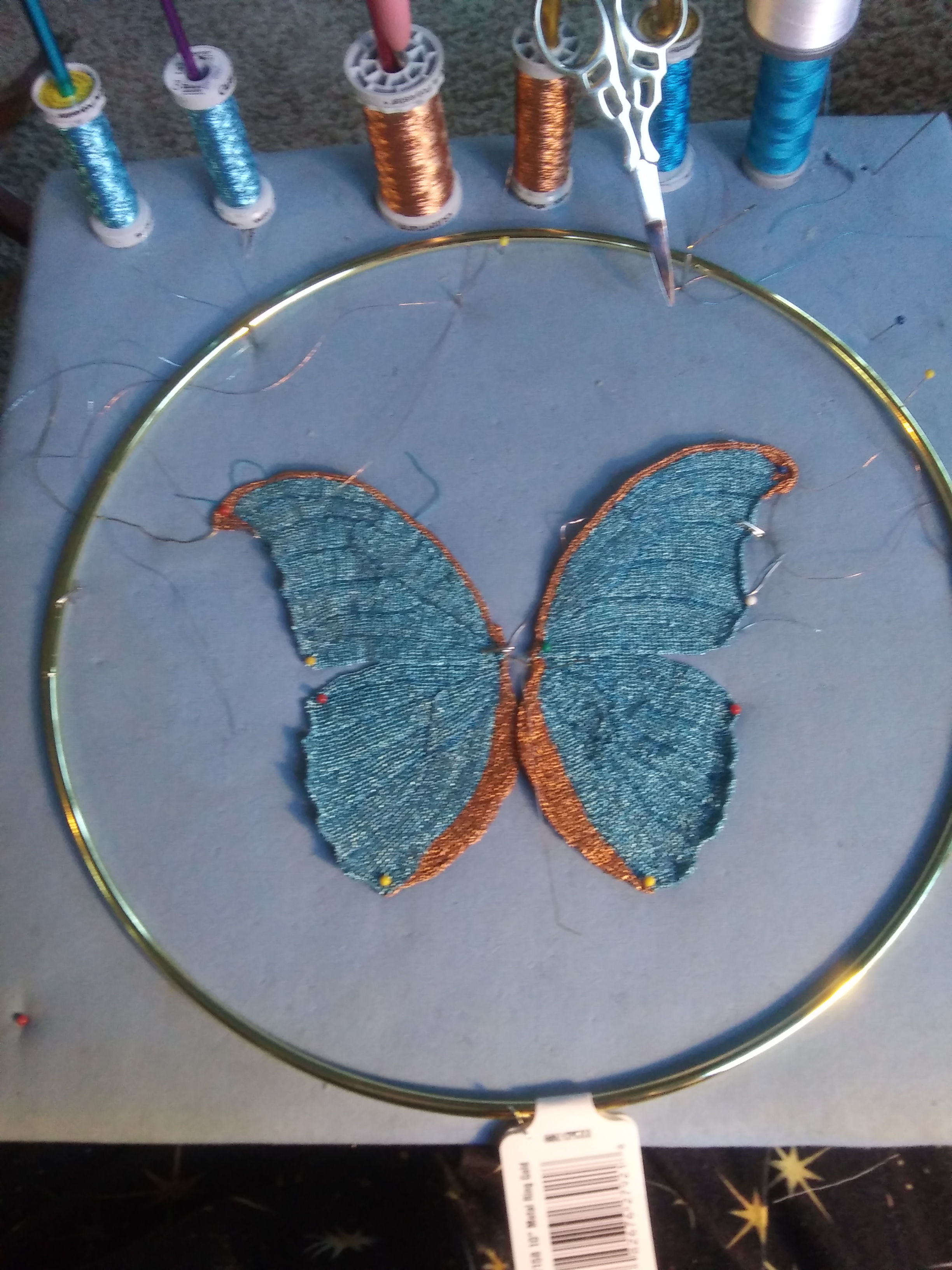
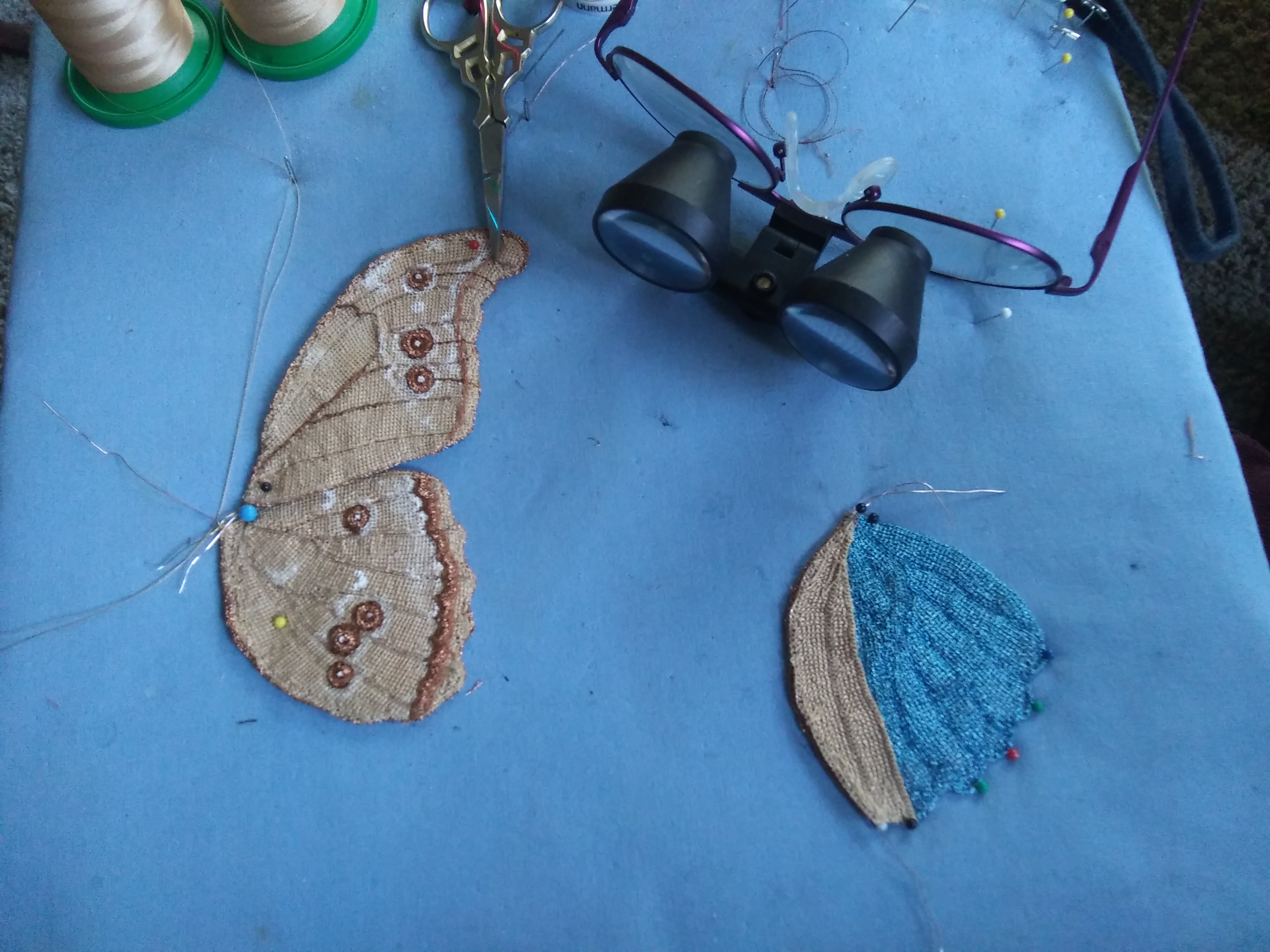
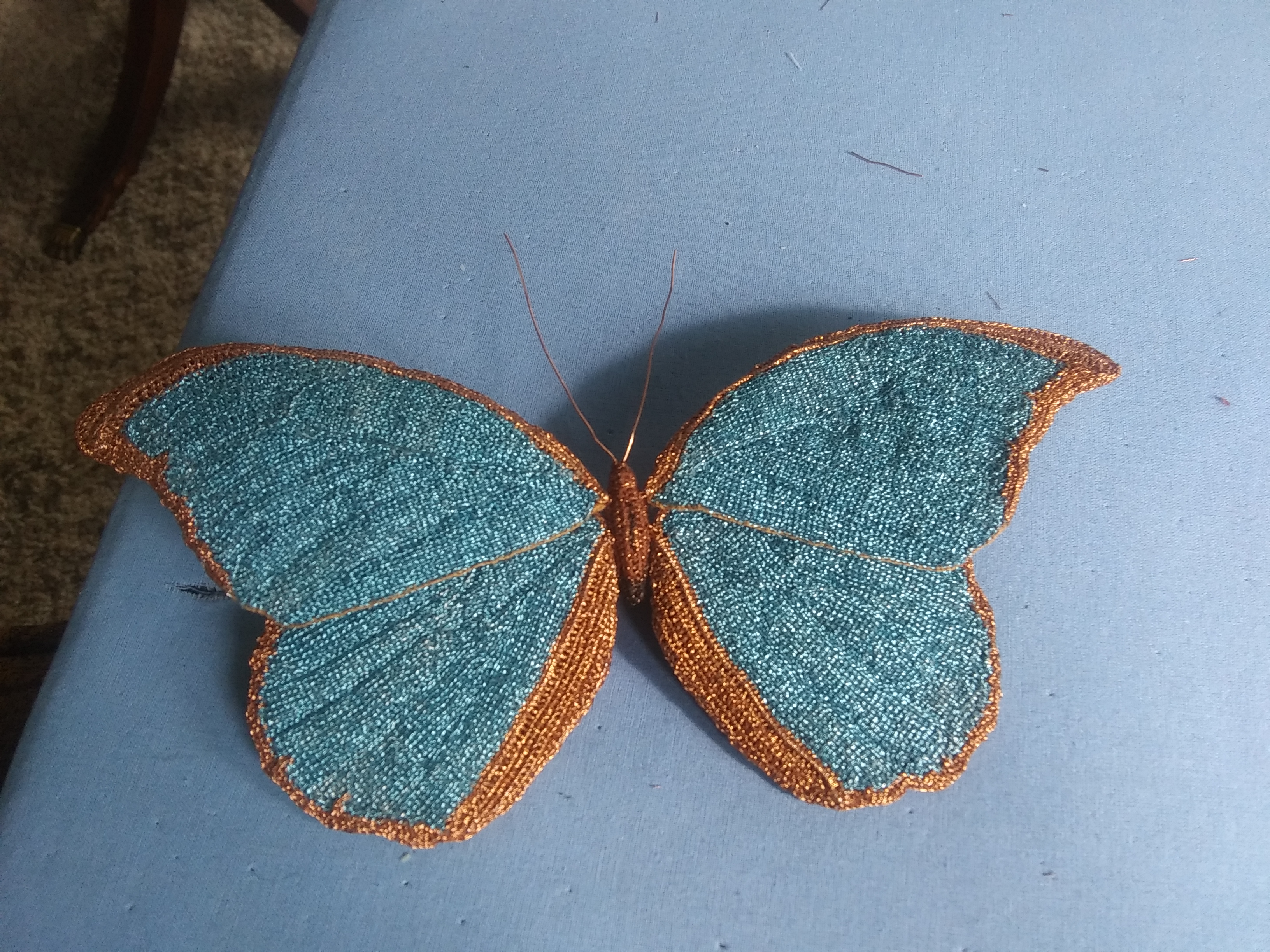
This giant Morpho butterfly is part of another butterfly ring. The photo above is the top side. The photo below is the bottom side.

This spectacular butterfly has two distinct sides. As a result each side has to be made separately. As you can see in the photo above on the right, I am in the process of making the mirror image of the bottom left wing.

All the work is a combo of my Basket Weave crochet stitch, the detail is done with needle tatting, and the closure is the simple blanket stitch. The beauty of the Basket Weave Stitch is that it lies flat, and can be made the base for all sorts of decorative stitches, as well as paints. The white you see on the left finished underside, is simply acrylic paint.

Some think I am a bit “nuts” for doing this detailed work, but it brings me great joy.

Just sharing- KT

Read Full Post »

I am sorry to say that I do not like working with double pointed needles.  That is not to say that I haven’t been successful knitting with them, but I did not enjoy it.

I recently remodeled my home and put new windows in the music room, so with all that new woodwork framing those beautiful windows, I just had to have a new white round tablecloth for the  table that sits in front of the window.

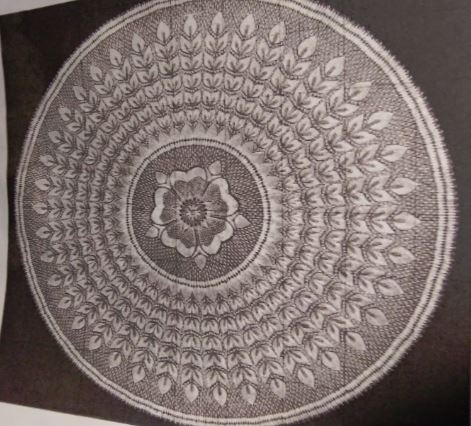
I found just the pattern in “Modern Lace Knitting” by Marianne Kinzel.  The pattern I chose was called “English Rose.”
Of course, the first instructions were to pickup the double pointed needles to start the center.  However, my inclination was to make a crocheted Magic Loop-which I did, replacing the DP needles with a 47 inch circular needle.

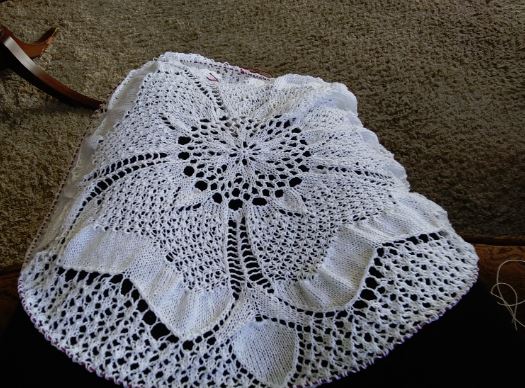
Here is a photo of my work in progress.  In the photos below I hope I can explain the process I used simply enough that you will be encouraged to try it, if you haven’t already done so.

Create your Magic Loop.
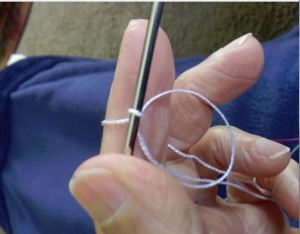
Insert tip of circle needle into crocheted loop.

Using the crochet hook, insert hook through Magic loop, yarn around hook and draw through to front, yarn around hook again and draw through loop on hook.  Place this loop on the knitting needle.  I repeated this process 10 times, as this pattern calls for 10 stitches to be cast on.
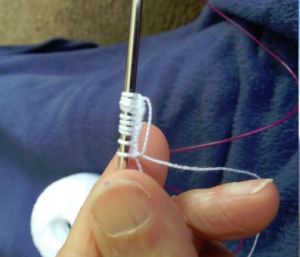
Take up slack in the Magic loop.
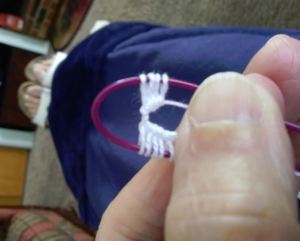
Once all the stitches are on the knitting needle, I pull the needle all the way to the left, leaving only a small amount of cord to my right.  Next, I divide the stitches up as instructed in the pattern.  In this case there were 3 sections, 4, 4, and 2.  I simply bent the cord and pulled it through, allowing a loop to form.  I did the same for the next 4 stitches, then the two that remained were my last unit.

Once this was completed, I closed the Magic loop to form the center ring.
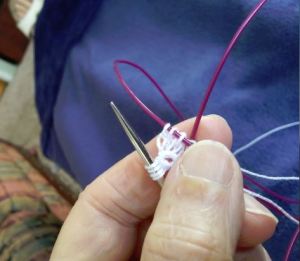
To begin the first round, pull the left needle into the “start position.”

Pull the right needle though and make a clockwise circle, positioning the needle in the start position to begin knitting off the needle in your left hand.  Be sure to make the first stitch snug to the cord of the right needle..

Personally, once I have knitted all the stitches off the left needle, I pull my right needle through so that the stitches rest on the cord.  Next, I pull the left needle back so that it is in position to knit the next group of stitches.  I adjust my loops for comfort, before I begin the next section.  I have never lost a stitch doing it this way.

When you first try this it is best to work on a table top.  It helps you to keep the work from twisting.  I admit it takes a bit of practice, but I think it is worth it.  I also don’t have to go back and fix the center.
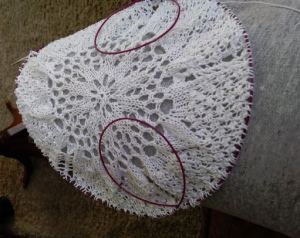
Here you can see the loops as they have diminished in seize.  Once the needle is full, I changed to a 60 inch circle to finish the project.


Happy knitting-  KT

Read Full Post »
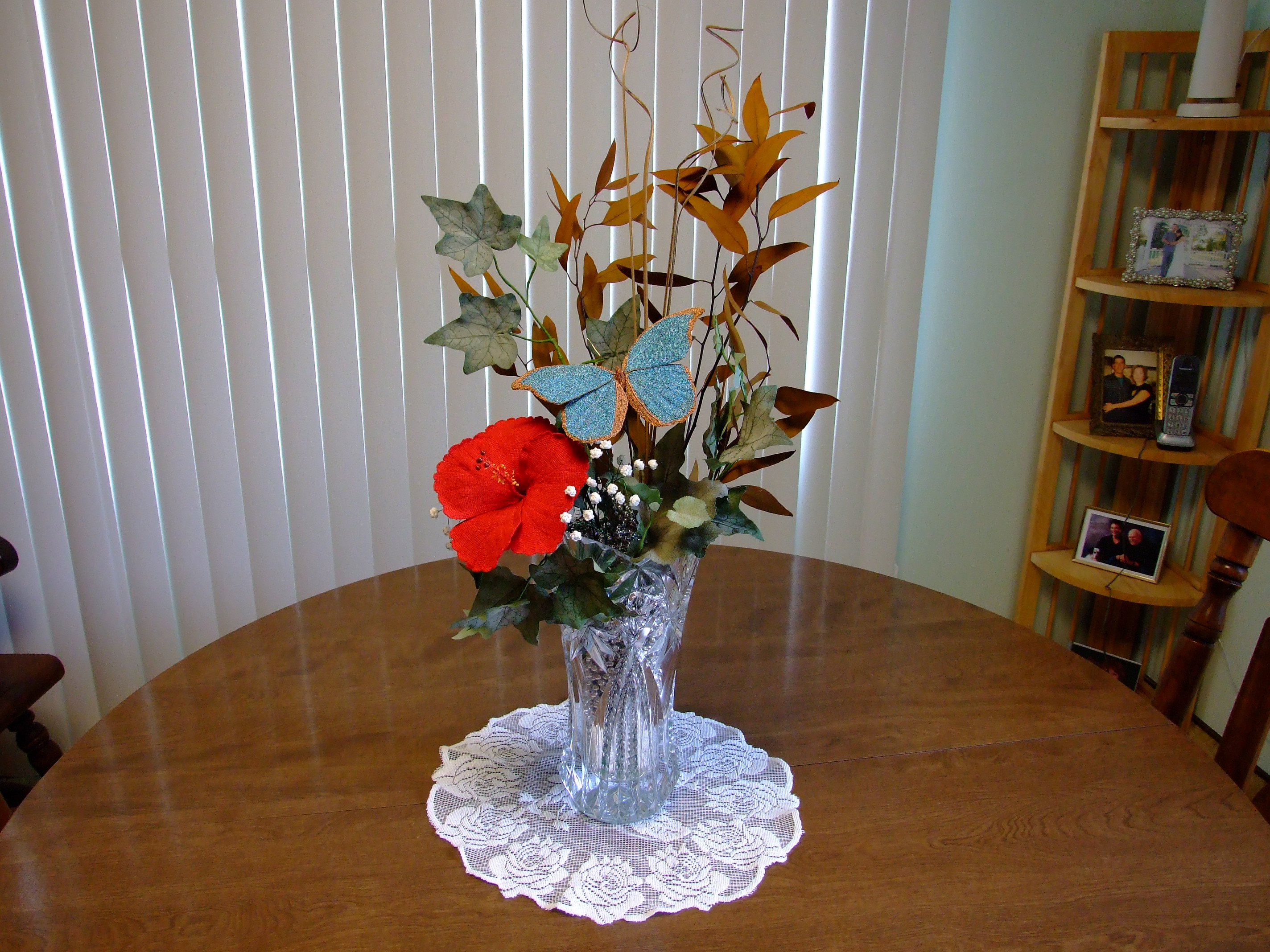
My rose finally has a home.  I added a few items to the mix, but not much-just enough to support the stem and leaf structure.

I might add another rose or bud someday, but for now it is enough to know that my idea worked.

I do like the look of the leaves much better than normal crochet, as they are smoother, and I was able to make them more life like.  They are in the foreground hanging over the Baby’s Breath.

Just sharing!

KT

Read Full Post »

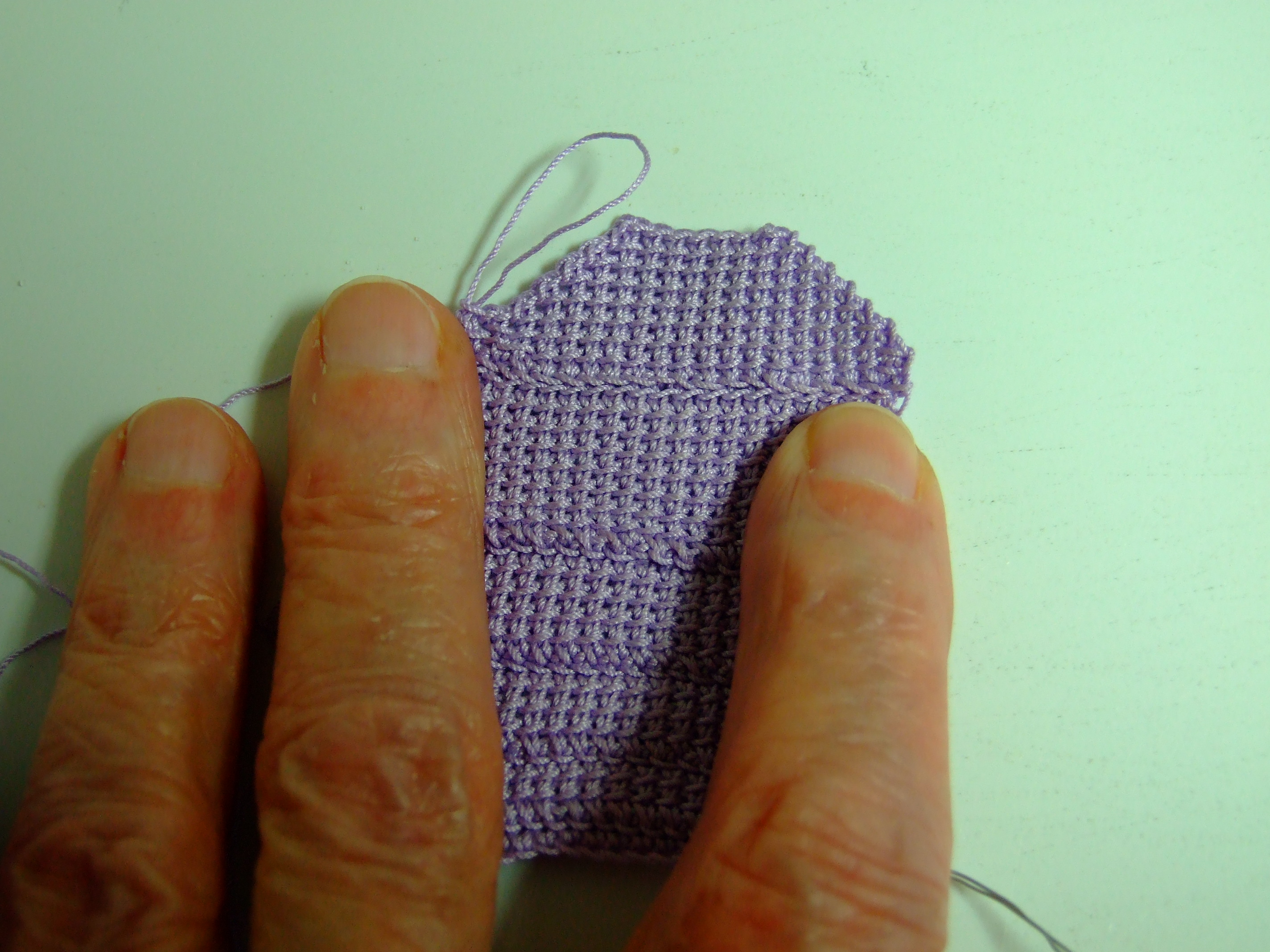
I have been working with this stitch for a while in the hopes that I could produce a fabric like “look.”  I wanted the stitch to be flatter than normal crocheted posts, as I wanted to be able to paint and embroidery on it.  The results of my efforts are shown in the photo below.

003

This large “Peace and Love” rose is a duplicate of the one that is in my back yard, and my husband’s favorite.  He wanted me to immortalize it for posterity.  🙂

*Just as a side note- got a test from a friend

She asked if the rose was made of painted fabric and dried over a mold of some kind.  This, of course, let me know that I had achieved my goal.

As of now I am working on the leaves, and will be adding them as it section is completed.

008

The photo above shows my work in progress.  The leaf at the far right is almost finished.  You can see that each vein is worked separately.  The leaves on the far left are finished to their base, and details are embroidered with #80 crochet thread.

My leaf pattern is a duplicate of the original leaves in two sizes, as the rose I cut from the bush had leaves in groups of three, one large and two small.

It has been a fun project.

I will upload the finished product soon.

My man will be happy.


Just sharing, KT

Read Full Post »

I delivered this arrangement to my friends this morning.  They were delighted.  Many people think I am crazy, but all the hours I put into this are worth it, when I see the smiles on their faces.

It is currently being displayed with dignity on their black baby grand piano.  There are also plans to provide a flash light handy for anyone who wants to view the details of the underside of the Morpho butterfly.

*You will see that the maiden’s fern is not in the mix. Why?  I have discovered that it looks better when there are no more than 3 crocheted elements in an arrangement.

So…..what’s next?  I am working on development of this stitch and it’s possible use in other projects.  As I perfect these variations, I will share with those who are interested.  Right now, I am working on using to colors, as I do in Intarsia knitting.  I think the possibilities are endless.

But….for now, it is nice to have this one finished.

KT

Read Full Post »
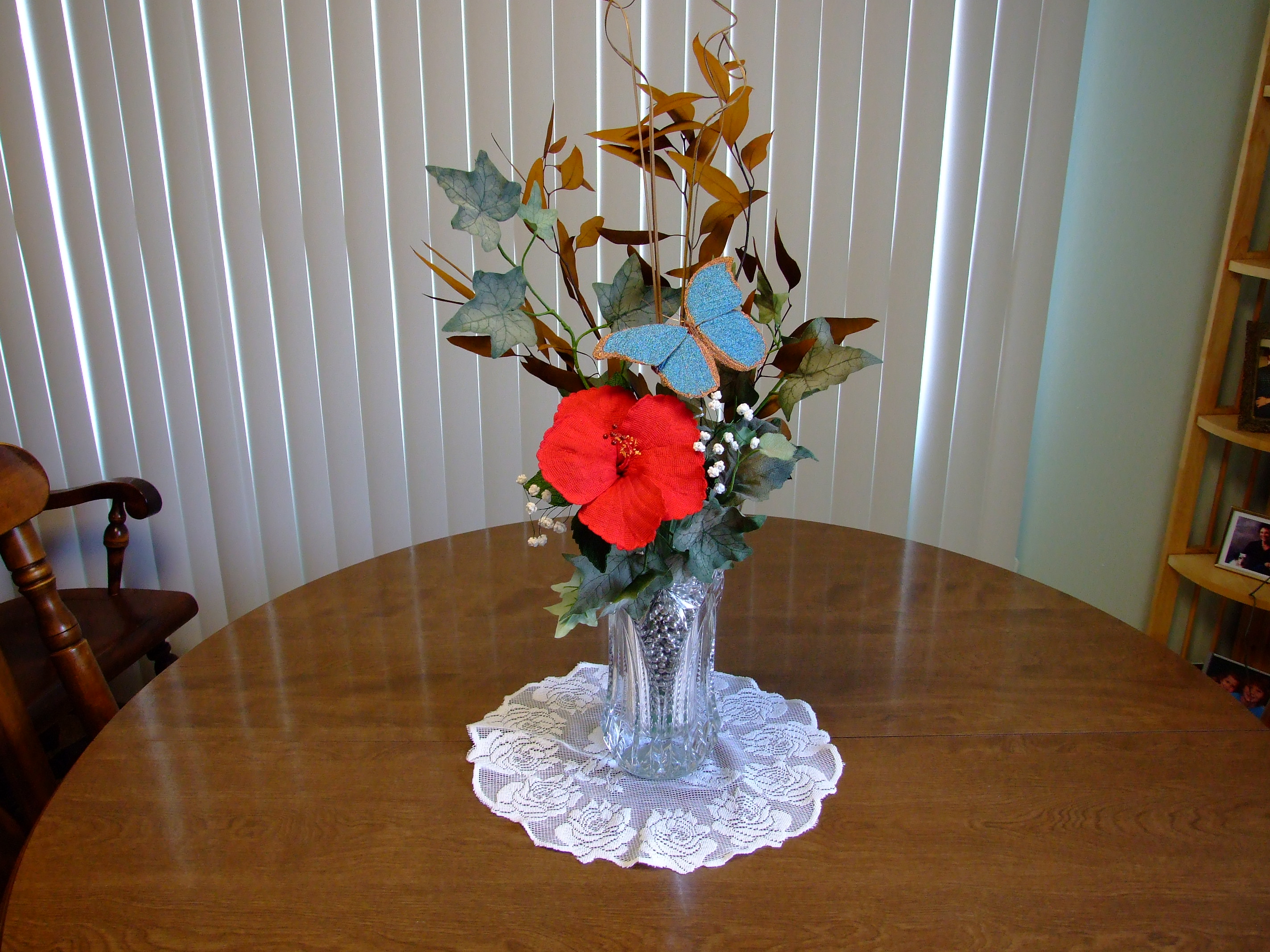
As I mulled over the elements I wanted for my Morpho Butterfly arrangement (butterfly, Baby’s Breath, Maiden Hair fern, stems and grasses), I found I was lacking 1 essential item- a flower that my butterfly could land on.  So, I did a little research and found out that since  this butterfly comes from Central America region, then one of the flowers from the same region is what I needed.  My choice- red Hibiscus.  Not only is it gorgeous, but red is one of the background colors of the room where it will be displayed.

hibiscus- illustrations 4

Here it is in all it’s glory!

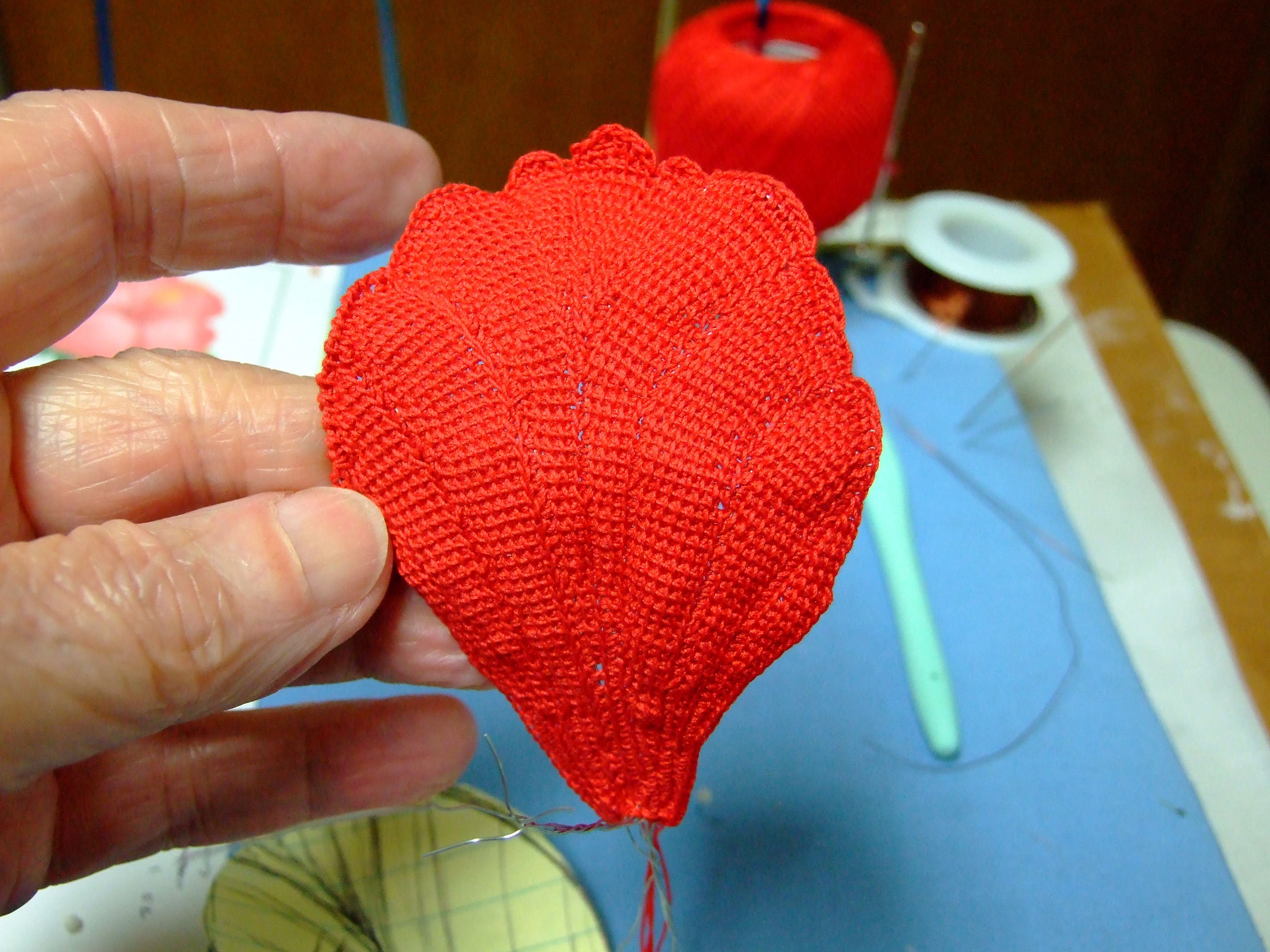
Now to examine my subject.  I noticed that the “vein’s” of the petals run vertically, just as they do in my butterfly veins.  So with that in mind, and using size 40 thread and a .09 hook, I made a sample.

001

006002

Once I had played around with this, I decided to write up the process, hoping to encourage some of you to do the same.

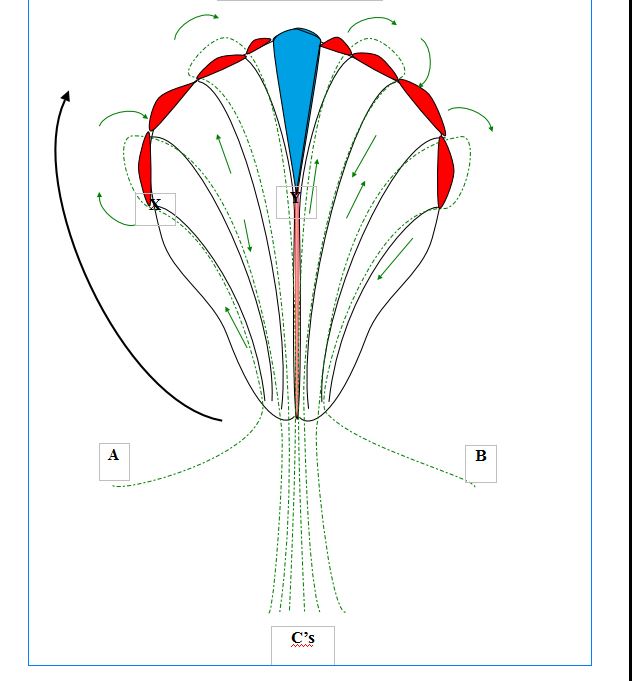
To start with, the paper template you see in the last photo was my guide.

hibiscus petal template with instr

Hibiscus Petal Illustration

The green lines and directional arrows, are the wires (size 32g, red).  Those wires are divided as shown in the illustration.  A and B will be used to secure the petal to the main stem.  The center 6 wires will establish the center pistols and stamen, which are at least the length of one petal plus some.  One wire from each petal with be the top of the 5 pistols and have a red bead to finish them off.  The other wires will be pealed off one at a time, trimmed to length and finish with a #11 yellow seed bead.  You can see those wires in the last photo.

By using the wires in the manner I did, I am able to flute the edge.  I add even more detail in the solid red areas, as I enclose the wire turn.  Here I can sc, hdc, etc, defining the edge as I like.  I can do the same with the 2 veins that do NOT have the wire turn.  *On the sample I did not add all the scallops.

The solid blue section of this illustration will be worked as one vein.

This may seem complicated to some, but for me it is fun.  Keep in mind that this is a guide, and I am always open to changing things as needed.  Another thing is that nature is not perfect, so any slight variation in the petals is more perfect than you think.

I can not wait for my red wire to arrive so I can get started on the Hibiscus.

I will keep you updated on the progress.


Read Full Post »
basket weave sample029

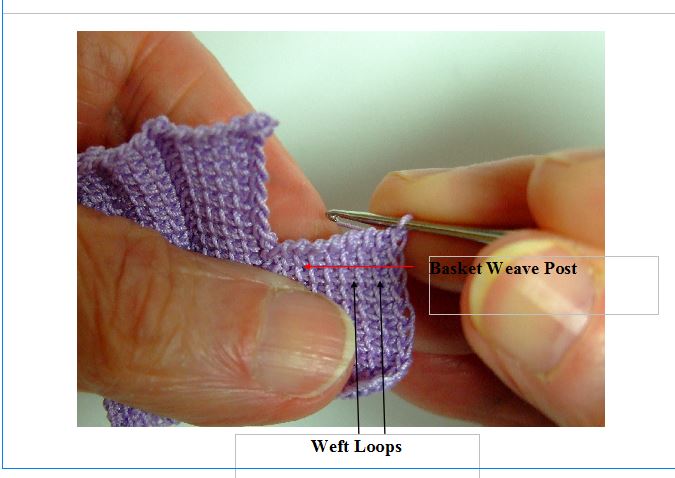
One of the most important aspects of free form crochet is knowing how to make the shapes you see on the picture or template you are working with.  To explain this concept I have uploaded the next part of the Basket Weave stitch tutorial.

You will note that the  completion of each section results in a post- ie.,  Basket Weave Post, or BWP.  You will also note that you will be working across the row in a vertical position, as the weft loops (Wflp) lead the way.

I hope that I have made this tutorial understandable, but if you have any questions, you can contact me.

Basket Weave Stitch – Ups and Downs

Happy crocheting!

Update on Morpho Butterfly arrangement elements

1 – frawn of Maiden Hair fern done!

2- 2 clusters of Babies Breath

Morpho arrg

This vase is one that is handy to put the elements in as I go.  It is not the vase that the final arrangement will be made in, that one is a 16 inch crystal fan design.


KT


Read Full Post »

20190406_113004

My Morpho Butterfly is done.  I even have 6 legs under him.

20190406_113349

In the photo above you can see both sides, and his legs.  By the way, this photo is the favorite pose of my butterfly professor.

The brown circles are tatted(Josephine knot).  The out side circles are embroidered with chain stitch, and the white wash is white enamel.


20190406_114043

Now he has a home!

I will leave him here until I have the rest of the elements of the arrangement done.

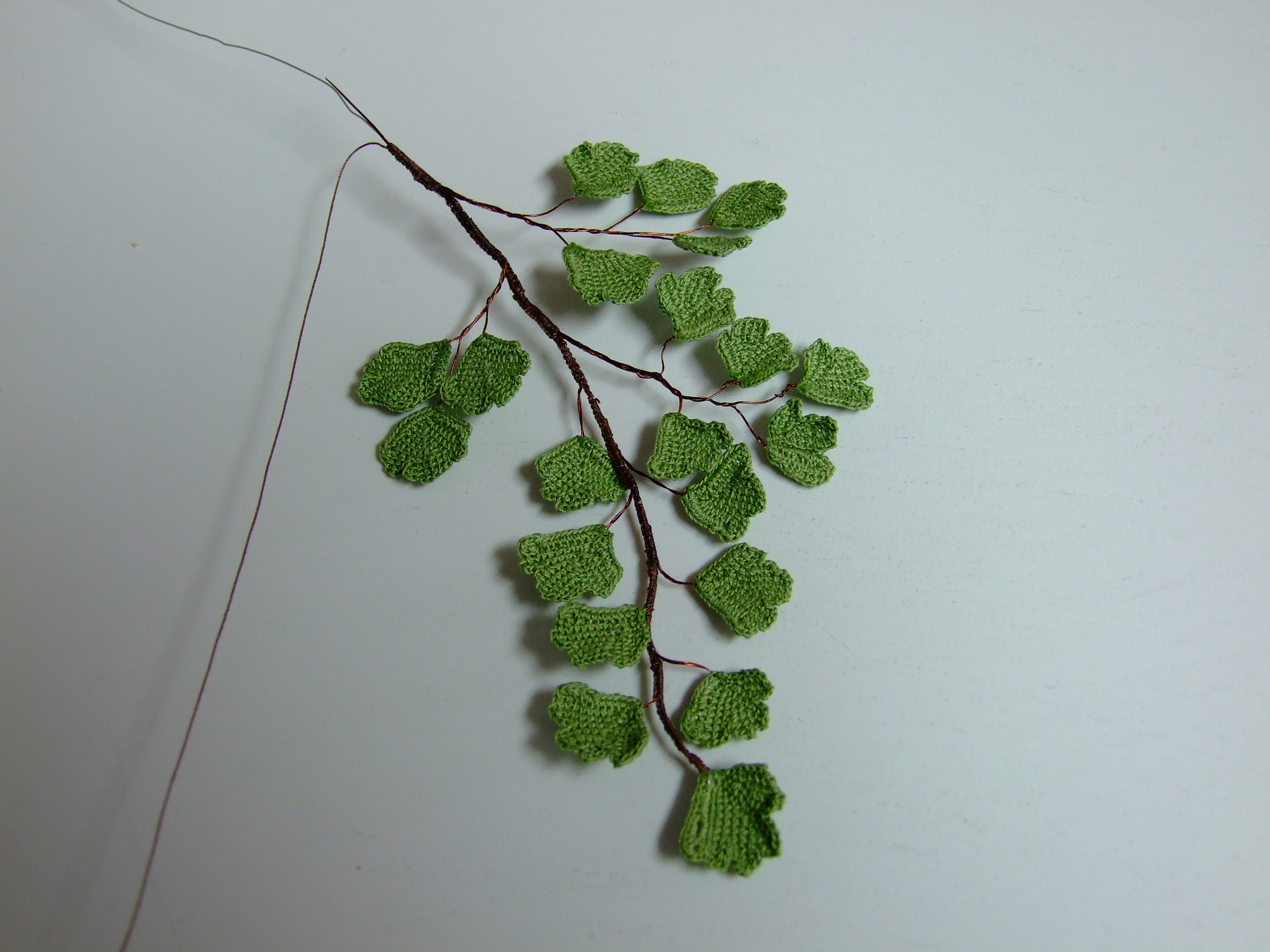
The next segment of this project involves Maiden Hair fern, and Baby’s Breath flowers.  Below is a photo of the Maiden Hair fern in progress- one branch at a time.

011

For this element, I also used the Basket Weave Stitch.  I am still working on the tutorial and will upload it as soon as it is finished.

These leaflets are about 1/2 to 5/8 inches in size.  I am using #80 thread, .06 hook, and size 32 gauge jewelry wire.   Each 12 inch section will be made separately then connected.    The brown thread you see lying on the table surface is #80, and used to tat “double stitch,” anchoring each stem to the main wire.  It is overlaid with Hard as Nails clear polish as I go.  When finished, the entire stem sections will be coated with a coffee brown polish.  Not only with this make is all match, but it helps to secure the stems in place.

As in nature, the leaflets are similar but not exactly the same.  This of course means that I am free to shape them a bit different, and just keep them in the ball park of the size I need.

And yes……………., it takes patience, but I am very happy with the results.

Below is part I of the basic Basket Weave Stitch

Basic Basket Weave Stitch


KT


Read Full Post »
Older Posts »