
As I was working on the second sock I decided to take some photos of the double heel set-up.
First, let me say that I have discovered that using a needle at least two sizes smaller for setting up double knitting, gives a much smooth transition than doing it with the needles designated for the field. So…, since I am using a #3 for the main knit, I will be using a #1 when setting up the double knit for the heel.
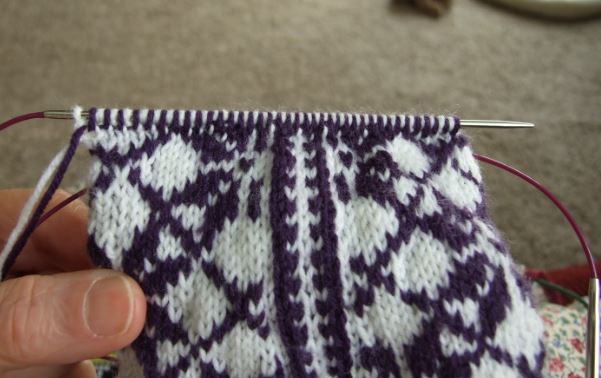 Double Knit Set-up
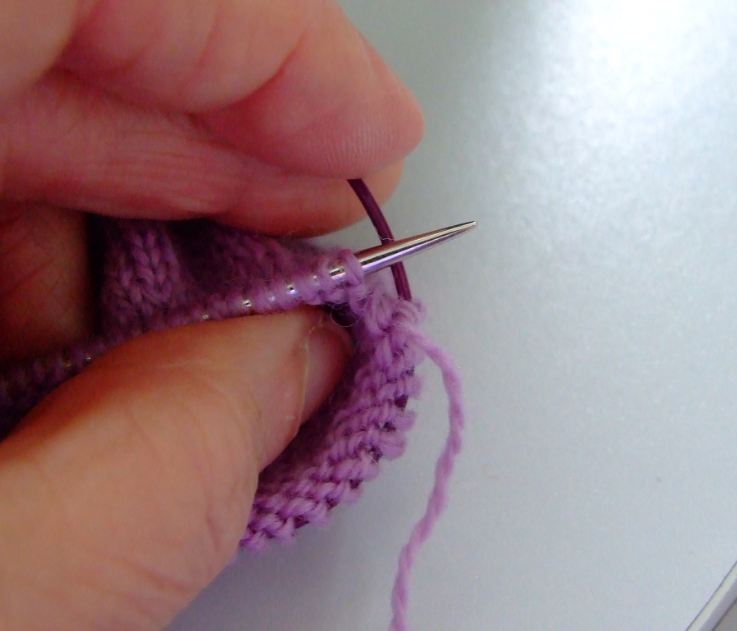
Using my #1, I knitted the first stitch with the MC, leaving it on the needle, I brought both the yarns(MC and CC) through to the front; with the CC I purled into the same stitch. To repeat, bring both yarns to the back, then knit the next stitch with the MC. Bring both yarns front, and purl in the same stitch. Work all the heel stitches this way. You should have twice the amount of heel stitches on your needle. The next step is to pull the #1 through all the way so that the stitches are now on the right end tip of the circle needle. This puts them in position to be slipped off onto the two tips of the #0 needle.
Pick up a #0 circle needle. Fold your #0 in half so that both ends face the same direction.

You can see that I have positioned the tips between the thumb and index finger of my right hand.
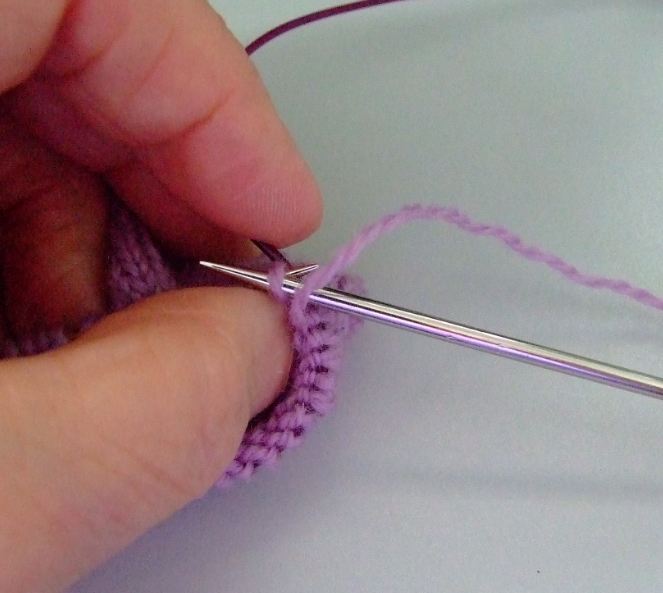
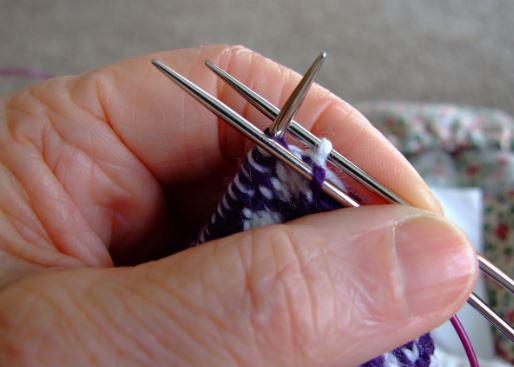 By rocking my wrist forward and backward, I pick up the MC from back to front, with the nearest needle, the CC stitch is picked up in the same manner, with the farthest needle. The trick is to keep your right hand thumb on the stitches just picked off.

You can see in the photo above how it looks as you progress across the row.
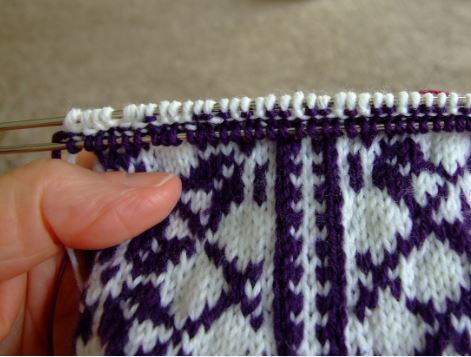 Once you have them divided onto the two points of the needle, it is time to set up for knitting the MC heel on my #3’s. To do this just turn the needles around so that the working yarn is on you right. Now pull the #0 needle holding your CC through, so that the stitches ride on the cord.
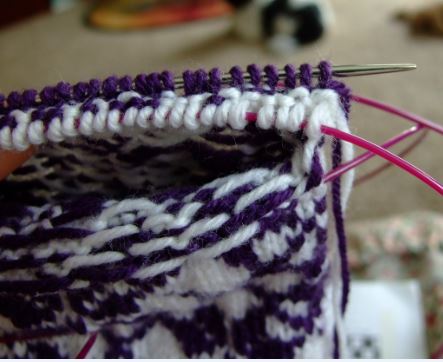
*Note- you will find that knitting off the #o holder, leaves you ample room for the larger needle and makes a smooth transition.
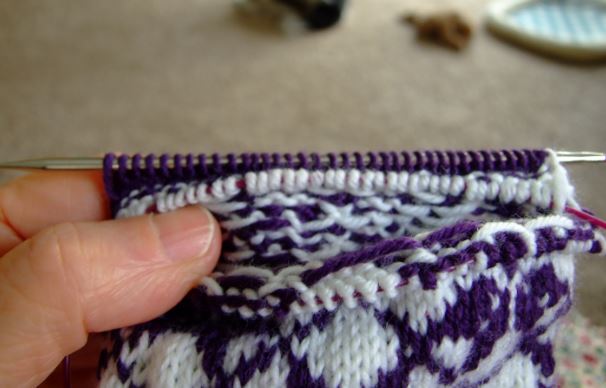
Next, pick up the #3, slip the first stitch, and purl across, beginning your short row heel. Once the #0 is released from this row, pull it through so both side hang out evenly. I actually tie a loose knot in the coil and let it hang. This needle serves as a stitch holder for the CC stitches of the inside heel.
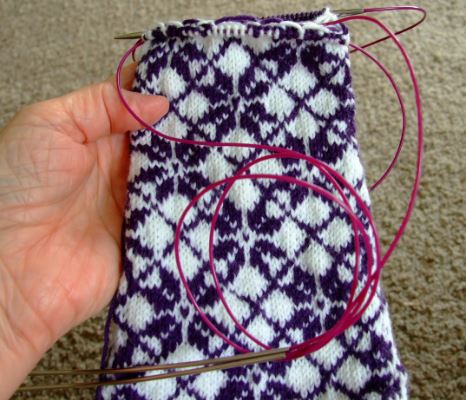
Complete the MC short row heel, ending on a knit row. Why? This will set up our working yarn in the proper order to complete the round that was interrupted when the heel was begun.

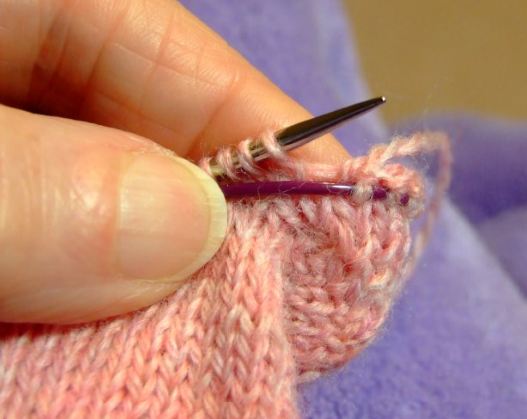
After transferring the finished MC heel stitches onto a spare #1 or #0, beginning at the right edge, with the purl side of the MC heel facing you; with #0 needle, pick up the stitches for the inside CC heel.

Here you can see the stockinette stitches of the inside CC heel. Beginning in the knit side, complete the short row heel, ending with a purl row. Now both working yarns are in position to complete the original round.
Below are some photos of the completed heels.
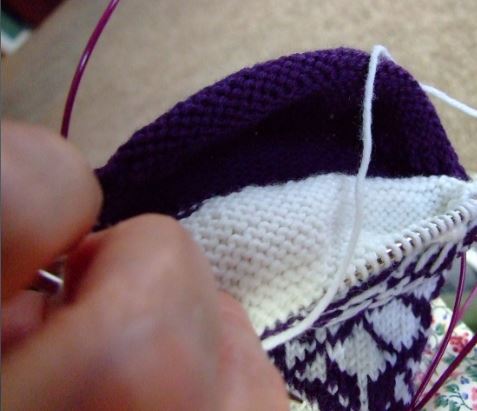 You will notice that the purl sides oppose each other.
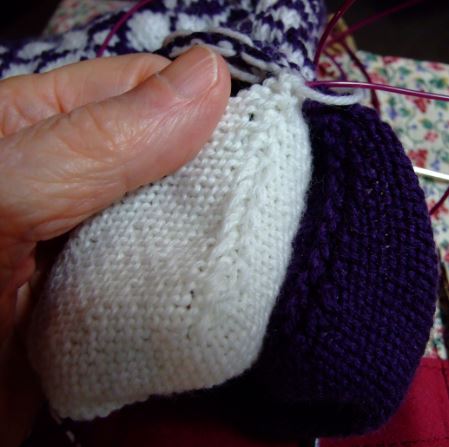 Once the two heals are completed, line up the short row turns as shown in the photo, and loosely stitch them together, weaving in the ends of your yarn. I have found that using a piece of the MC works best. Now turn the heels inside each other, both sides should be in stockinette. Slip the stitches alternately back onto your the right tip of your #3 needle. Pull the cord through, in preparation to complete the original round. The heel stitches riding on the cord should in the same order as in the first photo in this post. Now complete you chosen chart for the instep section.
When you come to the heel portion with the two colors, knit the MC and CC together with the MC. At the same time you will be weaving in the CC behind every other stitch.
From this point on you just complete the charts you have chosen for the instep and sole section until you get to the toe. Repeat the process as for the heel on the amount of chosen stitches. Join the two together, and Kitchener stitch the remaining stitches to the matching sole stitches.
* I interlock the first and last two stitches, before I start my Kitchener in order to eliminate the bulk at the beginning and end. Using 2 #0 DP needles makes this process much easier. Click on the link to “Techknitter” for instructions.
Here are some additional ideas and instructions. Nordic Boot Sock Ideas
Chart tips-For this and any other project requiring a chart I have found that “whiteout tape” you can get at Staple or stationary supply, works great for keeping track of where you are.
 It peels off easily and can be moved up the chart as required. You will notice in this photo that I also have used it to mark the out the section for the heel. As you can see it great for any application where you need to mark your progress.
Happy knitting!
KT
PS- You can find the original version of these stockings at Knitting Daily.
*The original stocking, uses a Shepherds heel. It works well, but I prefer the short row version.





 Creative Knitting - Beyond Knit and Purl