Feeds:
Posts
Comments

Archive for the ‘Knitting Tutorials’ Category

While working on a new set of moffit designs for a Ski Sweater, I decided to include a pine cone in my winter scene on the chest area.  To make the pine cone 3D, I used two tones of brown yarn, light brown for the tips of the seed and a darker brown for the inside portion.  You can see the results below.

Here is a photo of my “pine cone” bobble.  It uses the two colors I mentioned.

The Pine Cone Bobble
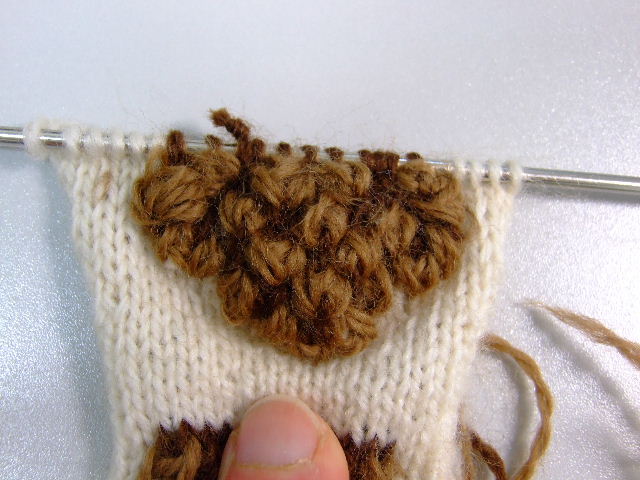
Unlike the normal method of making a bobble, each bobble is completed in one row and in one stitch.  You can vary the size of your bobble by simply adding or subtracting the number of loops picked up in the base stitch.  These bobble can also be made on knit or purl rows.  The method I use for making the loops is K 1, YO, K 1; or P 1, YO, P 1.

To make this bobble,using the light color,  pull up the number of loops desired (I used 5 here, 3 loops allows more of the dark color to show through), leaving the original stitch on the left needle, bring the second color(dark) under the first (as in Intarsia) and knit in the back loop of the stitch.  Next, using the tip of your left needle, lift all the light colored loops over the top of the dark colored stitch.  Now, knit at least one dark stitch before you make another bobble.  That’s it.

By varying the stitches (dark color)between the bobbles you can create the appearance of the closed or open cone, as cones open in response to the moisture in the air.   And.. in this case, at least, you are the weatherman.  Experiment!  Play a little!!!

When my winter moffit set is complete I will let you know.  It will be added to my “Patterns” page and will be available in my Etsy Shop.  The moffit set will include a chart for the bottom edge of sweater and sleeves, using Fair Isle, an Intarsia design for the chest area, and an combo of Intarsia and Fair Isle for the shoulders and top of sleeves.  I am very excited about it, and can’t wait to share it with you.

The Leaf Bobble

In the photo above, I used my “Cable Chains” (see my tutorial) to create the stem and a (special) bobble to make the leaf.  You will notice that the leaf bobble has been cabled to the right.  Cabling this bobble to the right or left during the 6 row process allows you to shape the leaf anyway you want.

To make the leaf bobble ,beginning on the knit side

Row 1 – Pick up 7 loops of green.

Row 2 – On the next purl row, slip all the green loops, cabling them in whatever direction you want your leaf to lie.

Row 3 – Divide the bobble into 3 parts as follows:  SSK 3 loops, K on loop, K 3tog.  Finish row .

Row 4 – Slip all loops (here again, cabling them in whatever direction you want this portion to go).

Row 5 –  Knit all three loops together.

Row 6 – Slip the single leaf stitch left and  cable leaf in whatever directions you want it to lean, and purl it with the background color.

Make a swatch and try it.  Once you get the hang of it, you can put them anywhere.

The neat thing about the”bobble” is that you can vary the length of your loops, carry (or slip) them over more than one row to elongate them, divide them, as in the leaf above, and cable them to make various shapes.  It is fun, and will peak your creative juices to find more ways to use them than I will describe here.

Have fun – Knit-tweaker

.
Read Full Post »

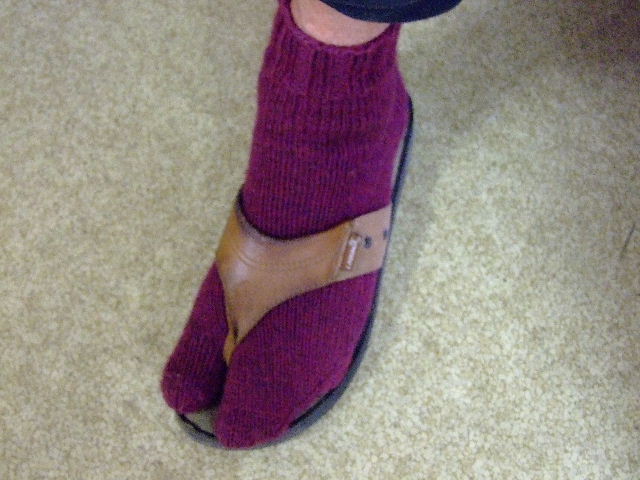
I just finished the Tabi Sock pattern (unisex) and have it available on my Free Pattern Catalog page.   This Tabi sock pattern knitted from the toe-up is constructed using Magic Loop method.  The pattern has detailed instructions, and illustrations, and will be accompanied by the necessary tutorials for your convenience.  Once you have the concept, you can design your own Tabi’s, as plain or fancy as you like.  With the necessary proper measurements done, all you have to do is apply your gauge and away you go.

One exclusive feature of my sock patterns is the toe shape.  I like my socks to “fit.”  For this specific sock, that means that I want the four toe section to fit perfectly, no wrinkles, no gaps.  In this pattern I will illustrate how I make the adjustments needed to help you fit your toe shape.  One of the concepts I introduce in this pattern and in the Foot Glove pattern, is called a CTF (connecting toe fan).   This little addition provides added comfort between the toes and conforms more closely to the actual foot shape where the toes are attached.

The picture below, is of my brothers Tabi socks.  These are done with Sports weight yarn.  With this pattern you can do either fingering yarn (my favorite) or Sports weight.

You can see in the picture above that my toe shape is intirely different than his.

Some might think my patterns are a bit lengthy, but, I like to draw, and love working with my camera.   It is very important to me that you understand the reasoning behind the instructions.  Why?  Because I am one that learns better by doing than by reading.  I need pictures.  I need to know the concept.  Once I do, then, look out!  Get out of my way!  I’m coming through!!!

The creating process is fun for me- it’s not work.  So bear with me, you’ll have to get use to the 15-20 pages of detail. 🙂

Knit-tweaker

Read Full Post »

Most of the time, when one thinks of short row closures,  it means making the turn to complete the diagonal seam in a sock heel, or toe.  However, there are times when short rows are used to add shape or a rounded extension to a garment, or hat, like in the pattern for the Mock Tyrolean offered  on my “Pattern Catalogue” page.   The instructions for these types of short rows often involves a wrap, made around the adjacent stitch during the turn.  I have tried this method, but was never pleased with the result, so I thought I might share the process that I use to accomplish the task.

To do this we will start with a swatch-my favorite practice tool.  Use whatever needle and waste yarn you have available.

First, cast on 30 sts ( I used the purlwise longtail cast on).

Row 1.  Knit across.

Row 2.  Purl across.

Row 3.  Knit across.

Row 4. Purl across until there are 3 sts left on LN.  Turn.

Row 5.  YO, knit across until there are 3 sts left on LN.  Turn.

Row 6.  With yarn in back,  purl.

Keep the single YO, and first purl snug.

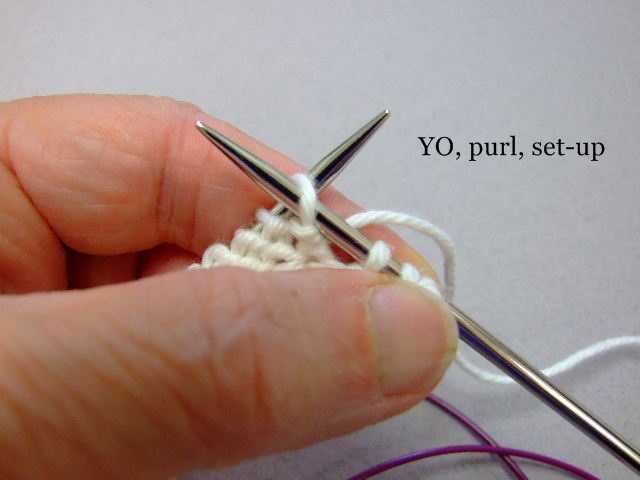
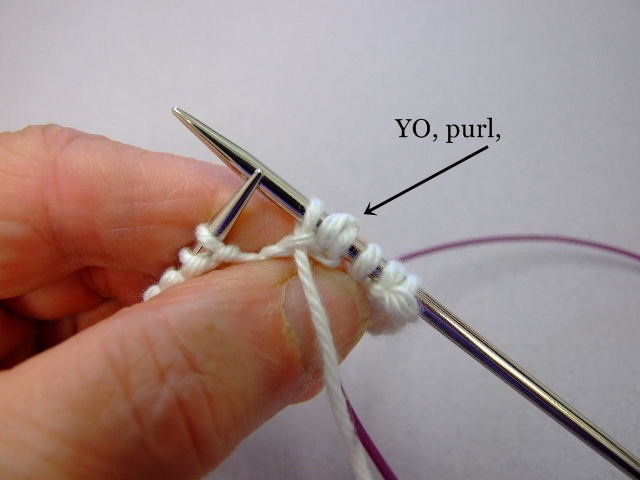
 Now, continue to purl across until you 3 sts before the first YO on the LN ( 7 loops).  (See picture below).  Turn.

Row 7.   YO, Knit across, until there are 7 loops on LN, including the YO.  Turn.

Work back and forth in this manner as many times as you like, ending on the purl side.  Turn.

I worked until there were 9 sts left in the middle.

Now I am going to show you how I close those gaps.

Knit across to the first YO.  Slip the YO knitwise, place it back on the LN (left needle) and knit it together with the knit stitch on the left side of the gap.  Continue across knitting the next 2 stitches.  As before, slip the YO knitwise, return it to the LN, and knit it together with the stitch on the left side of the gap.  Work to the end of the row closing all the knitside gaps.  Turn.

Purl side row.  Purl across to first YO.  Slip the YO onto the RN through the back loop (twist it), purl the YO.  Slip the purl to the left, knitwise, place it back on the LN.  Now slip the new purl stitch made in the YO back to the LN.  Pass the stitch to the left over the stitch on the right.  Return the new stitch to the RN.

*This move sets the knit stitch on the right side over the YO.

Work purl side, closing the gaps as instructed above.  Turn.  Now knit across.  Place your stitches onto a piece of waste yarn and view your results.  I think you will like it.  One of the key things to remember is to keep the YO and first stitch very snug.

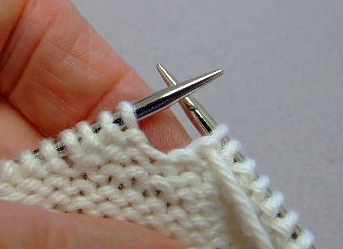
Here is the result-

Last row completed.

Try it!

Knit-tweaker

By the way,  my “Foot Glove Pattern is now available at my Etsy Store.  Just click on the “Pattern Catalogue” page for the details.

Read Full Post »

In my last post I shared with you that I was working on a pair of socks for a friend.  This lovely lady has a problem buying socks because she has extremely large ankles in comparison to her foot size, along with the fact that one ankle is 2 inches larger than the other.  What to do?  Hummmmm?????

First off, I couldn’t use my customary ” left/right toe cap” in the  “More Toes” tutorial (click my “Tips and Tutorials” page)  because of the large amount of increases I would need to accomodate the ankle measurement, so to solve that problem I opted for my “Slipper Toe Cap” pattern instead, using the width of the three middle toes for my provisional cast on ( see “Tips and Tutorials page).  When my toe cap was completed I began increasing equally on each side till the entire toe area was complete.

With the toe section finished,  I began a 2 x2 rib on the upper center instep section.  The increases from that point on were made every fourth round, one stitch in from the beginning and ending of each side of my Magic Loop NA (needle A, first half of round) and NB (needle B, last half of round).  My ultimate goal for a total stitch count was 1 inch less than the circumference measurement of the ankle.

My next task was to form a relatively narrow heel, while retaining the large number of stitches I needed for the ankle.  To do this, I planned a 3 inch deep heel.  Using half of the total stitches, in my case (52),  I began my heel by working 18 sets of short rows, leaving 16 stitches, ( or 2 inches) in the center at the turn.  Here is the result.

You can see the wide ankle stitches are in their proper place, evenly distributed to fit this special foot.

* Just a note on the placement of the heel.  Even though her foot measured 10 inches from tip of big toe to back edge of heel,  I finally got the proper fit when I planned the turn of the 3 inch heel at 8 1/2 inches from the tip of the big toe, otherwise it did not fit the heel as smoothly as I wanted it to fit.

If you will take a good look at a commercial sock, you will notice that the heel turn is NOT at the back edge of the heel, but forward of it.

Now, all I have left is a few more rounds, working stockinette only on the heel portion, then I will complete the sock with  the 2×2 rib  around the entire sock for about 5 inches.

The right foot will begin as for the left foot, except that the increases on the instep with be less, and will be spaced every 6th round.

The 3 inch heel construction will still be  needed so I will have to borrow a few stitches from the instep in order to work the 18 short row sets for the heel, but that’s OK, it will fit, and that’s what is important.

Hope this helps those of you who might have these special feet.

Knit-tweaker

If you have any questions,  feel free to contact me.

Read Full Post »

While working on a pattern for a Tabi Sock Pattern, I began to think about all the different foot shapes, heel shapes and variables there are in making a custom fitted sock.   I was especially thinking of those I know that have difficulty in finding socks that fit them.   Some just have unusual foot shapes, while others have had to deal with medical issues.  The bottom line is that they should have socks that fit them, too.  So where do they go – hummmmmm??????  Who can make socks to fit them?????

Well, to me it is a challenge, one that is definitely worthy of my time and effort.  So to that end I have put together a short illustrated tutorial to give you some ideas you might consider in designing your own custom socks, or perhaps designing some for that friend who can’t seem to find the “right” fit.  This offering is one that will be updated as I deal with different issues, but for now it covers the basics.

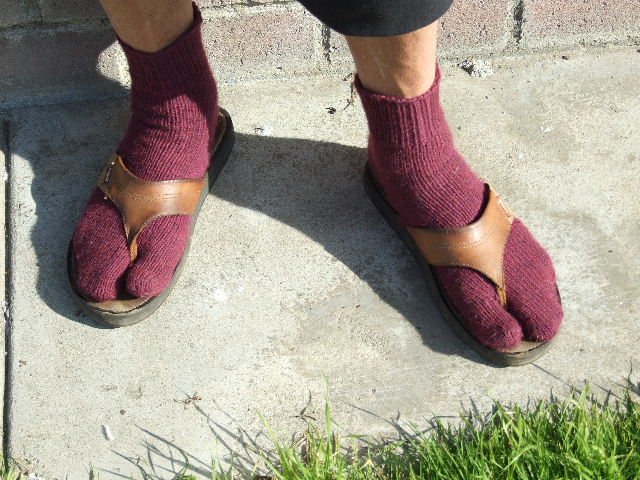
Below is a picture of the Toe-Up Tabi Socks my brother and I designed when I was in California.  His foot is a bit unusual as he has a second toe that extends way beyond the big toe.  He also has a very narrow heel and ankle.

 You will also notice that his toes set at an extreme angle, and the base of the little toe is well below the base of the big toe.

All these challenges were resolved by starting each section with the proper measurements,  knitting a Toe-Cap, and finally, shaping each section to fit his foot.  This process is described in Customizing Your Toe-up Socks

Have fun- Knit-tweaker

Read Full Post »

As I was working on my new design for a felted Chess Board, I decided to experiment on some tension issues.  Being that the felted project did not require a perfect tension, I decided this was the perfect time to try to examine different way to hold the yarn.  Now, up front, I will tell you that I have a hard time with my left hand as I am loosing the sensitivity I once had to control the yarn.  In the past I have been able to maintain even tension in my knitting simply by making one wrap around my little figure.  It worked for my single knitting, stranded knitting with both hands, and double knitting.  Now, however, it isn’t working as well, and I knew I would have to come up with something more reliable.

Below is a picture of what happened when I used my old system.

You can see the contrast between the tight and loose rows.  This causes what I call, the “wave” affect.  It is not very attractive, to say the least.

The second picture is the result of one extra wrap around the little figure of my left hand.  The tension is more even, and I feel that I am heading in the right direction.  Will it ever be perfect?  Probably not. Ugh!   But…. then, I’m not a machine.

Coming Soon!

Here is a picture of the large version of my felted/ fulled Chess Board

This board was knitted  using Patton’s Classic Wool.  It finishes to about 20 by 20.

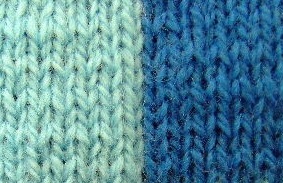
The sample at the top with the two shades of blue will full /felt to about one inch squares, yielding a board that will be between 11-12 inches square.- perfect for small Chess sets.

The pattern will include a detailed chart, and instructions.

Here is a sample of the chart.

Check back if you are interested.  I will be putting it on the shelf in my Etsy store soon.

Knit-tweaker

Read Full Post »

While dinking around with a DK(double knitting) swatch, I finally worked out a “no twist” yarn edge closure that even I can do.  Now, I will say right off that it is not a new discovery, for I am sure someone has done it.  However, after reading and watching some of the offerings on this subject, I was a bit confused.  So… I decided, that either my ears were plugged, or my brain wasn’t functioning on full tilt when I investigated the subject.

Now, that said, here is what I have to offer.

After you have your set up row in place. tie the CC(contrast color) on loosely.

Row 1. ONLY– Slip the first stitch of the DK pair knitwise.  Bring both yarns to the front. Placing the MC (main color)yarn from the first knit stitch over the yarn(contrast color) of the purl.  Lift the CC yarn, while holding the MC yarn firmly to the left.  Purl the second Stitch of the DK pair with the CC.  Bring both yarns to back.  Continue across the row, working DK pairs till you have one DK pair left.  Knit the first stitch of the pair with MC.

Drop the yarn behind your work (the green one).


Pick up purl yarn (CC)and bring it to the left, under the tip of the needle and to the front.


Purl the last st.  Turn.

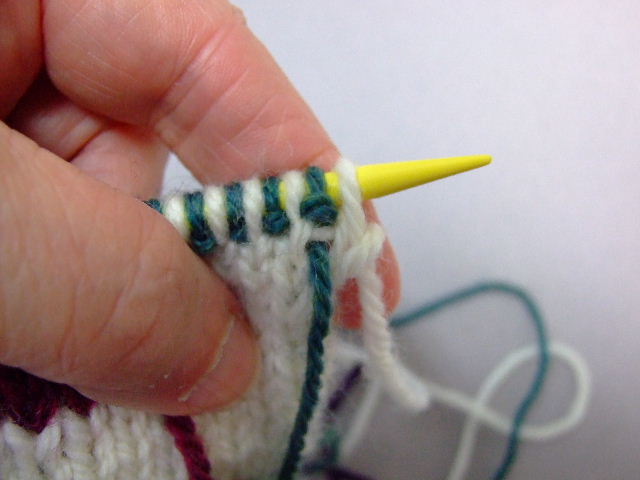
You can now see the captured yarn underneath the white bar.

Row 2–  With yarn in back, slip the first stitch knitwise.  Bring yarn to front and lay it over the needle to the right. Stick tip of right needle into purl st to left. See below.

Pick up yarn CC (contrast color)and purl the stitch.  Move yarn(green) to back.  Move MC(main color) to back.  Now you are set up to work across DK pairs.  Work all pairs to last pair.  Knit first stitch of last pair, drop yarn in back as before.  Pick up CC yarn, bring to left, underneath the needle, and forward.  Purl the last stitch.  Turn.

Row 3– Slip the first stitch knitwise, as before.  Repeat the beginning and ending procedure as for Row 2  throughout your project.  It works for me.  Maybe it will work for you.

 This make a nice slip stitch chain up the side, and secures the CC without any twisting or turning tricks.

OK, here’s the MORE part!

For the last few days I have been trying to figure out how to make a solid color band around a double knitted picture.  However that required that I have the same color yarn on both sides of the bottom, top and side edges of my project.  The bottom and top portions were no problem, as it only takes a separate strand of MC to be worked with the MC working yarn to produce the double sided solid frame of the same color.  The problem was how to connect the picture portion using two different colors to the frame edge stitches.  This method is also helpful if you don’t want all those different colors running down the trench between the two sides, causing extra unwanted bulk.

The problem was solved when I began to think, INTARSIA!   I realized that I could combine any amount of colors if I began to handle them as an Intarsia pattern.  The only difference is that I will be working both sides of the picture at the same time.  So… here’s the fix!

Here’s another of the “more” tips-

Double Knit Tension Problems

Most of the tension problems with DK seem to center around the “purl” stitch being to loose on the backside.  Practice definitely helps, but I’ve discovered that sometimes it take a bit of playing around with how your hold your yarn to tension it.  For me, (since I purl with my left hand and knit with my right hand) that means double wrapping the yarn around the little finger on my left hand.  This seems to keep my purl sitiches much firmer, and evens out my overall tension.  You might give this a try if you find you are having the same problem.

Read Full Post »

This past year I was asked by a friend to duplicate a comercial knitted sweater.  Her husband had bought it for her many years ago and it was her favorite, but as all things do eventually, it began to show its wear.  So, I bravely, but reluctantly, said, “OK!”   Boy, was I in for it! 

First off, I had a devil of a time finding a yarn that came even close to the original.  Next, I had to find a stitch that would duplicate the one used in the sweater.  After searching for some time I came across a version of the “Brioche” stitch in an old Burda book that I had.  Now, I had it made- or so I thought. 

So…. what’s the point in this post?  Just because the pattern is in a book doesn’t mean it can’t have mistakes.

This beautiful slip stitch rib pattern instructed me to, ” YO, slip purl, knit two together.”  This basic sequence was to be  repeated every row to form a reversible rib pattern that lies flat.   Well, I did that, but the first time I tried it out on a swatch, the K 2 tog would not lay open like it looked in the picture.  I knew something was wrong, so I changed it to YO, slip purl, SSK.  It worked.  I had it made-well sort of….

Now I don’t know about you but when I see instructions to YO (yarn over) before a knit stitch, I bring my yarn to the front then knit the stitch to the left.  In this case, the instructions were to slip the purl, so I brought my yarn forward and looped it around the needle as I do if the next stitch to the left is a purl.   I will have to tell you that it worked fine accept in this particular case, I had to be very careful that my YO was snug, otherwise the tension of the slip stitch was very hard to control-in other words,  it was definitely NOT a relaxed knitting experience. 

 After finally reaching the arm hole on the back, I began to look carefully, following  the yarn as I knitted,  trying desperately to fine a better way of handling the stitch pattern.   As I did, I realized that the term YO (yarn over) was in error( or at least my interpretation of it), so I tried just bringing my YF( yarn forward), slipping the purl, then working the SSK for one row.  When I turned it around to start the next one, I noticed that the two stitches that were to be knitted together were already in their proper order and I no longer had to SSK them to get them to lay open.  From that point on I was able to yf(yarn forward), slip the purl, then knit the two stitches together.  The tension was also no longer a problem, and the move set me up for the next row.   My nightmare was over.  I could finally relax and enjoy knitting the sweater.

 Why all this blather?  If the pattern you are working on doesn’t look right, it doesn’t always mean that you have made a mistake.  Your knitting instructions could have been written incorrectly.  Terms means things.  Our understanding of them is very important, and I will say that I have discovered that many have different intrepretations of similar terms.  Also as a writer, it is very easy to assume your readers know what you are talking about, and many times the editors don’t catch these things as they are not actually knitting them.    In this case the YO(yarn over) slip purl, should have been written YF(yarn forward) slip purl.   What a difference  two little letters, can make.  Had I only known I would have saved many hours of pulling my hair out. Oh, well, live and learn.

Knit-tweaker

PS:  I also had to figure out how to handle decreases, increases and proper case on for the pattern.  What fun!!!!

Read Full Post »

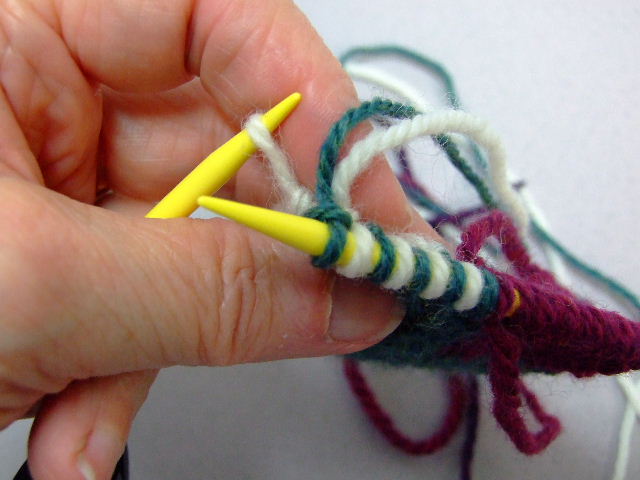
While starting my new Double Knitting project, I decided to try a new cast on method.  In the picture below you will see my two color cast on. Each color was put on by itself, producing an alternating colored edge.  I think it looks pretty cool.

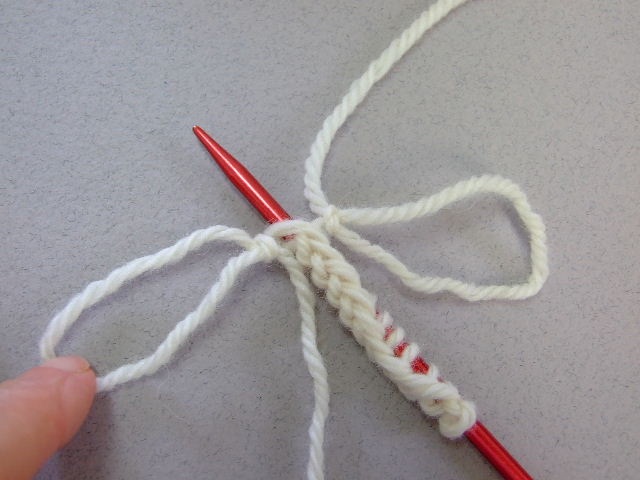
How to do it.  Using the yarn and needles required  for your project, calculate the yarn length for your long tail cast on by making a slip knot, then casting on 10 sts.  Now tie a loop at the end of both pieces of yarn.  See  picture below.

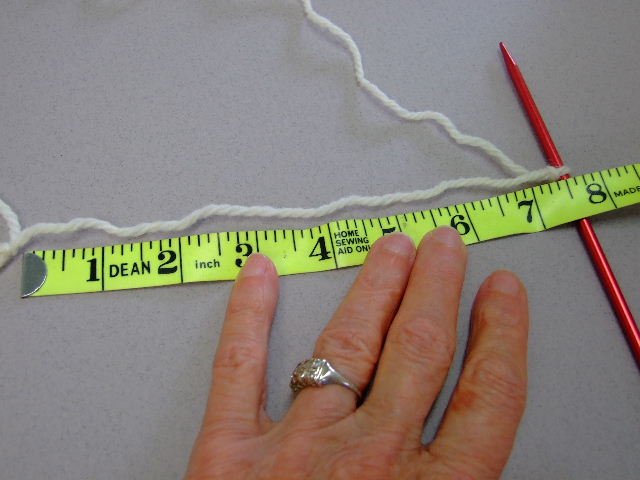
Carefully undo the 10 cast on sts, leaving the original slip st on needle.  Now measure the ( A)  long tail side.

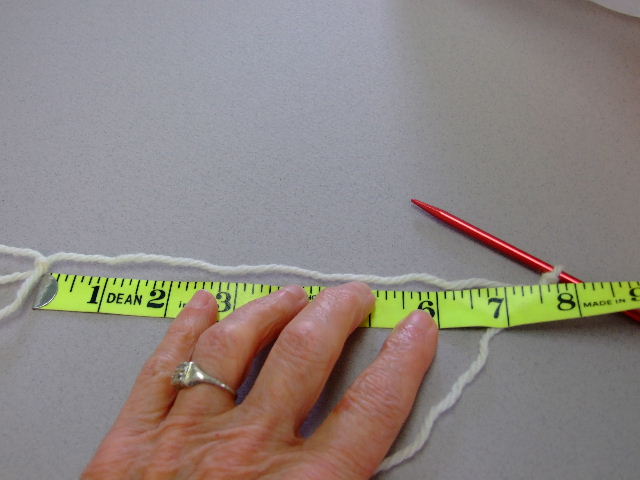
Then measure the ( B)  working yarn side (the one attached to the ball of yarn).

Here you see that the length is about 7 1/2 inches, but I will round it up to 8 inches.  Having determined how much yarn you need for 10 sts,you now can divide the number of cast on stitches required by 10 and multiply it times  the length just measured, then add about 6 inches extra.  

*You may notice that the measurements are about the same.  But don’t be fooled.  That is NOT always the case.  It is important that you write down the numbers.  On my current project, using size 10 1/2 needles, the B (working yarn) was about 1/3 more in length than the A (long tail).

Once you have determined the length of the long tail (A), peel off that length of  yarn for one color then make a slip knot.  STOP!!!!  Before you go any farther, make a loose knot in A.  You’ll thank me later.

Measuring again from the slip knot onward toward the ball of yarn, measure off the length of B.  Break the yarn.  Repeat this process with the other color, placing the slip knot infront of the first one.  Now, with both slip knots on the needle, lay out your B’s (long tails, the one’s you marked- I hope) to your left, and the A’s straight ahead.  Now you are ready to cast on.

In the video below, I will show you the move.  Try it!

Once you are finisned casting your stitches on, just spit slice your working yarn on to the ends left and start knitting your double knit pattern.

You might also like to try this decorative cast on for a Fair Isle project.

Enjoy!!

Knit-tweaker

Read Full Post »

I don’t know about you , but I hate having to purl the first row of my long tail cast on to getthat smooth looking edge on the right side of my work.  The solution- cast it on with purls.  This move requires a bit of practice, but it is easy to do and also can be used in setting up any rib pattern.  So….without further ado, and armed with my new toy (my video camera)  I thought it might be fun to upload this method for your enjoyment.  Don’t laugh.  Practice makes perfect.    I hope you like it.

Read Full Post »

« Newer Posts - Older Posts »