Feeds:
Posts
Comments

Archive for the ‘Knitting Tutorials’ Category

One of the techniques I use to shape my pillow tops is to block them on the needles.   I use the cords of two 47 inch circle needles.  Needle A, goes across the top and down the left side.  Needle B holds the stitches across the bottom and up the right side.  This allows me to use the cords as blocking rods.  Below is a picture of my latest Needlepoint Knitting pillow top.  This one is for my grandson, who is a mighty hunter. 🙂

The stitches have been picked up on the edges and are set up to knit the tubing for my corded edge.  This process is completed before I wash the top.   Notice the cord loops in the corners;  needle A, in the upper left corner, and needle B in the lower right corner.  These loops free the cord, allowing me to pull the edges straight.   To secure the pillow top in place,  I use T pins.  It works great.

When dry,  I will be knitting the tubing using the same method used for working with 2 circle needles in the round.  You can find this method by typing in “socks on two circles,” or “knitting with two circle needles,” in you search engine.   There are some good videos on YouTube.

Thought you might like to see this-thought it might be helpful.

Happy knitting- KT

Read Full Post »

Unable to purchase all the necessary shades I needed to knit up the Wood Duck pillow for my grandson, I decided to make up my own by blending two single strands of colors together.   In the illustration below, the areas where I have used the blended yarns are marked with circles of various colors.

The red circle indicates the Steel grey/ Iris heather mix.


The next combination  in the green circle, is a teal/dark green mix.


The blue circle marks the side of the body.  In this section I chose to blend the Suede color with gold.  This combination allowed me to transition to the single gold color without a definite line.

All this is to say that you don’t have to settle for the color combinations that are out there.  You can blend your own.

HOW ?

1.  Select you colors.  Peel off the amount you normally use in your colorwork ( I use about an arm’s length).

2  Separate the plies.

3.  Tie one end of the two strands together.

4.  Lay the joined end of the two strands in the palm of your left hand.

5.  Lick or moisten the palm of your right hand and rub the two strands together vigorously for about 30 seconds-

inotherwords, “spit splice” the strands together.

6. Wet your right palm again, now push down on the combined strand and roll it away from you about 5-6 time.  This sets the twist.

7.  Move the blended strand to the left, so you can work the same process in the next section of yarn to your right.  Be sure to repeat the same number of rolls when setting the twist.  Continue this process to the end of the strand.

Your finished strand should look something like this-

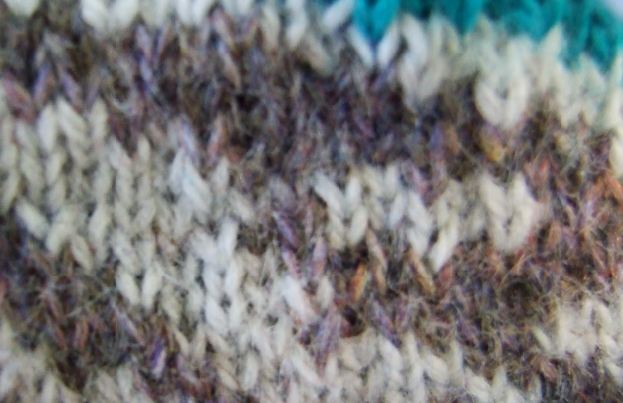
The above strand is a combination of “Pumice Heather ” and “Iris Heather.”

*  If you find an area that didn’t get twisted enough, just wet you palm and work a few more rolls at that point.

Next time you can’t find the color you need, you might try this out.  It’s fun to see what color combos you can come up with.  When I need larger amounts, I use a drop spindle to re-spin the two strands together.

Have fun- KT

Read Full Post »

It definitely is Spring around here, as the wild  flowers are blooming and the mountains are turning green.  Add this to the birds singing and the butterflies checking out the blooms and next thing you know I found myself drawing up a new pillow design of daisies and butterflies.

As before, this chart is gauged for 8 stitches and 11 rows, knitted with fingering yarn.  I will be using Knitpicks Palette yarn for this design.  The chart for the detailed crocheted lines and specialty stitches are included in the download.  The knitted cording instructions are in the PDF file listed below.

Of course, you can use the center motif on other projects.  Here is the pattern – daisies and butterfly pillow

For knitted cording instructions, Knitted Cording Instructions   This file includes instructions for joining knitted back.

Give it a try –

KT

Read Full Post »

Some time ago, in the post  incorrect-knitting-instructions/ , I described the process of  replicating a machine knit sweater for a friend.   It has been two years in process, but today I finished it.  That being the case, I thought I would post some of my “lessons learned” working with the Brioche stitch.

First of all the, TADA!!!!!  Here it is-

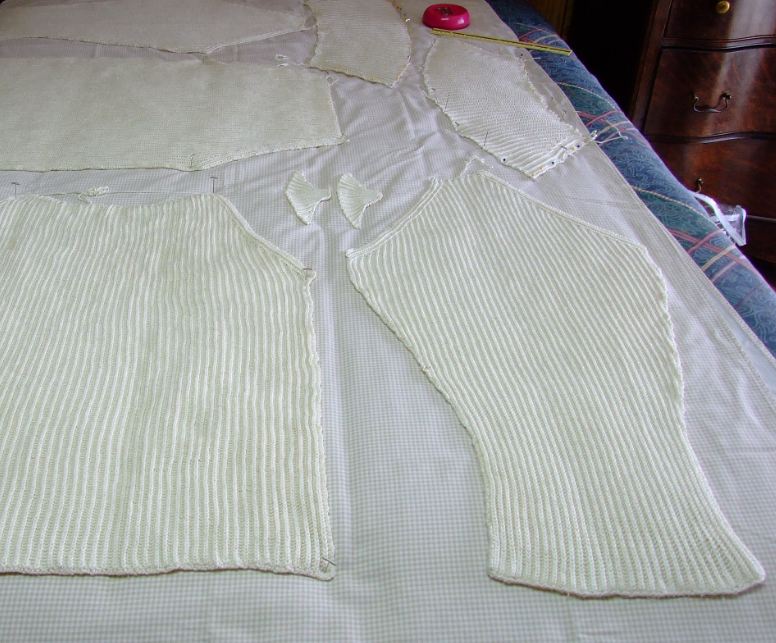
Remember, I had no pattern, just the sweater, so my original task was to draw the pieces, make them, then put them together.  Praise God, it fits her perfectly!!!!

But, I digress!  First lesson

The Brioche stitch is very stretchy, and is even more so if you are using a stretchy yarn.  I selected Knitpicks Comfy cotton because it was the closest yarn to the original.  However, since cotton gets softer and more pliable with washing and wearing, I found I had to stabilize the collar, and the bottom and cuff edges.

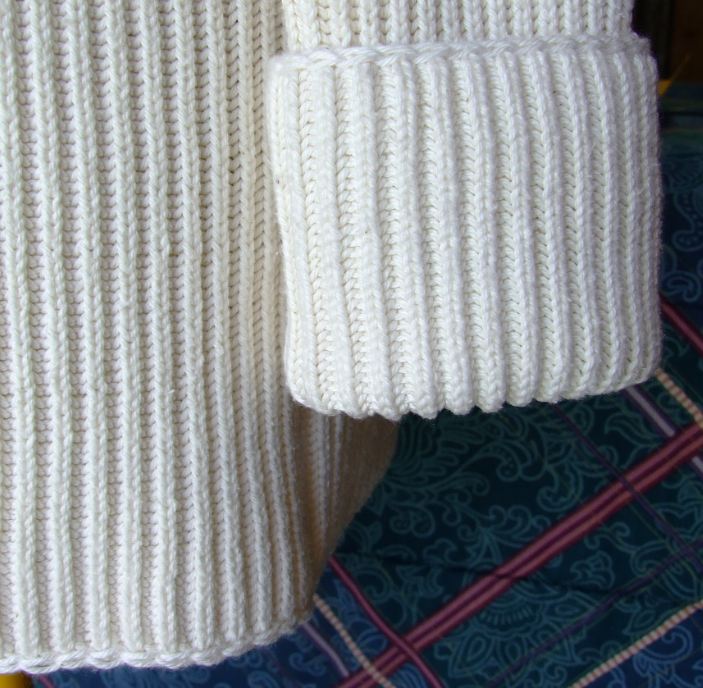
To stabilize the bottom edge, I began by running a waste yarn through the stitches close to the bottom edge.  After adjusting the size as desired, I secured the waste yarn with T-pins.  Next, using the working yarn, I used a crochet chain, looped horizontally across to hold the edge in place.

The above photo is of the bottom edge of the sweater.

Here is a photo of the finished product.  You can see it makes a beautiful decorative edge for both bottom and cuff.

Stabilizing the cowl collar–  To make the collar stand up above the neck edge as it is suppose to, I ended up running several strands of yarn through the underside of the last inch of the collar closest to the neckline.  That is what they did on the original  sweater-now I know why.  It was the only thing that worked.  My only other option was to run a horizontal crochet chain along the same route, but I opted for the single strand as it added less bulk.

Lesson 2 – The best cast on, at least for this project, was the Italian invisible cast on.  The only change I made was to use one size larger needle to make the original cast on.  Then I switched to my #2,  to do my set up row for the Brioche stitch.

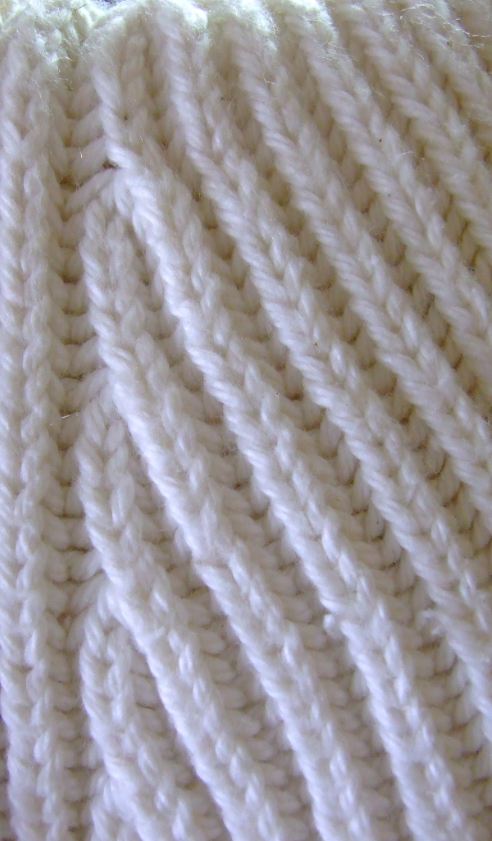
One note I must add.  Be careful to make sure your stitches are in the proper position when you turn to start row two.
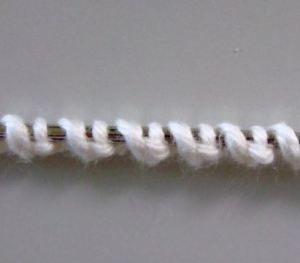
Make sure to straighten them out by rolling them away from you.  They should look like this, before you start your second row, or your full Brioche stitch row.  You will note that all the YO’s are leaning to the left.

Lesson 3-  I tried several different seam closures before I settled on crocheting them together, stitch for stitch.  Yes, I tried the mattress stitch.  In fact it was my closure of choice, but it didn’t do the job on this sweater.  I also opted for two ply of the four ply yarn, to do my crocheting with.  It worked well- less bulk.  The sweater was heavy enough, no since to add more weight.

Lesson 4–  Instead of using single decreases,  I used double decreases on each side to establish the shape of the cowl collar.

 This made another attractive addition to the sweater.

Lesson 5 –  I washed my sweater pieces before I put the sweater together.  It was kind of scary, but since I had knitted a swatch of the pattern and had washed and dried it, I thought I might as well give it a try.

I actually cheered when they all came out as I had planned.  Whewwwwwww!!!!  I almost couldn’t stand the excitement.

Although I never thought this moment would come, I am glad I made the attempt to take on this project.  My friend is happy.  I’m happy.  And….. I learned a lot.

Just thought I would share-

Knit-tweaker

PS-  It also made me finish my dress form.  It is made by putting on a tight T-shirt, and having some one cover you with blue masking tape.  Be sure to wear the under garments that you would wear under  your clothes.

Once done. you cut down the back.  Tape it back together, put a large plastic bag in the inside and start filling it with Fiber Fill, until you have a solid form.  Mount the bottom on a heavy cardboard cut to shape.  Cut a hold in the center to fit on your choice of Tripod or holder.  My sits on a Tripod light holder.  The rod runs up the middle and has a piece of board the width of my shoulders, screwed on the top.  This board hold the body up on the Tripod.   This form is the REAL YOU, whether you like YOU or not. 🙂

Read Full Post »

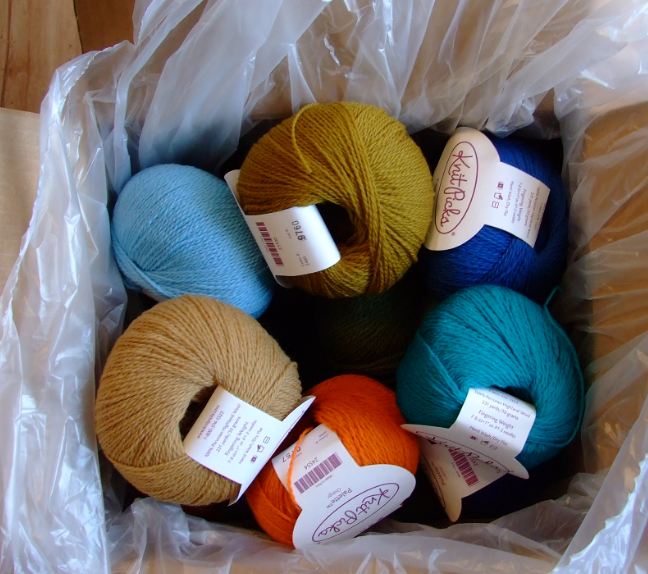
Yesterday, I received my order from Knitpicks.   The box contained all the yarns I had recently ordered for the next two pillow tops I have planned.


As you can imagine from my previous posts on ” Needle Point  Knitting,”  I have drawers of Palette colors at my disposal.   So here I sit with still more to stuff in the corners.   But…. this time I am going to be smarter than before.  I have decided to catalog all my colors.  Why?  Using Pattern Maker to create my pillow top charts, requires that I choose  DMC colors for my palette; therefore, I need to be able to cross reference the colors available to me in the selection of Knitpicks “Palette” fingering yarns.    With that in mind, I took the time to make my life easier by taking care of the issue TODAY.

To get started, I picked up a couple of pieces of card stock, grab the scissors, and some school glue.  Next, I pasted some index cards on the surface, one for each category of the main colors, such as browns, reds, greens, etc.

As you can see from the photo, I  wrote the name of the color on the left, and pasted a double strand of yarn to the right of it.  The next step was matching it to the DMC chart, and writing down the number of the corresponding color.

I will tell you that you won’t be able to match them all, but you will be able to match them close enough that when you select the colors to use in PM, what you see will be very close to what you get.

I know this takes a bit of time, but it is well worth it.


Happy Knitting – KT

Read Full Post »
I can see from the response to my last post, that I need to write up separate instructions for this process.  This knitted cording can be done on any pillow you are knitting.  Even though I have assembled it with a cloth back, you can make a tubing for one with both sides knitted by incorporating the pick up stitches from the knitted back with the purl bars picked up in closing the tubing as instructed in the tutorial.

However, another option uses the double knitting technique, and a Kitchener stitch closure.  I will work out a tutorial for this soon, as I have a heart shaped pillow planned and this one will require a knitted back.

Knitted Cording Instructions


The next addition to the “Wild Life Series” is a Wood duck.  Vibrantly colored, with defined color changes, it is one of my favorite patterns.  I will be using different stitches to add texture and detail to the finished piece.  My yarn is ordered and I am anxiously waiting it’s arrival.

Hummm…..??????  I wonder what color border I should put on this one?

 Happy Knitting!

KT

Read Full Post »

I just finished another Whitetail Buck pillow.  This one has a knitted cording incorporated into the pillow top, along with the seam allowance to help in sewing it to a cloth back.   I even made my own cording.  It was fun!

The picture below is a “snip-it” of a section of the cord that frames the pillow.  Here you see it in contrast with the cloth back.   I have to say that there is no comparison to the commercial cording available.  I have tried finding complimentary edging for this use, but have always been disappointed.  The fillers they use are mostly cotton, and seem lumpy at best, not to mention that they take a much longer time to dry.  That is why I decided on this approach-make your own.  In addition, there is no better match in color than the actual yarn you are using in your project.

I will be adding this pattern to the Pattern Catalog page, so feel free to upload it.  The pattern contains 18 pages of detailed charts and instructions.  You can use Intarsia, Armenian Knitting, and sections of Fair Isle in this project.

The Basics

1.  Knit the Basic chart.

2. Identify and secure all loose stitches

3. Weave in the ends

4. Block pillow top on needles (This works great!)

4. Pick up stitches to begin tube for cording

5. Knit tubing

6. Close tubing, and make button hole opening for cording.

7. Knit seam allowance

8.  (opt)  Secure pillow top to woven fabric.

9. Prepare fabric back, and sew to pillow top, make cording.

10. Insert cording.  Stitch pillow close.  Adjust cording.  Close cording opening.

10. Decide on some of the options I have for making the pillow cover removable for washing.

The pattern walks you through all the above issues.  Wow!!  And that ALL???  I’m tired just making the list.  But trust me, it was worth it.  My friend Deb at Tempting Tangles ( see link on side bar) has given it her approval.

 You will also be given instructions on making your own cording out of poly quilt batting, which, of course, makes it lighter, and easier to dry when washed.  This particular pattern is backed with fabric that has been pre-washed, so the entire pillow can be “dunked” in Wool wash, squeezed out, then air dried without much fuss.

My hope that you will try your hand at color knitting.  I also hope you will take a look at my “Painting with Yarn” E-book when it comes off the press.  The book contains all my color knitting experience on this project, along with detailed illustrations and how to’s, or what I call, “Technical Tutoring.”  I hope to have it available for you soon.  Would you believe it, I am already up to 60 pages!

As a side note, I will be uploading a couple of new tutorials on my “Multi-color Knitting Tips” page.  Check them out.

Happy Knitting!

KT

Read Full Post »

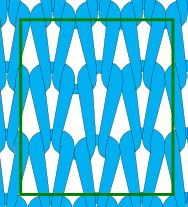
I don’t know about you, but no matter how good of knitter you are, once in a while there will be a stitch that just doesn’t look right.  In fact, it stands out like a sore thumb, but you can’t figure out what’s wrong with it.  Case in point, is the knit stitch that leans to the left or right, ruining your lovely Stockinette stitch pattern.   Below in the green box is an example of what I am talking about.

You will notice that one stitch is leaning slightly toward the right, and is not in a straight vertical line with the others.

When I first noticed this issue, I  wasn’t quite sure what was going on, but alas, the light went on and, “bingo,”  I had it.   As I looked closer at the stitch I noticed that when I had knitted it, my needle had barely( and I mean barely) split the yarn of the stitch in the previous row.   You would think that just a few hairs, or fibers couldn’t possibly have this much affect on the surface of a Stockinette pattern, but it does.   It stands out for all the world to see.

I my case, I was able to free the fibers with the point of my needle without having to take out several rows, but in most cases a re-do is in order.

So if you see one of these “leaning stitches” in your work, you might consider the above cause, and check it out.

One of the ways that I have learned to avoid this problem is to knit “steel to steel.”  What’s that?  When I put the point of my right needle into the stitch, I make sure that it comes in contact with the left needle, then I let the tip “ride” the surface of the left needle, under the belly and out the other side.  By doing this I have almost eliminated the split yarn problem.

Ever striving for perfection-

KT

Read Full Post »
The most beautiful knitted or crocheted work, is one in which the stitches are all the same size, and that goal is always before me whatever the project I am working on.  I know that I am “knit-picky,” but that’s just the way I am.  I even notice the uneven stitches in the photos in my knitting books, and wonder why they chose to use the picture.  I guess some people just don’t notice it like I do. That said, I thought I would share a tip or two on adjusting the tension in loose stitches without pulling out your knitting.

Adjusting Loose Stitches in Intarsia

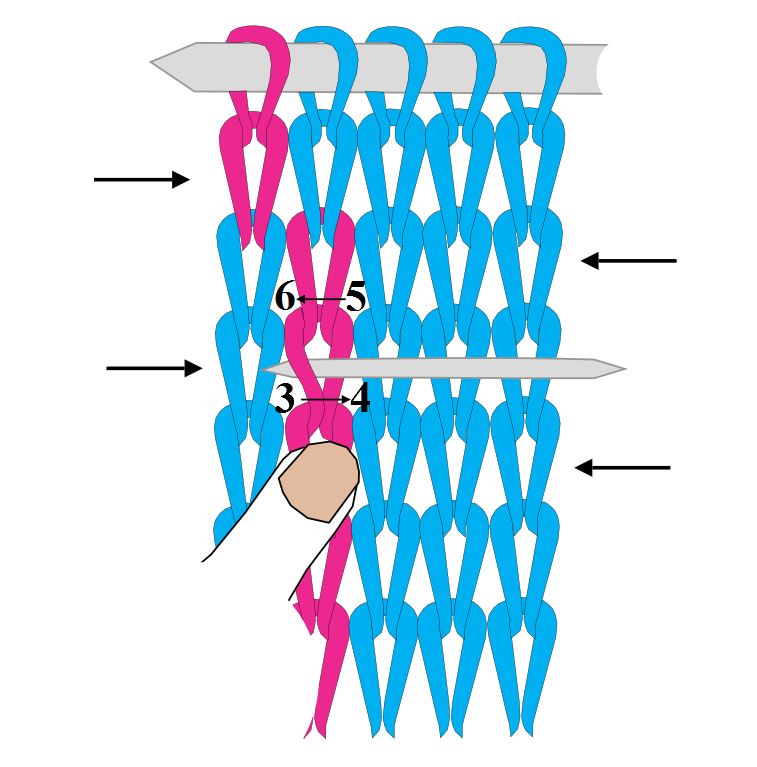
I am going to share this technique with four illustrations.  In the first one below, you will see the loose stitch in a green box.  Counting down from the top row(the working row) you will see that the stitch was created in a “knit” row.  That means the right leg of the stitch must be lifted first (see #1).

Once you have taken up the slack, lift the left leg (#2)of the same stitch, taking up the slack as before.  Now, place your thumb on the stitch to prevent the yarn from slipping back.  Next, you will move up to the purl row, and begin by lifting the left leg of the stitch (#3).

Once you have taken the slack out of #3 and #4, move up to the row above and take the slack out of #5, beginning with the right leg.  Take the slack out of 6, as indicated in the illustration.  Don’t forget to place your thumb on the stitch when you are through adjusting it.

In the third illustration, you will see that I have move up again. However, this stitch is off to the left. Does it matter?? NO!!  The procedure is the same.  Because it is a purl row, you will begin by lifting the left leg of the stitch first(7).  Next, lift #8, taking out the slack.

Now that you have your slack yarn pulled up to the row you are working on, you can pull the rest of the extra yarn out by giving your working yarn a tug.

This technique works especially well when knitting an Intarsia design.   You can work across as many stitches as necessary.  Just remember to determine which direction the stitches were created with first, knit or purl.  You can also work across a row to the nearest color change and take up the slack yarn on the back of your work.  I will illustrate that in the E-book I am writing on “Painting with Yarn.”

Happy Knitting – KT

Read Full Post »
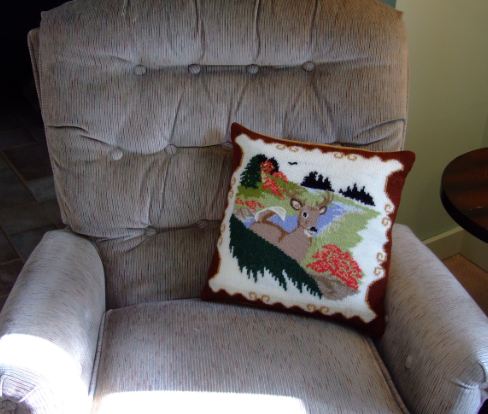
I finally finished the pillow.  Even though the stain I discussed last post is still there, it looks quite nice now that it is finished.  I put a fabric backing on the pillow, but will be using a knitted back  for the 16 inch version.

Here it is -flaws and all


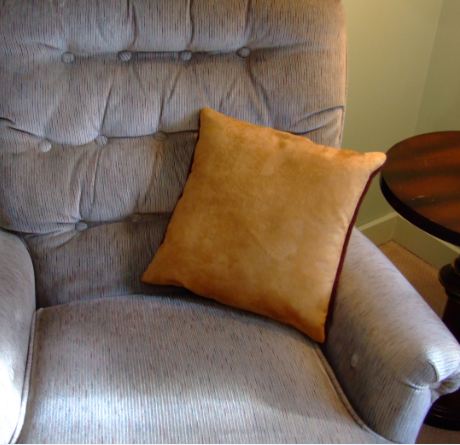
I found this lovely washable brush suede at Joanne Fabrics for the back, but before I could do that I had to do some prep work.

First, I select my gold yarn, as it was the closest color to the fabric I had chosen.  Using it, I knitted 4 rows around the pillow, adding one stitch each side of the corner stitches, every row but the last.  After binding off the gold, I steam pressed it out so that it would lay relatively flat.


During the steaming process I made sure that my pillow measured 14 3/4 inches square.   Next, I took a square piece of heavy bleached muslin,(slightly larger than my pillow), and beginning  where the two edges of the squares met, began to pin them together using the line created at the beginning of the salvage edge.

When the pinning was done, I chose a gold sewing thread and stitched through the layers.  That stitching line was my guide when I was ready to sew the fabric back on to the knitted front.  I hand stitched the bottom together after inserting the form.  I have to say that this particular pillow form has a lot to be desired, as the corners were not stuffed very well.

For those of you who might wonder, I did try put a cording on it, but it was not as attractive as I thought it might be.  A knit covered cord might work-I will try it next time.  I also decided not to put a zipper or Velcro closure in the fabric back, as all the parts of the pillow are washable in cold water.  I have found the my Tropicana Rose Pillow washes beautifully right on the poly filled pillow form.


Just an update – KT


Read Full Post »

« Newer Posts - Older Posts »