Feeds:
Posts
Comments

Archive for the ‘Uncategorized’ Category

As I was working on my lastest Intarsia pattern, I did some experimenting with duplicate stitches.  I found that when it comes to “smoothing out the curves”  most of the time I only needed to cover one leg of the stitch, NOT BOTH.  This “half” duplicate stitch does not add a lot of bulk to your project, as does crocheted chains or regular duplicate stitches, and it retains the intregrity of the knit stitch.

Below I have illustrated the process.  Give it a try.

You begin as you would for a regular duplicate stitch, bringing your yarn up through the desired stitch.  Next, follow the green arrow,  sticking your needle down over the bar, and pulling your yarn through to the back between the two stitches on your right.

 Here you seen the results.

Work in the opposite direction, if you want to slant a half duplicate stitch to the left.

Below is a photo of the results in the real world.

Happy knitting!

Knit-tweaker

Read Full Post »

This last month as I began working on my Wildlife series I found myself back in the mood to paint some more yarn pictures.  The White Tail Buck motif spurred me on, so here is #2 in the series- I just couldn’t put it aside.  I’m on a roll!!!

I realize that the digital renditions are not the real thing, but it does give one the luxury of seeing what the finished work will look like – almost.  It also gives me an opportunity to judge the balance, and color combinations; besides, never in a life time could I knit up all my ideas, I would have to live to be 200 plus.

All the charts in this pattern are detailed.  They include many variations and applications for you to consider, along with instructions for the special stitches I use in the finishing details.

The charts can be applied to the front of a sweater (Eagle motif options), incorporated into an afghans design (sportweight) and adapted to needlepoint project.  This particular pattern is charted for 8 stitches and 11 rows using a #1 (2.5) needle, knitting with fingering yarn, but I always include the charts for sportweight yarns as well.  All of the patterns are set up for knitting, thus the grids are composed of  rectangles, not squares. There is also a cameo grid applied to each version, which is one of the many options available.

The main pattern is set up for a 14 x 14 and 16 x 16 inch pillow tops, however, I always knit the whole pillow, (see my Tropicana Rose design in the pattern gallery)- I love using texture stitches on the back.

Bottom line for me is the artistic creation.  It’s been great fun, and very rewarding.

Pictured below are version I and II

 “Majestic Eagle”

  It will be on the shelf soon.   I hope you like it!

Happy Knitting!

Knit-tweaker

Read Full Post »

I got a wild idea yesterday as I was working on my designs for my double knit afghan, and thought I would share it with you.

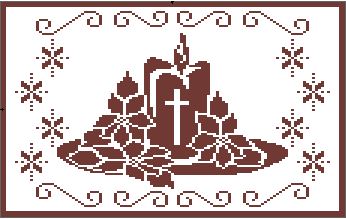
Here is my Christmas Placemat design.  It measures about 19 by 13 1/2 inches.  Each mat requires 2 skeins of each color of sportweight yarn.  The gauge is 6 stitches and 8 rows per inch( my gauge).  I also have a chart for 6 by 9, if you need it.

You can obtain this pattern on my Pattern Catalogue page.

Just had to get this to you now, as the holidays are just around the corner.

Happy knitting –

KT

Read Full Post »

I recently shared with you plans for my “Idaho Memories” double knit afghan, and as I was writing up the pattern this week,  I decided that I might offer you some of the charts.  All of them can be used for other projects as well.  Simply changing the yarn weight, will size them down or up as all the charts are designed specifically for knitting.  These specific charts are gauged for 6 spi,(stitches per inch) and 9 rpi (rows per inch), and 6 spi and 8 rpi.  Why the second set?  I don’t know about you, but when I double knit my row count is less.  So  I offer you both sets of charts.

Do your swatch then pick your chart.

These blocks can also be made into pillows, and knitted with Fair Isle or  Armenian knitting methods.

I apologize for the picture, but I was not able to load a larger version.  You can click on it and save it, or use your “snipping tool” to make a copy then enlarge it on your computer.

Anyway…………..,  I was just thinking that you might like to have some of these charts to make your own afghan or a pillow for that someone special for Christmas.  I have created a PDF file of some of the charts for you to download.  Enjoy!!

Memories Afghan Moffit Charts – 6 by 9

Memories Afghan – 6 by 8 charts

Yarns estimates – 15 skeins of sports yarn for each color

Size #4 circle needle  ( 6sts per inch)

Have fun-

Knit-tweaker

Read Full Post »

I have been working on the idea for wildlife designs for Ski sweaters for some time now.  My inspiration for this particular series was the gorgeous change in foliage, harvest time, and “buck fever.”  Yes, in Idaho, Camo gear is the fashion of choice this time of year, as everyone and his brother is hunting for that vension or elk back strap steak to put on the table.

So… with all this in mind, my first set in the series is my “White Tail Buck” combo to use on a sweater for your favorite hunter.  Below is a peak at my digital finished sweater.

I am designing these sets to include charts for bottom borders, shoulders, and Intarsia chest scenes. The gauge is set up for sports weight yarn, but you could use them for fingering weight as well,  the patterns would just be a bit smaller..   Of course all these charts can be used for other things, such as pillows, and socks.(especially the Squirrel border).

I have had a great time creating these, and hope you will enjoy them too.

The method combines Intarsia (in the round), and Fair Isle.  I will include the how to’s and all special affects instructions in the patterns.  The patterns will also include the basic structure of a Ski sweater and application variations.

I originally opted for selling these motifs on Etsy, but since then I have opted to share them with you at  not cost.  If you are interested, email me (see contact page).

Happy knitting-

Knit-tweaker

Read Full Post »

In the last few days, since I posted a snip-it of my afghan design, I have been taking a good look at the pictures I charted.  Then the bright idea came to me that I could use these same picture charts for my ski sweaters or pillow or, etc.  Hummmmmm????

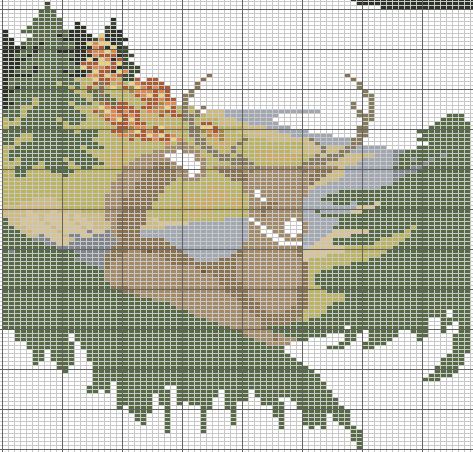
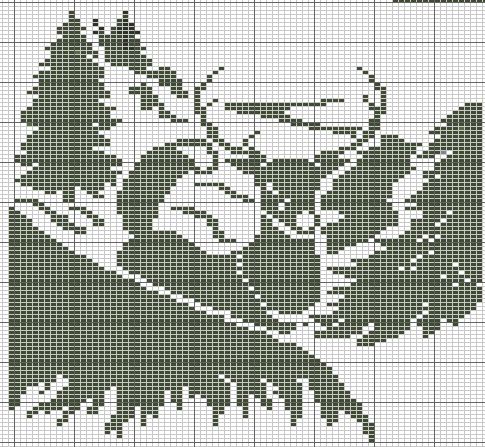
Going one step further, I started with my “stag,” turned him into a white tail buck, then began creating a scene to surround him.  That done, I then thought I might try using the same chart, but doing it in only two colors, which would be great for a double knitting pattern as well.

Below is the result.

This second chart began with the picture  above.  You will notice that it has been simplified, and color has been removed around the objects of most importance.  I decided not to extend the creek behind the buck as it was made the area to busy.  Here again, it is a matter of taste.

This chart is perfect for a DK project, or a Fair Isle knit.  As I told you in the last post, I make all my charts with Pattern Maker.

Although these are MY original designs, I give you permission to use your “Snip-it” tool in Windows to save and study these charts on your computer.  I actually use this wonderful tool to make a pictures of my charts, then insert them in my publishing program (I use Serif) and play with their arrangement.  This technique gives you the ability to see your idea in a completed format, allowing you to change whatever you like before starting on the real deal.  It takes all the guess work out of it- well, most of it anyway.   AND, it’s FUN!

 Thank you God for Pattern Maker!!!

Knit-tweaker

Read Full Post »

For  about a year I have been mentally trying to put together my ideas for an Afgan that would depict some of my fondest memories of living here in Idaho.  It would, of course, have to include the wildlife, Christmas in the snow with the grand kids, and scenes of our beautiful surroundings.  All these thoughts came together this past week, and I spent 3 days drawing the picture motifs, using Pattern Maker ( a cross stitch software program); by the way, this program works great for charting knitting, too.

My building block for this project was a 12 inch motif framed with maple leaves (from the tree in our front yard).  From that point on it was simple a matter of inserting my picture ideas into the center of the block, and saving each block into a separate file.  Below is a picture of a portion of the Afgan chart.

This Afgan with be 5 blocks across and 6 blocks long, giving me nice size reversible double knit blanket, in cream and burgundy.  Now all I have to do is knit a swatch, calculate the yarn required per stitch and I am on my way.

So…… why did I post this?  Just sharing an idea, hoping it might spur someone to do a similar project.  Hummmm….. what do  you think?

Here is a PDF file of the final digital results – Idaho Memories Afghan

Do check out Pattern Maker, and if you are interesting in doing a project like this, I will be happy to help you get started.

I estimated the yarn requirements at 15 skeins of sports yarn for each color on a number 4 needle (6 sts per inch).

Knit-tweaker

PS. For you experienced “charters”  this is just a pictorial chart of the desired results, my knitting charts are set up to match the gauge.  I also do this with Pattern Maker.

Read Full Post »

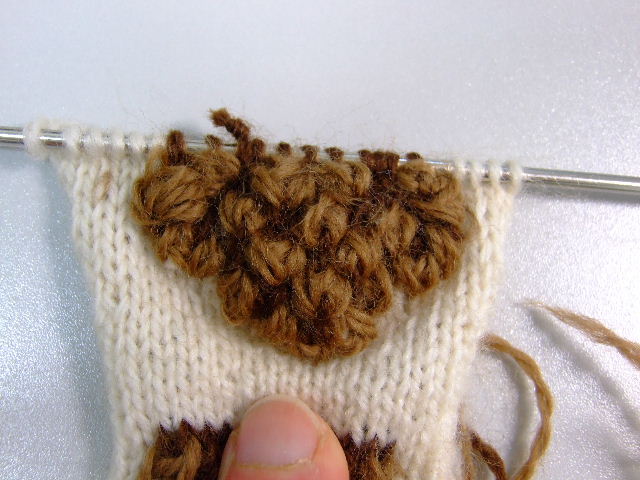
While working on a new set of moffit designs for a Ski Sweater, I decided to include a pine cone in my winter scene on the chest area.  To make the pine cone 3D, I used two tones of brown yarn, light brown for the tips of the seed and a darker brown for the inside portion.  You can see the results below.

Here is a photo of my “pine cone” bobble.  It uses the two colors I mentioned.

The Pine Cone Bobble
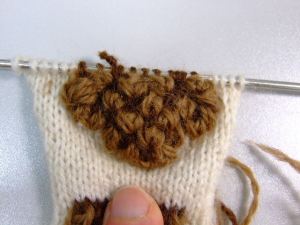
Unlike the normal method of making a bobble, each bobble is completed in one row and in one stitch.  You can vary the size of your bobble by simply adding or subtracting the number of loops picked up in the base stitch.  These bobble can also be made on knit or purl rows.  The method I use for making the loops is K 1, YO, K 1; or P 1, YO, P 1.

To make this bobble,using the light color,  pull up the number of loops desired (I used 5 here, 3 loops allows more of the dark color to show through), leaving the original stitch on the left needle, bring the second color(dark) under the first (as in Intarsia) and knit in the back loop of the stitch.  Next, using the tip of your left needle, lift all the light colored loops over the top of the dark colored stitch.  Now, knit at least one dark stitch before you make another bobble.  That’s it.

By varying the stitches (dark color)between the bobbles you can create the appearance of the closed or open cone, as cones open in response to the moisture in the air.   And.. in this case, at least, you are the weatherman.  Experiment!  Play a little!!!

When my winter moffit set is complete I will let you know.  It will be added to my “Patterns” page and will be available in my Etsy Shop.  The moffit set will include a chart for the bottom edge of sweater and sleeves, using Fair Isle, an Intarsia design for the chest area, and an combo of Intarsia and Fair Isle for the shoulders and top of sleeves.  I am very excited about it, and can’t wait to share it with you.

The Leaf Bobble

In the photo above, I used my “Cable Chains” (see my tutorial) to create the stem and a (special) bobble to make the leaf.  You will notice that the leaf bobble has been cabled to the right.  Cabling this bobble to the right or left during the 6 row process allows you to shape the leaf anyway you want.

To make the leaf bobble ,beginning on the knit side

Row 1 – Pick up 7 loops of green.

Row 2 – On the next purl row, slip all the green loops, cabling them in whatever direction you want your leaf to lie.

Row 3 – Divide the bobble into 3 parts as follows:  SSK 3 loops, K on loop, K 3tog.  Finish row .

Row 4 – Slip all loops (here again, cabling them in whatever direction you want this portion to go).

Row 5 –  Knit all three loops together.

Row 6 – Slip the single leaf stitch left and  cable leaf in whatever directions you want it to lean, and purl it with the background color.

Make a swatch and try it.  Once you get the hang of it, you can put them anywhere.

The neat thing about the”bobble” is that you can vary the length of your loops, carry (or slip) them over more than one row to elongate them, divide them, as in the leaf above, and cable them to make various shapes.  It is fun, and will peak your creative juices to find more ways to use them than I will describe here.

Have fun – Knit-tweaker

.

Read Full Post »

I just finished the Tabi Sock pattern (unisex) and have it available on my Free Pattern Catalog page.   This Tabi sock pattern knitted from the toe-up is constructed using Magic Loop method.  The pattern has detailed instructions, and illustrations, and will be accompanied by the necessary tutorials for your convenience.  Once you have the concept, you can design your own Tabi’s, as plain or fancy as you like.  With the necessary proper measurements done, all you have to do is apply your gauge and away you go.

One exclusive feature of my sock patterns is the toe shape.  I like my socks to “fit.”  For this specific sock, that means that I want the four toe section to fit perfectly, no wrinkles, no gaps.  In this pattern I will illustrate how I make the adjustments needed to help you fit your toe shape.  One of the concepts I introduce in this pattern and in the Foot Glove pattern, is called a CTF (connecting toe fan).   This little addition provides added comfort between the toes and conforms more closely to the actual foot shape where the toes are attached.

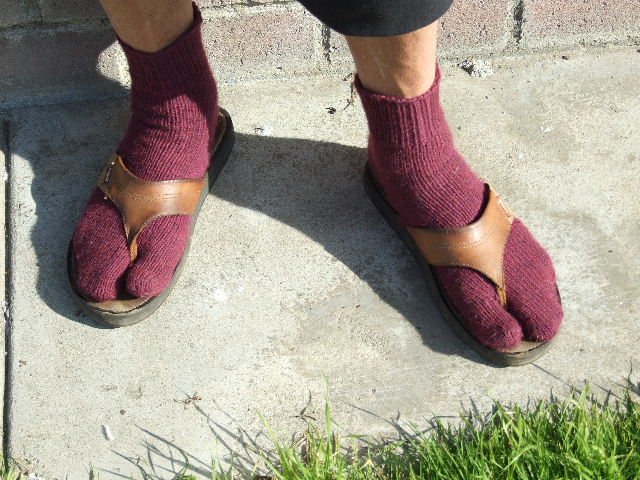
The picture below, is of my brothers Tabi socks.  These are done with Sports weight yarn.  With this pattern you can do either fingering yarn (my favorite) or Sports weight.

You can see in the picture above that my toe shape is intirely different than his.

Some might think my patterns are a bit lengthy, but, I like to draw, and love working with my camera.   It is very important to me that you understand the reasoning behind the instructions.  Why?  Because I am one that learns better by doing than by reading.  I need pictures.  I need to know the concept.  Once I do, then, look out!  Get out of my way!  I’m coming through!!!

The creating process is fun for me- it’s not work.  So bear with me, you’ll have to get use to the 15-20 pages of detail. 🙂

Knit-tweaker

Read Full Post »

Most of the time, when one thinks of short row closures,  it means making the turn to complete the diagonal seam in a sock heel, or toe.  However, there are times when short rows are used to add shape or a rounded extension to a garment, or hat, like in the pattern for the Mock Tyrolean offered  on my “Pattern Catalogue” page.   The instructions for these types of short rows often involves a wrap, made around the adjacent stitch during the turn.  I have tried this method, but was never pleased with the result, so I thought I might share the process that I use to accomplish the task.

To do this we will start with a swatch-my favorite practice tool.  Use whatever needle and waste yarn you have available.

First, cast on 30 sts ( I used the purlwise longtail cast on).

Row 1.  Knit across.

Row 2.  Purl across.

Row 3.  Knit across.

Row 4. Purl across until there are 3 sts left on LN.  Turn.

Row 5.  YO, knit across until there are 3 sts left on LN.  Turn.

Row 6.  With yarn in back,  purl.

Keep the single YO, and first purl snug.

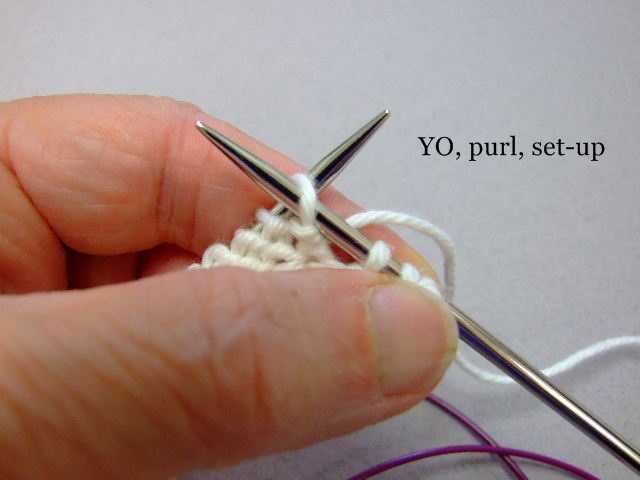
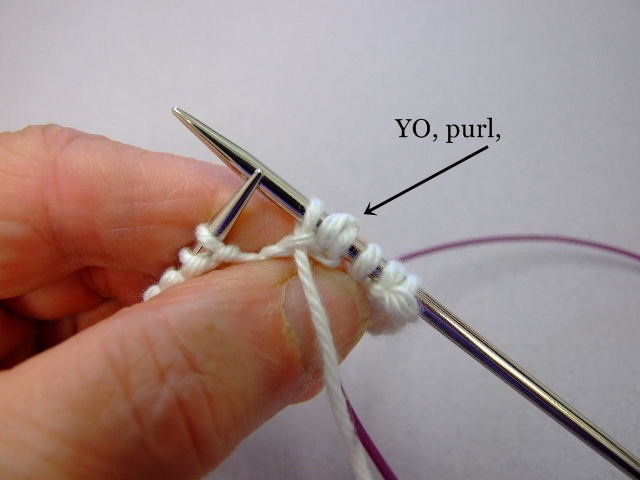
 Now, continue to purl across until you 3 sts before the first YO on the LN ( 7 loops).  (See picture below).  Turn.

Row 7.   YO, Knit across, until there are 7 loops on LN, including the YO.  Turn.

Work back and forth in this manner as many times as you like, ending on the purl side.  Turn.

I worked until there were 9 sts left in the middle.

Now I am going to show you how I close those gaps.

Knit across to the first YO.  Slip the YO knitwise, place it back on the LN (left needle) and knit it together with the knit stitch on the left side of the gap.  Continue across knitting the next 2 stitches.  As before, slip the YO knitwise, return it to the LN, and knit it together with the stitch on the left side of the gap.  Work to the end of the row closing all the knitside gaps.  Turn.

Purl side row.  Purl across to first YO.  Slip the YO onto the RN through the back loop (twist it), purl the YO.  Slip the purl to the left, knitwise, place it back on the LN.  Now slip the new purl stitch made in the YO back to the LN.  Pass the stitch to the left over the stitch on the right.  Return the new stitch to the RN.

*This move sets the knit stitch on the right side over the YO.

Work purl side, closing the gaps as instructed above.  Turn.  Now knit across.  Place your stitches onto a piece of waste yarn and view your results.  I think you will like it.  One of the key things to remember is to keep the YO and first stitch very snug.

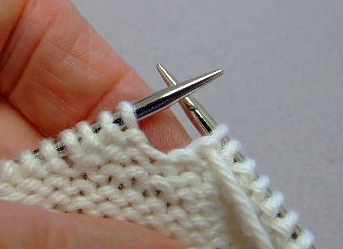
Here is the result-

Last row completed.

Try it!

Knit-tweaker

By the way,  my “Foot Glove Pattern is now available at my Etsy Store.  Just click on the “Pattern Catalogue” page for the details.

Read Full Post »

« Newer Posts - Older Posts »