Feeds:
Posts
Comments

Archive for the ‘Knitting Projects’ Category

As I promised a while back, I have been working on a tutorial that gives you the process of how to work with the Cable Chains to make a diamond pattern on a flat surface.  Why?  This great little stitch opens a world of possiblities for design.  Once learned, this particular pattern can be applied to sweaters, scarves, socks-  you name it. 

 I am in the process of developing a line of 16 inch  pillow designs using these and various other unusual stitches.  When I am ready, which I hope will be soon,  I will add a page entitled “The Design Gallery.”  If you are interested, you will be able to check there for the available patterns and contact me directly if  you wish to purchase one.   All the tutorials for these designs will be free.

This offering is a practice piece, similar to the Wandering Chains tutorial,  accept that it is a little more complex, and it is more geared toward the other designs I have in mind. 

 I don’t know if you checked out my post on ” Painting with Yarn,” but if you have, you saw the Iris Motif I designed.  That particular piece is one that will be included in my pillow collection. 
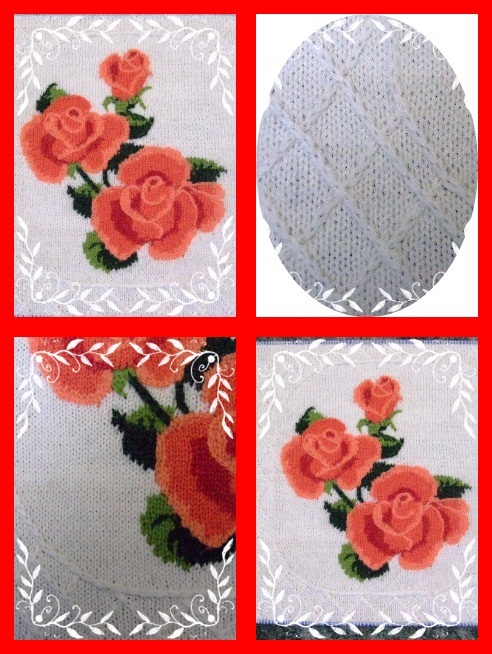
                                                                                                                          

Also, included in this collection, will be my Tropicana Rose design, pictured on the left.

For now, we will call this offering an introductory sample.  or….., perhaps, something to peak your creative juices.   Or….. , well….. something like that!

I hope you like it.  One more thing-you don’t have to do the letter in the middle, you could put whatever you like in it’s place.

 I have included a chart  in the tutorial, that will give you a visual layout, and have tried my best to walk you through the process with pictures and illustrations, along with written  instructions, row by row.   Fell free to download and print it off.
Cable Chain Tutorial and Chart 

Read Full Post »

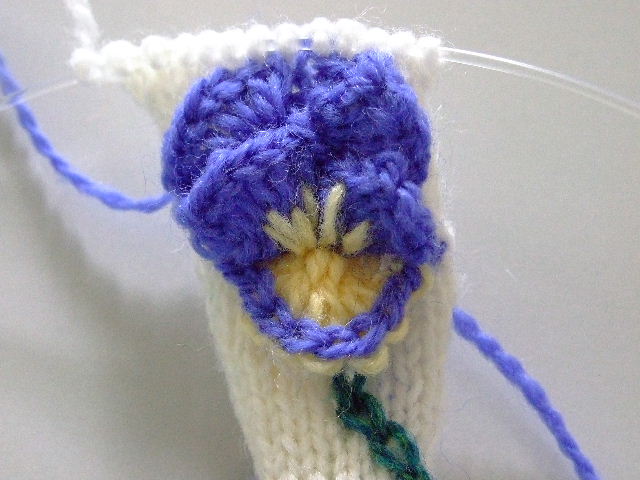
I found these notes on my desk this afternoon, and decide I better upload them before I either lost them or forgot about them.  These pansies are fun to make, and the fan that makes the petals can be used for other flowers as well, even butterflies.  I am sure that some of you will come up with even more ideas on how to use them.


Try them out.  * Pattern note-  be sure to pull your loops at least 5/8 inch long.

Pansy tutorial

Feel free to contact me if you have questions.

Have fun!!

Knit-tweaker

Read Full Post »

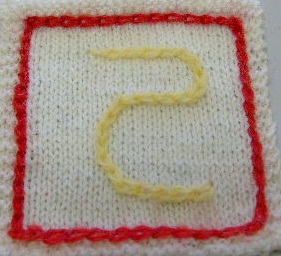
Lately, I have been playing around with what I term as Wandering Cable Chains.   Why this term?  First, the stitch itself appears as if it is a crocheted chain laying on top of the knitted surface.  Secondly,  the method of moving the stitch is similar to when you work a “Cable” pattern; hence the term “Cable Chains.”  The “wandering” part, is the ability to take this chain st anywhere you want. 

 This stitch has enabled me to created many differents special affects for my lastest project-Needlepoint Knitting.  It can be used to outlines sections of any Intarsia design(if you like the smooth edge look),  draw designs on plain stockinette background, and best of all it is a great cover-up st for decreasing a very busy pattern on a raglan sleeve design.   The pictures below show just  a few possiblities for their use. 

This pillow top is one of my lastest Needlepoint Knitting designs. You can see that I have used the Wandering Cable Chain to create an oval frame and textured design around my roses.  Below is a close up of the detail in the frame of my Tropicana Rose Pillow.  You can see the chains forming  lattice work around the oval frame of the design.

 Below is another application of this technique.  This diamond design can be applied to sweaters or any flat surface.  I will be posting this pattern soon. 


Here is a example of how I used this stitch to cover the necessary decreases in this complicated pattern.

 But for now, I decided to post a tutorial that explains the process, and gives you a chance to play around with it.

This sample is just a swatch I played around with.  You will notice that it is not centered, that is because I was indeed just wandering around with my chains.   However, the pattern that I have in the tutorial is centered.  There are 14 pages of  written instructions and pictures,  as well as a chart that will give you a chance to try it out.  The chart on the last page has the symbols that I will be using in all my Needlepoint knitting patterns. 

I hope you have as much fun as I had working with these chains.

Wandering Cable Chains Tutorial

Please feel free to contact me if you have any questions.

Read Full Post »

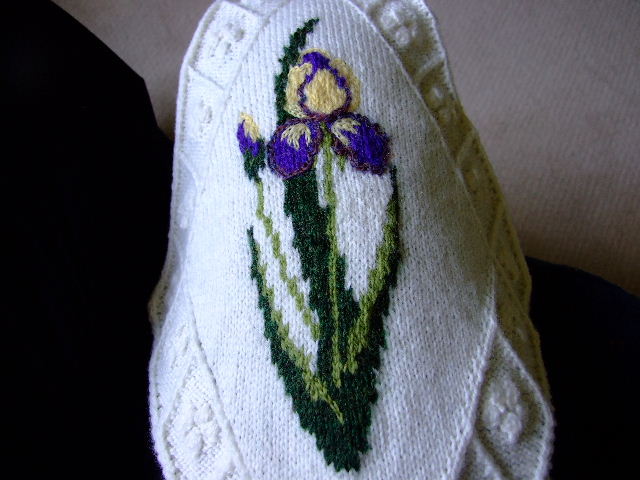
I am so excited to be able to share my new project with you.  It began when I was inspired to knit a cross stitch Iris, designed by my friend at Temping Tangles.  My first challenge, of course,  was to create a canvas on which to place my picture.  The next question was the shape.  Finally, deciding on a diamond sampler, I began working on the frame design. As the frame of a picture is very important, I played with many ideas before I settled on the final design.  I knew that I wanted to incorporate several techniques in the project, so keeping that in mind I did the canvas itself in stockinette, the picture in Intarsia,  used a variety of  texture stitches to created diamond frame, and a crocheted chain to fill in the details.

No boring knitting here!!!!

After several attempts  I came up with this.  Here is my first knitted canvas.

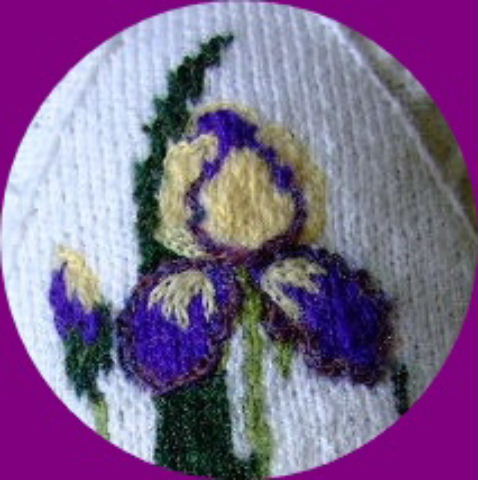
In the flower itself I concentrated on the main colors, then with a crochet hook I used a chain stitch to put in the details.  It worked just great.

The next step was to see if I could design one myself.  So….using a picture of an Iris I found on my computer, I charted it for my diamond shape knitting canvas.

Here, again, I did the detail stitches with a crochet hook , using a single strand of the yarn(making it lace weight).  This technique gives you great detail without adding a lot of bulk.  This diamond frame can be filled with your favorite flower, or pet. It can  be adapted to apply on a sweater, front , back or sleeve.  *I will be posting a tutorial on this adaptations soon.

Here is a closer look.  You can see that I elected to leave the leaves with the cross stitch look, but that can be rounded off with the crocheted chain as well.

Here is a close up of the crocheted detail.

Why am so I excited about this?  It has opened a Pandora’s Box of ideas for future projects.  Now I can chart any picture I want, place it on my canvas and knit away.  In fact, I am working on a new one right now.

After finishing the design, my friend took my work and turned it into a cross stitch pattern.  The result was a pattern that offers both knitted and cross stitch designs. There are two versions of each design, along with complete detailed instructions.  Of course you are always welcome to contact me for further instructions if needed.

If you would like to try this, click on “NeedlePoint Knitting” here. All four patterns will be  toward the bottom of the page.

You can also click here.

Oh, be sure to check the info below for Counted Wishes Cross Stitch Festival and pass it out on to your Cross Stitching friends.  You even might find something there to tempt you!

On midnight, just before the start of the upcoming Counted Wishes Festival, August 1-7th, I will be releasing several Brand New Designs for your stitching delight.

Remember, you will have the chance to win one of my designs, FREE if you are the grand prize winner. So be sure to visit and sign up because there will be more than one winner!

If you love Cross Stitch you are in for a Treat!

Show Specials, Grand Prizes, Drawings, Just for Fun Games AND –  best of all, Pricing Discounts during the show week. At the start of the show week, I will post the information right on my main website’s “News! News! News!” page at http://www.temptingtangles.com/

 so you can find out just what my Special Pricing Discount will be.

Remember: Counted Wishes Cross Stitch Festival for the upcoming 2010 Fall edition will be available to all of you August 1st through the 7th where you can buy from us directly.

My designer friends and I will be there to offer you new designs and lots of wonderful surprises.  Even better is that our designs are available instantly – what is better than Instant Gratification? Do come see us in August and join the fun.

Read Full Post »

I just ordered my yarn to make a Lavender and Black pair of the Double Knit Slippers.  But, when I was thinking about the color my thoughts went to an Iris, instead of a rose. Hummmmmmm…….?

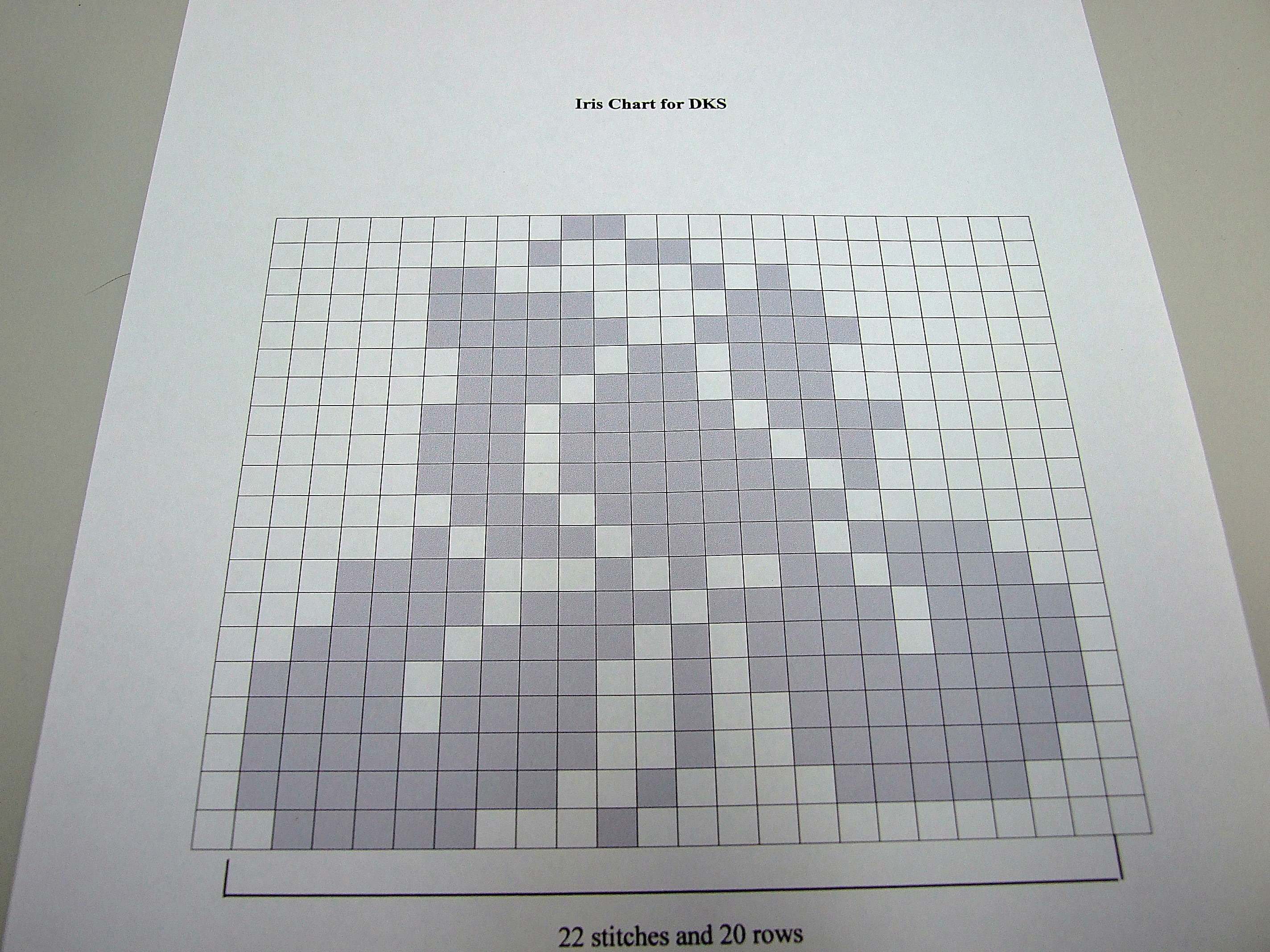
Here we go again!    So this time I used my “table tool” in Publisher, 20 rows and 24 columns.  I clicked on each cell, then hit the line option button and selected,”hair line.”  Once I had all my cells outlined, I saved it as “blank for charts,” etc.”   Next, I took a picture of an Iris, enlarged it, put it in the “back layer” behind my grid, and started pointing and clicking the grey I had selected into the appropriate cells.  Here is the results.

Once done, I was inspired to do a few more.  Feel free to up load and use them as you like. I had great fun making them.

I will also upload them to my Free Charts and Patterns page so that you can access them later at your convenience.  All these charts were designed with the toe area in mind, although you could use them in the cuff or leg area as well.

Charts for DKS

Read Full Post »

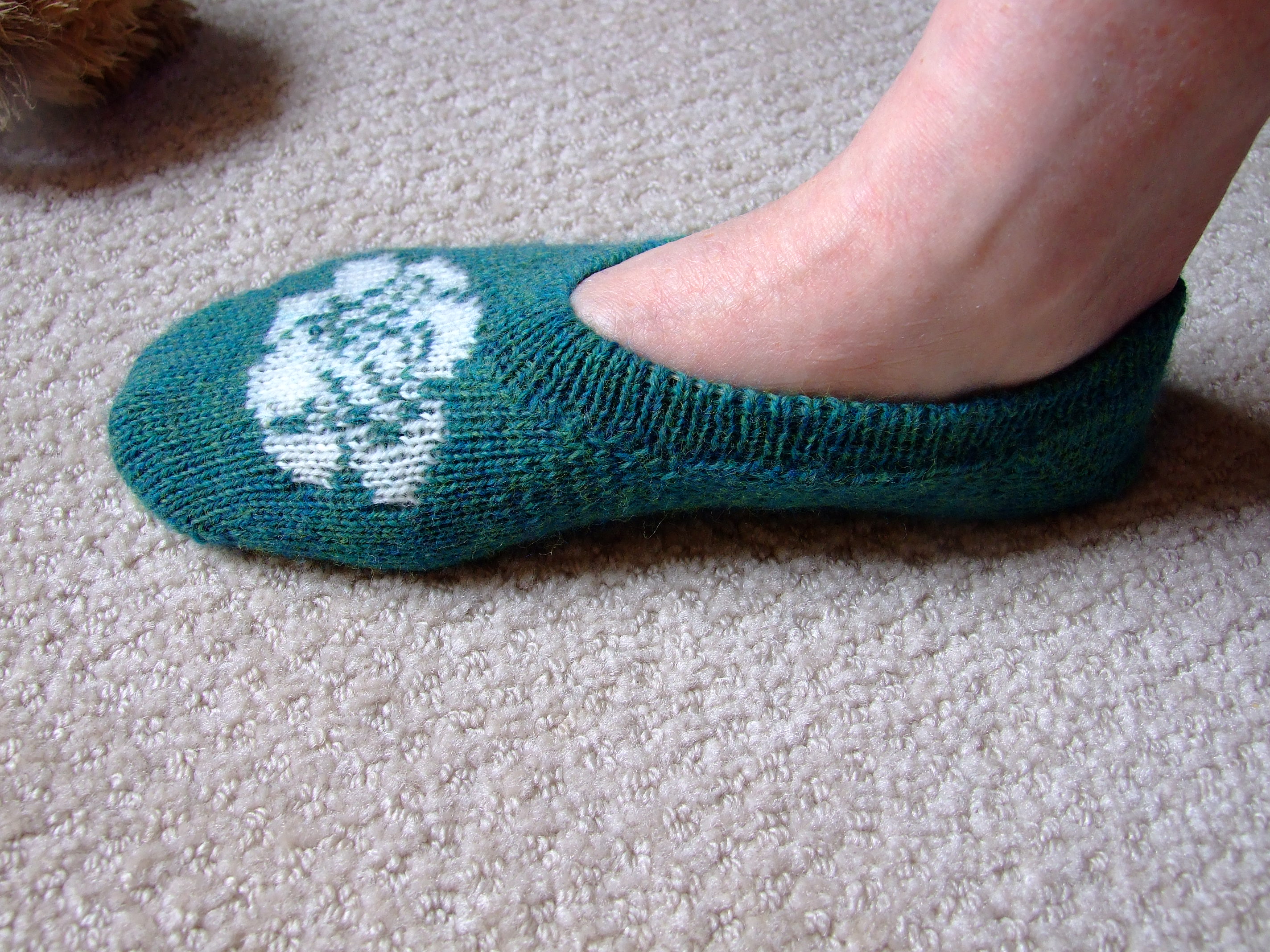
I designed my Double Knit Cozy Slipper Socks so I could use the “Slipper Toe”  pattern I stumbled on to while playing around with short rows.   I am delighted with the results.  And …. they feel so…… good on my feet.  My husband even said he might like a pair for next winter.  Hummmm… , maybe I could chart an  elk on them. There were nine on the hill behind the house this morning.

Here are the pictures of the ballerina slipper.  I will post the pattern as soon as it it off the press.

You will notice that I incorporated that rose I used in “Charting Your Knitting Ideas.”  Next time I’ll turn it around so I can see it.

Beside using the Slipper Toe, I was able to use several techniques for this project.  I picked up my stitches for the ribbing as I went- yes,  picked ‘um up on the fly.

I used the invisible cast off, which provided me with a tube through which to slide my elastic thread, for a nice fit.

Combine that with the fun of  double knitting, and what more could a girl ask for?

You may purchase the pattern in my Etsy store.  Click here.

Read Full Post »

I thought I would share tip with those of you who might NOT have done a lot of Magic Loop knitting.

Last night I was working on a pair of socks for my friend, and in the process of putting pictures of her Doxies on the leg  portion, using the Armenian weaving method,  I discovered that if  I divided my sock into smaller sections,  I didn’t have to worry about the ” laddering” at the needle divisions.  It  allowed me to lay the adjacent section out flat before proceeding to the next one to the left.   Here’s the  pictures of what I mean.

These three smaller sections (three Doxies, sections A, B and C) of stitches allowed me better control over the tension of the floats, especially between the sections.  It also saved me from having to use markers to identify the beginning of the chart, or new dog.

Hummmmmmmm??  Why,  I might be able to use this method as if I had double point needles.

I think I am going to opt for a 47 inch next time I order my needles from KnitPicks. I could , of course, pull the cord out at every section, but I guess I’m not very keen on pinching and pulling.

Below is a picture of the left foot sock, finished with an invisible cast off- my favorite.  This toe shape is the one I posted in “New Toe Shapes for Toe-up Socks.”

This cast off looks very professional. It makes your sock look like it came right from the factory.  I learned this wonderful technique from  a book by Peg Arnoldussen, entitled, “Essential Techniques for Serious Knitters.”  The book also includes working with “steeks” as well as various finishing tips. It is inexpensive and well worth the money.

You can get her book here.

Just a PS.  My socks are modeled on a sock form I made from an old sock. Just stuffed it with fiber fill, and made a heavy folded paper ring to go in the leg part.  It works great.

Read Full Post »

My most recent post showed you a method of shaping your toe-up socks by starting them off with a waste yarn crocheted chain.  Taking that one step further,  I thought I would show you the Tabby Sock I designed using the same method.

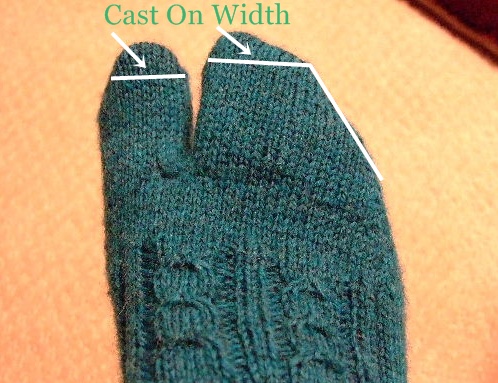
As you can see in the photo above,  I measured the width around my big toe about a half inch from the tip.  Dividing this in half gave me the CO width for my Toe Tip Cap for this section of the Tabby Sock.

Calculating the stitches using my gauge (9 sts , and 12 rows per inch), I made my chain, adding 10 additional chain sts for something to hang on to, and proceeded to pick up the number of  CO stitches required.

Next, I worked  3 short rows each side to make my cap.  Picking up the stitches off the chain, and I knitted in the round with no increases till my toe measure about 2 inches.  * This measurement was  1/4  inch longer than the inside length of my toe, to allow for the two sections to meet in the middle of the gap.  Not allowing this extra length would have  made it uncomfortable to wear.

Leaving a long tail, I cut the yarn, put the live stitches on some waste yarn and proceed to the next toe section.

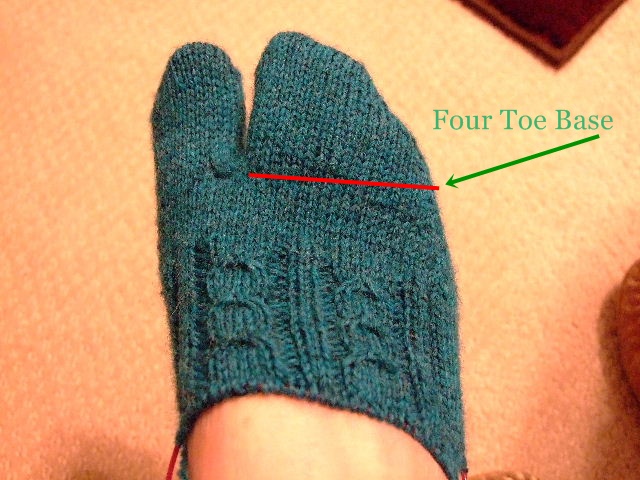
The four toe section Toe Tip Cap is made exactly like the pattern in this tutorial-More toes tutorial,  the only difference is that you only need to measure the width of the first two toes adjacent to the big toe, to calculate your CO stitches.  Work the increases on one side only, till you have the number of stitches needed for the width of the four toe base. See below.

Once this section is done, place it on a piece of waste yarn so that it will be flexible.  Do not break you yarn.

Now, using the tail from your big toe section, Kitchener stitch the big toe and four toe section together, using about a third of the stitches from the big toe section.  Secure the yarn, and weave it in.  Next, pick up the stitches off the waste yarn from both sections.

Knit around, picking up at least 3 stitches where the section are joined (front and back). These extra stitches make the sock more comfortable to wear. Try it on!  If it needs a few more stitches in the gap, this is the time to do it!!

From here you can proceed with whatever style sock  you want.

Hummmmmm???? I wonder if this could work for mittens, too?? I can just imagine have all those little finger tip caps lying around.

Read Full Post »

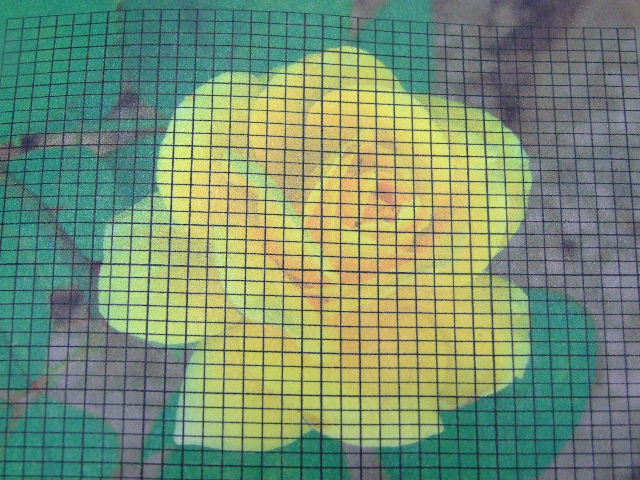
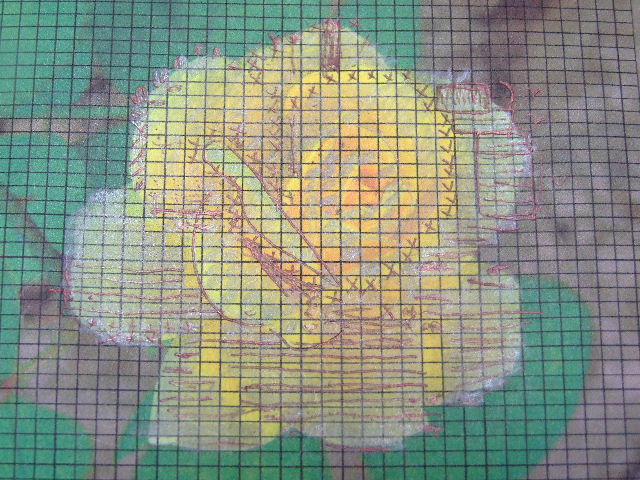
Last night I finally finished charting a picture of the yellow rose I grew in my garden last year, and thought I might share the process with you.

Some of you probably already know how to do this, but for those of you who don’t, I’ll do my best to illustrate it.

If  you are viewing this site, I know you have a computer.  And, as most computers come with  software that allows you to draw simple shapes(I use Microsoft Publisher), then you have the means to make these simple charts.

Below is a picture of  a chart made for the gauge I knit when using sock yarn and a #1 needle.  There are 9 stitches, and 12 rows, to one square inch.  The chart is created by opening your art program and  selecting the “square” in the shapes. Draw your square.  While it is still “selected” go to the top task bar and click on the line thickness icon.  Select “hairline.”  Now you can copy and paste as many boxes together to represent the gauge of the project you are working on(I did 9 across and 12 down). Once you have the number of boxes neatly arranged, take the “select” tool pointer and draw a square around the entire group, then click “group.”  Now line that unit up with your side and top rulers to form a one inch square.  It should now look something like the picture below.  The camera angle on this makes it look oblong, but, trust me, it’s square.  You will also notice that your squares have turned into rectangles.

SAVE this unit in a separate file, maybe something like “my 9 by 12 knitting template.”  Now click on the unit and copy it.

Having copied the template  we will form the complete grid for our project in a NEW FILE.  Paste the template as many times as needed to form the size of grid desired.   When finished, group it, and SAVE IT.  Why? So that you will have a CLEAR grid to start again on a different picture-you won’t have to DO IT AGAIN.  Ask me how I know?  No, don’t.

Be sure to name it, with the d1mensions-such as “my sock chart -9 by 12,” etc.

Next, copy the chart that you have just SAVED.  You can paste in a another file or just add a page to the file you are using.  In any case, put it on a page by itself.  Now you can use the  “insert picture tool”  to import the picture you want to chart.  Enlarge it as you wish, then in the task bar at the top select “arrange.”  Click on  “back. ” This will place the picture behind the grid.

Once that is done, you can print the page, take it to your table and start filling in the squares as you like.

Here you can see some of my pencil marks.  Next I will take it back to my computer, click on the squares I have marked and click the color I want to fill them in with. I chose gray.

Here’s the finished product.  You will notice that I also added orange lines at  intervals.  I do this before I start filling the color, as it helps me keep track of where I am.  When I am pleased with the results, I SAVE it to my Knitting Chart Collection.

Have fun!

Have questions, contact me.

Knit -tweaker

PS.  Another alternative is to purchase a software program called Pattern Maker Pro(PM).  It is a cross stitch program but works well for my knitting projects.  The key is to “size” the fabric with the gauge you want to use.  When you set the stitch and row counts the chart grid changes to rectangles, thus what you see is what you get. Check it out.  I now have PM Professional.   I love it!

Read Full Post »

This probably should have been one of my first posts, but, better late than never.  For about 45 years I was what you would call an average knitter.  I made useful things like, afgans, sweaters, scarves- you know, simple things.  Then one day I picked a Vogue Knitting magazine, and in it was a picture of the lady wearing a knitted lace sweater.  I had to have it.  I went to the local variety store and came home with Knit Crocheen.    It wasn’t long before I was witnessing magic taking place right before my eyes.

This first project in lace, definitely tweaked my sense of creativity.  I loved learning the new stitches, and had great fun with all the needle gymnastics involved in the pattern.  Knitting wasn’t boring anymore.

From there I moved on  to a little more challenging pattern.  This one featured a spider web pattern on the front.

It didn’t have sleeves, but this old lady does not feel comfortable without them.  So.. I made some.  I wear it quite often, changing the color of the tank I wear under it to go with the rest of my attire.

Now I was really on fire to to something intricate.  so I began my first “real” lace shawl with “real lace” yarn.  The Print o Wave shawl  I made for my daughter, was offered aa a free pattern on the web, by Yuny Jang, of Interweave.   I designed the header of my website with it.

Following that, I ventured out to make two more shawls, one for a friend,  and one for my daughter-in-law.  They were followed by a lace scarf for my sister-in -law.

Southwestern Shawl

by Fiber Trends.

Pacific Northwestern Shawl

by Fiber Trends

Maple Leaf Scarf

by Heartstrings Patterns

Next, came my greatest challenge in attempting the “Princess Shawl” from Heirloom-knitting.com

Here is the edging I am still working on. It’s my travel project.

All this is to say, that new adventures in knitting have taught me to be patient, to be willing to take out and redo, practice stitches and new techniques until I get them down smoothly, and most of all, not to be in a hurry to finish.  I have learned to enjoy the process.  I hope you have, too.

Read Full Post »

« Newer Posts - Older Posts »