Feeds:
Posts
Comments

Posts Tagged ‘nordic knitting’

I just finished putting the finishing touches on the ski sweater pattern I promised to share with you.  I have several verisons, but we will start with this one.

 The pattern for this sweater is a stitch by stitch chart, complete with pattern notes and finishing instructions.  Of course , you can adjust these figures as needed.  The chart is gauged for 6 stitches and 9 rows per inch, using sport weight yarn, knitted with a #4, 32 inch circle needle.

The chart is for a man’s large,  chest 50, hip just below waist, 39.   I always think  SWEAT SHIRT, when I think of a Ski sweater, so for me even though I wear a medium sweater normally, I like a large one when it’s cold so I can comfortably wear it over all my layers.

This pattern uses Intarsia in the round, and Fair Isle.  You can even uses one of my bobbles for the nuts.  Hummmm… that’s an idea….Hummmmm…..

I also have the set of charts for the borders and Whitetail buck available separately.

Below are samples of what you can do with the “fade out” chest panel.
If you are interested, please check out my Pattern Catalogue page.

Happy Knitting- KT

Read Full Post »

I have been dink’n around lately with a new wildlife design that I call, “Quail in the Snow.”  The discoveries I’ve made during the process of developing a bobble for the pine cone have been very interesting.  I have already shared with you some of the info in my recent post about “bobbles,”  but further trial and error has brought me to some new conclusions.

1.  A bobble can be made in one stitch and on one row.

2.  Varying the loops can create different special affects.

3.  If you want the knitting to expand for a 3-D look, be gentle, don’t pull them to tight, and knit them with one strand  of yarn.

4.  If you want your bobbles to lie flat on the backside, you need to work your boobles with two yarns- one to make the bobble, and one to knit the stitch in-between.  This second yarn is pulled tight across the back.  It pushed your bobble out front, and helps to retain a proper stitch gauge- very important.

In the picture below you can see the result of the 3-D affect I acheived with my pine cone.  The cone  and snow just above it, was worked with one strand.  The snow on the other branches was worked with two strands, thus putting it in the background.

You can see that the cone it is raised quite a bit above the surface of the work.  To retain the shape, I simply created a web of yarn across the back, weaving it together so that the backside retained the gauge of the entire piece.

Below is one of my new designs, which includes all four charts to play around with.  I am still doing a bit of fine tuning, but hope to have it ready soon.  This particular design was knitted with Palette fingering yarn from Knitpicks.

Hummmm?  A little glitter in the snowflakes might be nice.

This pattern will give you a chance to use Intarsia ( in the round), Fair Isle, bobbles of various kinds, and the experience of creating the pine needles and details with a crochet hook.

It was great fun to do.    Quail Motif – PDF

Have a great day!

Knit-tweaker

Read Full Post »

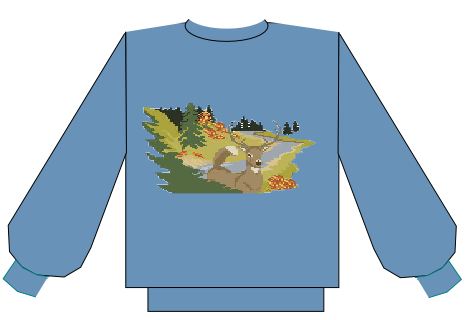
I have been working on the idea for wildlife designs for Ski sweaters for some time now.  My inspiration for this particular series was the gorgeous change in foliage, harvest time, and “buck fever.”  Yes, in Idaho, Camo gear is the fashion of choice this time of year, as everyone and his brother is hunting for that vension or elk back strap steak to put on the table.

So… with all this in mind, my first set in the series is my “White Tail Buck” combo to use on a sweater for your favorite hunter.  Below is a peak at my digital finished sweater.

I am designing these sets to include charts for bottom borders, shoulders, and Intarsia chest scenes. The gauge is set up for sports weight yarn, but you could use them for fingering weight as well,  the patterns would just be a bit smaller..   Of course all these charts can be used for other things, such as pillows, and socks.(especially the Squirrel border).

I have had a great time creating these, and hope you will enjoy them too.

The method combines Intarsia (in the round), and Fair Isle.  I will include the how to’s and all special affects instructions in the patterns.  The patterns will also include the basic structure of a Ski sweater and application variations.

I originally opted for selling these motifs on Etsy, but since then I have opted to share them with you at  not cost.  If you are interested, email me (see contact page).

Happy knitting-

Knit-tweaker

Read Full Post »

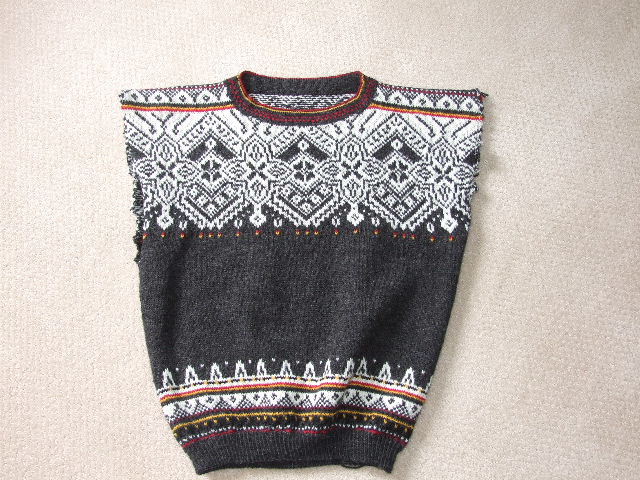
This past year has been very busy for me, with taking care of elderly parent in another state.  However, with that said, my knitting has kept me sane.  I really became fascinated with with the idea of working with colors when I saw a picture of a beautiful Ski sweater on the cover of an old knitting magazine.  So what did I pick for my first project?  You guessed it, the Norwegian Olympic Team sweater. Here are some pictures of the results- and did I learn a lot about “floats.”  This sweater was made of Heilo Norwegian wool, sports weight.

You will note that this sleeve is on my “Magic loop.”  I don’t think I have used a straight needle since I discovered this method.

On the bottom of the sleeve I used the weaving method of changing colors. To keep the gauge uniform I switched to a size larger needle than the pattern called for, but even with that change I still had to drag the stitches back toward the right with my index finger to keep the gauge even.  I discovered it just take a willingness to practice.

On the right is a picture of the main part of the sweater. I took it out three times before I was satisfied with it. After coming across an article that encouraged you to not worry about the floats, as they could be tacked down later,  I tired it.  With a little practice, I found that the design was much cleaner.  When I finished I simply divided my yarn into single ply threads and tacked down the long floats, then wove in the ends. It worked beautifully, and the gauge was even.  I used regular steeks for the sleeve openings, and wrapped steeks for the neckline.  What a neat way to put a sweater together.  The only thing I would add to the process is about four regular steek stitches each side of the neck opening before a I made the wrapped steek for the span. It would secure the neck edge stitches a bit more, making it easier to handle.  When I do the next one I will take some pictures of the process.

Here is a picture of my son wearing his new ski sweater. He loves it   It’s a little fuzzy, but you get the idea.

If I did it again, I would go to figuring weight yarn,(Palette, from Knit Picks) and use #2 needles, which would make it a bit lighter.


Read Full Post »

« Newer Posts