Feeds:
Posts
Comments

Archive for the ‘Uncategorized’ Category

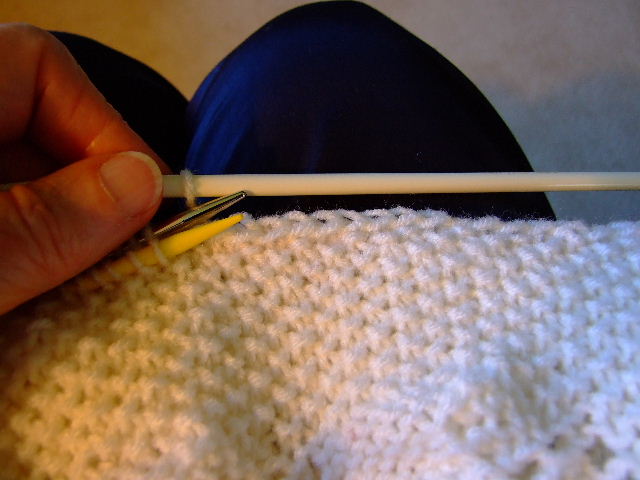
As I was binding off a shrug for my mom, the other day,  I noticed that I had formed a habit of pulling the work to the right, after each stitch.  The results- a flat bind off that had the same stretch as the rest of the work.  It is just a little thing, but I wish I would have realized it many years ago.  I had always been apprehensive when it came to binding off my garments-but no more.

Now, I just give my work  a little tug to the right , take up any slack of yarn, so that the yarn lays smoothly on my right needle, then I proceed on.

As you can see, the edge is not pulled tight, the chain on the top edge is tidy, and best of all, everything has the same stretch.  Try it!

By the way, for those of you who follow my blog, I want you to know that I haven’t been AWOL.   I have been working on an exciting new project.  I am hoping to be able to share it with you in a few weeks.

Later- Knit Tweaker

Read Full Post »

I just ordered my yarn to make a Lavender and Black pair of the Double Knit Slippers.  But, when I was thinking about the color my thoughts went to an Iris, instead of a rose. Hummmmmmm…….?

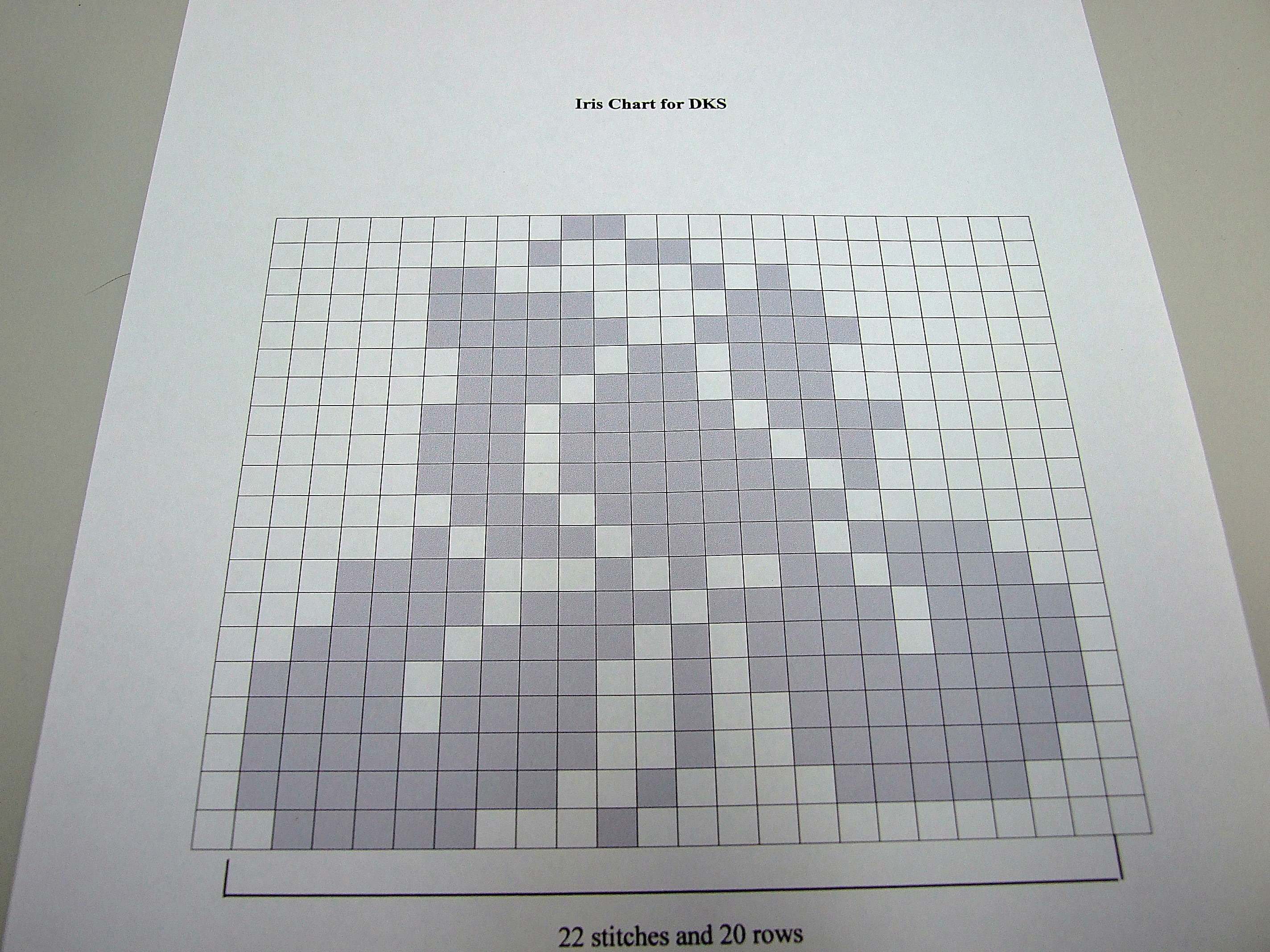
Here we go again!    So this time I used my “table tool” in Publisher, 20 rows and 24 columns.  I clicked on each cell, then hit the line option button and selected,”hair line.”  Once I had all my cells outlined, I saved it as “blank for charts,” etc.”   Next, I took a picture of an Iris, enlarged it, put it in the “back layer” behind my grid, and started pointing and clicking the grey I had selected into the appropriate cells.  Here is the results.

Once done, I was inspired to do a few more.  Feel free to up load and use them as you like. I had great fun making them.

I will also upload them to my Free Charts and Patterns page so that you can access them later at your convenience.  All these charts were designed with the toe area in mind, although you could use them in the cuff or leg area as well.

Charts for DKS

Read Full Post »

I was messing around with  a swatch the other day and decided I would practice the Invisible Bind Off technique. During the process I took some pictures and thought I would share them, hoping that maybe they would encourage someone to try it. I am sure this has been around for eons, but I learned this method from a book entitled “Essential Techniques for Serious Knitters,” by Peg Arnoldussen, a book that contains many wonderful tips and techniques.  Check it out!

Why the Invisible Bind Off?

First off, on the plus side, it looks very neat and professional, it stretches well, and it provides my socks with a tube through which I can run elastic, if I choose.

On the minus side, it takes a bit of practice to get the tension right. It requires a bit more time and planning. It also requires learning the Kitchener Stitch. Yikes!!!!!

Why am I doing this tutorial?
It helped me think through the process, and hopefully it will help you, too.

I purposely did this tutorial using a small practice swatch.   I also used different colored yarns so that you could see the process better. At least, I hope you can.

I have knitted many of these practice swatches, but once I got the hang of it, I was never afraid to use the Kitchener Stitch for any closure.  Once you get it, you get it!!!

Invisible Bind Off Tutorial

Read Full Post »

I recently received an email from a lady that was a bit confused with my explanation of what a SPR is-my term, of course.  So being one that believes that you can always improve things, I took a look at the picture on page 3.

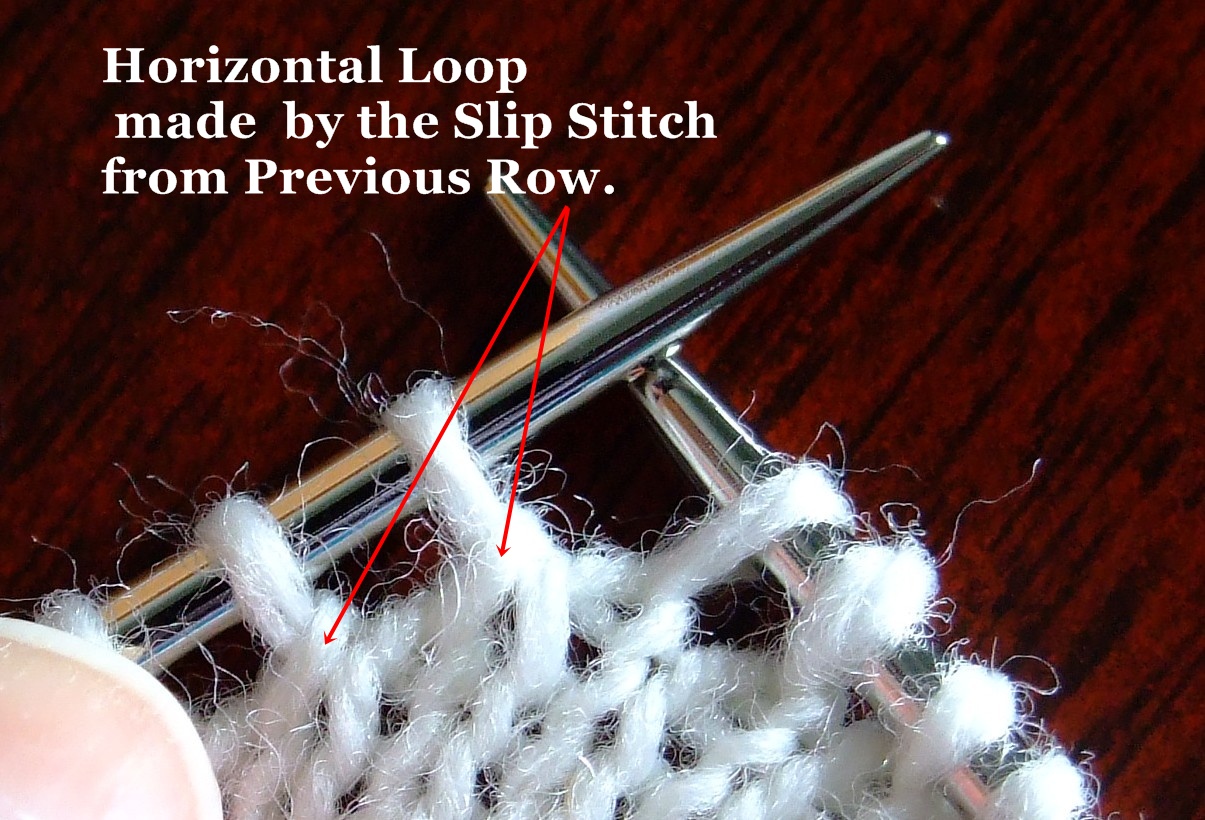
When I pondered on it a bit, I realized that it was the horizontal loop laying at the base of the slipped stitch from the previous row that I  actually lift onto the right hand needle to be knitted.

I decided not to change the term SPR, but, I put a more clear explanation of the process in the chart key and replaced the illustration.

Here is the new picture.

This loop is made, when the purl or knit at the end of the row is forced to the left, or in the direction your are knitting, when you slip the first stitch after the turn. The “loop” is what forms the gaps.

I hope this clears things up.  Who knows, I might even come up with a better illustration in the future.  If I do I will post it.

Knit-tweaker

Read Full Post »

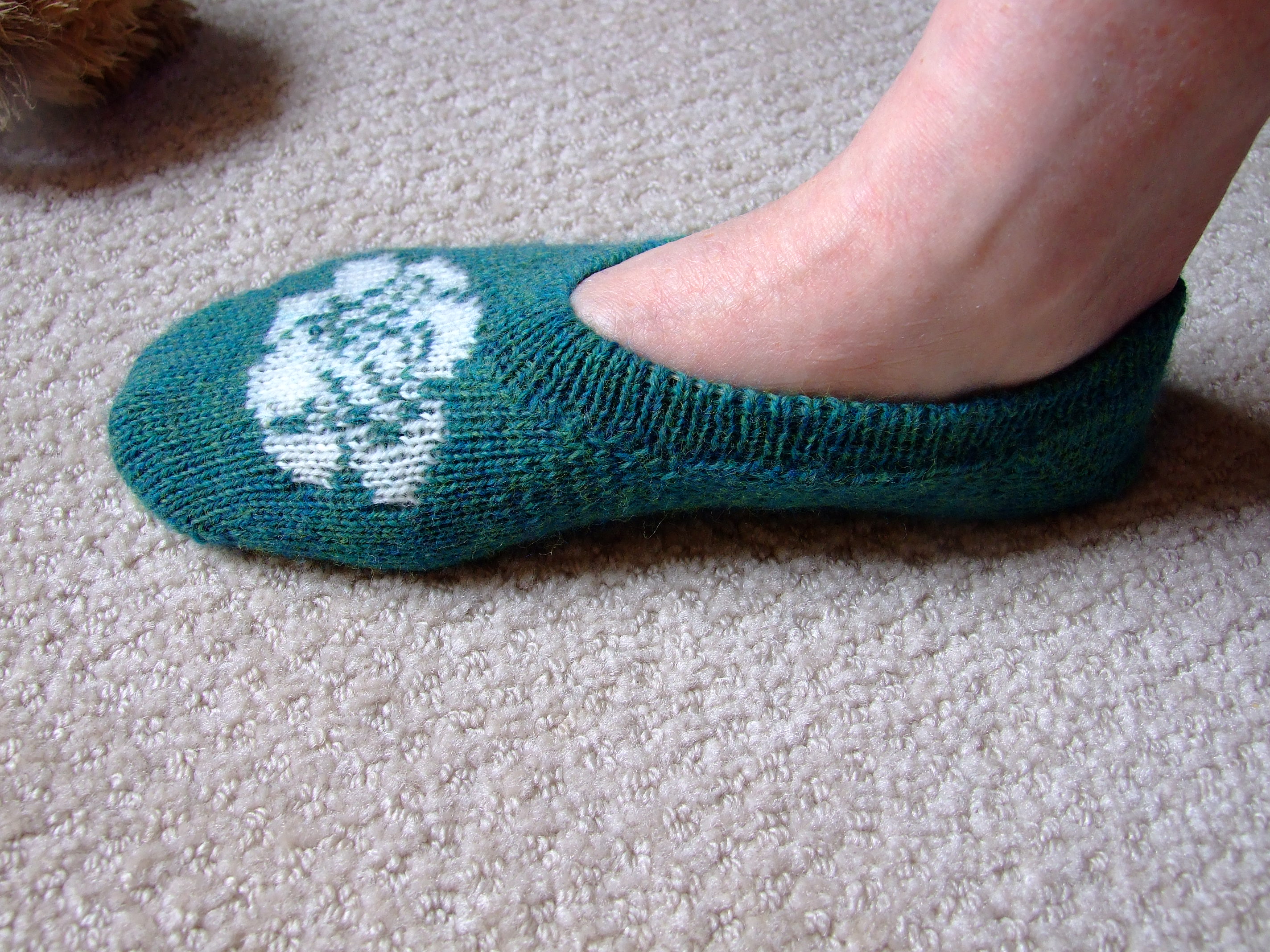
I designed my Double Knit Cozy Slipper Socks so I could use the “Slipper Toe”  pattern I stumbled on to while playing around with short rows.   I am delighted with the results.  And …. they feel so…… good on my feet.  My husband even said he might like a pair for next winter.  Hummmm… , maybe I could chart an  elk on them. There were nine on the hill behind the house this morning.

Here are the pictures of the ballerina slipper.  I will post the pattern as soon as it it off the press.

You will notice that I incorporated that rose I used in “Charting Your Knitting Ideas.”  Next time I’ll turn it around so I can see it.

Beside using the Slipper Toe, I was able to use several techniques for this project.  I picked up my stitches for the ribbing as I went- yes,  picked ‘um up on the fly.

I used the invisible cast off, which provided me with a tube through which to slide my elastic thread, for a nice fit.

Combine that with the fun of  double knitting, and what more could a girl ask for?

You may purchase the pattern in my Etsy store.  Click here.

Read Full Post »

I thought I would share tip with those of you who might NOT have done a lot of Magic Loop knitting.

Last night I was working on a pair of socks for my friend, and in the process of putting pictures of her Doxies on the leg  portion, using the Armenian weaving method,  I discovered that if  I divided my sock into smaller sections,  I didn’t have to worry about the ” laddering” at the needle divisions.  It  allowed me to lay the adjacent section out flat before proceeding to the next one to the left.   Here’s the  pictures of what I mean.

These three smaller sections (three Doxies, sections A, B and C) of stitches allowed me better control over the tension of the floats, especially between the sections.  It also saved me from having to use markers to identify the beginning of the chart, or new dog.

Hummmmmmmm??  Why,  I might be able to use this method as if I had double point needles.

I think I am going to opt for a 47 inch next time I order my needles from KnitPicks. I could , of course, pull the cord out at every section, but I guess I’m not very keen on pinching and pulling.

Below is a picture of the left foot sock, finished with an invisible cast off- my favorite.  This toe shape is the one I posted in “New Toe Shapes for Toe-up Socks.”

This cast off looks very professional. It makes your sock look like it came right from the factory.  I learned this wonderful technique from  a book by Peg Arnoldussen, entitled, “Essential Techniques for Serious Knitters.”  The book also includes working with “steeks” as well as various finishing tips. It is inexpensive and well worth the money.

You can get her book here.

Just a PS.  My socks are modeled on a sock form I made from an old sock. Just stuffed it with fiber fill, and made a heavy folded paper ring to go in the leg part.  It works great.

Read Full Post »

My most recent post showed you a method of shaping your toe-up socks by starting them off with a waste yarn crocheted chain.  Taking that one step further,  I thought I would show you the Tabby Sock I designed using the same method.

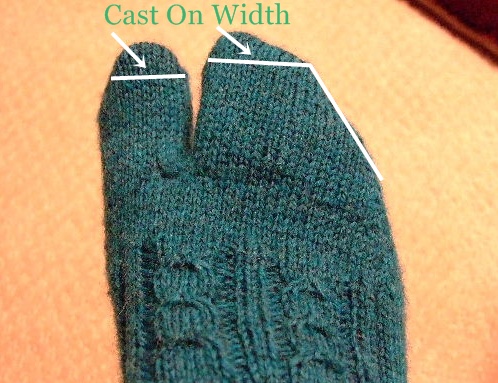
As you can see in the photo above,  I measured the width around my big toe about a half inch from the tip.  Dividing this in half gave me the CO width for my Toe Tip Cap for this section of the Tabby Sock.

Calculating the stitches using my gauge (9 sts , and 12 rows per inch), I made my chain, adding 10 additional chain sts for something to hang on to, and proceeded to pick up the number of  CO stitches required.

Next, I worked  3 short rows each side to make my cap.  Picking up the stitches off the chain, and I knitted in the round with no increases till my toe measure about 2 inches.  * This measurement was  1/4  inch longer than the inside length of my toe, to allow for the two sections to meet in the middle of the gap.  Not allowing this extra length would have  made it uncomfortable to wear.

Leaving a long tail, I cut the yarn, put the live stitches on some waste yarn and proceed to the next toe section.

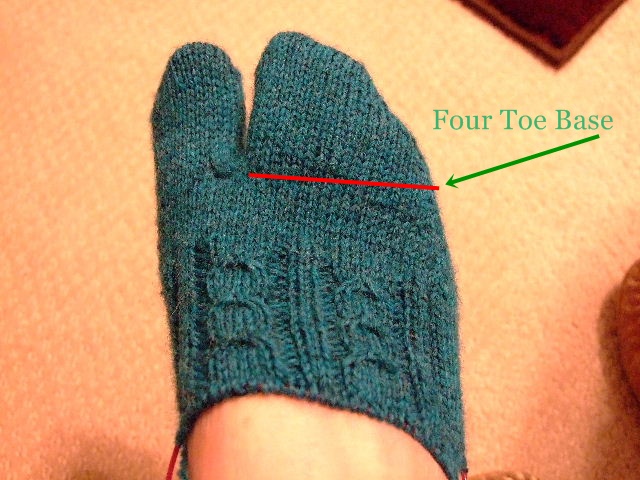
The four toe section Toe Tip Cap is made exactly like the pattern in this tutorial-More toes tutorial,  the only difference is that you only need to measure the width of the first two toes adjacent to the big toe, to calculate your CO stitches.  Work the increases on one side only, till you have the number of stitches needed for the width of the four toe base. See below.

Once this section is done, place it on a piece of waste yarn so that it will be flexible.  Do not break you yarn.

Now, using the tail from your big toe section, Kitchener stitch the big toe and four toe section together, using about a third of the stitches from the big toe section.  Secure the yarn, and weave it in.  Next, pick up the stitches off the waste yarn from both sections.

Knit around, picking up at least 3 stitches where the section are joined (front and back). These extra stitches make the sock more comfortable to wear. Try it on!  If it needs a few more stitches in the gap, this is the time to do it!!

From here you can proceed with whatever style sock  you want.

Hummmmmm???? I wonder if this could work for mittens, too?? I can just imagine have all those little finger tip caps lying around.

Read Full Post »

Short  Row Toe Shaping for Toe-up Socks

The short row tutorial I presented in “Short Row Heel with a Tweak,”  describes a method that can be used for toes as well. The original chart for the heel in the tutorial can be used to form the toe of the same sock.  The ONLY difference is that if you are working from the cuff down, you will need to close the opening between the instep and toe section, or the sole and toe section with the Kitchener Stitch.

Below is a picture of  standard short row heel shaping.  Normally, if you are doing a cuff down sock and you can use this shaping for your toe also.  You simply work the foot section down to within about * two inches, and (having made you decision on what side you will make the closure) you will begin to work the chart as before.  When finished, you simply use the Kitchener Stitch to join the live stitches on your sole or instep section, to the live stitches on you toe section.

Did I say NORMALLY?  Well, one day as I was  practicing one of those “normal” heel patterns (having started it on a crocheted chain, so I could pull it out), it suddenly dawned on me that if I just picked those stitches off the chain I could use it as a toe and start knitting the instep portion of a toe-up sock.  Wow!! That meant no more winding yarn around two needles, or some other funny little cast on.  I was all for that!

Now, since I don’t consider myself  NORMAL, I found myself immediately thinking, Hummmmm…., what if……???”

From that moment on I was on a mission to discover how many other shapes  I could make with those little short rows.  I actually found myself beginning to think of toe shapes in the middle of the night. Yikes!!! Now I know I’m losing it!  But it has not been for naught.  I have been having fun designing new shapes for toe-up socks and hope to share them with you as they are developed.

Here is the beginning tutorial- More toes tutorial

Have fun!

Read Full Post »

Last night I finally finished charting a picture of the yellow rose I grew in my garden last year, and thought I might share the process with you.

Some of you probably already know how to do this, but for those of you who don’t, I’ll do my best to illustrate it.

If  you are viewing this site, I know you have a computer.  And, as most computers come with  software that allows you to draw simple shapes(I use Microsoft Publisher), then you have the means to make these simple charts.

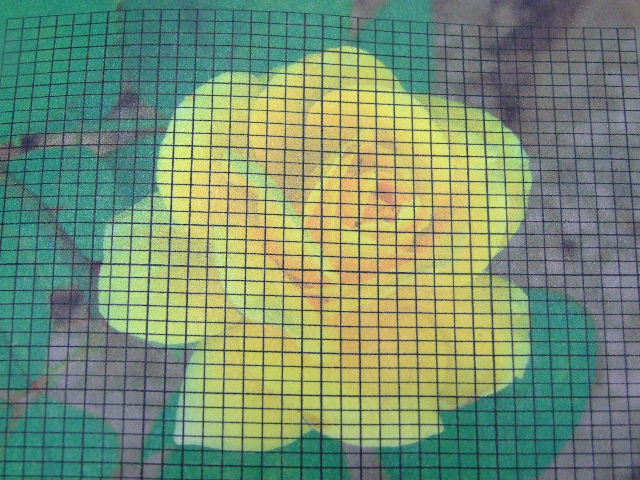
Below is a picture of  a chart made for the gauge I knit when using sock yarn and a #1 needle.  There are 9 stitches, and 12 rows, to one square inch.  The chart is created by opening your art program and  selecting the “square” in the shapes. Draw your square.  While it is still “selected” go to the top task bar and click on the line thickness icon.  Select “hairline.”  Now you can copy and paste as many boxes together to represent the gauge of the project you are working on(I did 9 across and 12 down). Once you have the number of boxes neatly arranged, take the “select” tool pointer and draw a square around the entire group, then click “group.”  Now line that unit up with your side and top rulers to form a one inch square.  It should now look something like the picture below.  The camera angle on this makes it look oblong, but, trust me, it’s square.  You will also notice that your squares have turned into rectangles.

SAVE this unit in a separate file, maybe something like “my 9 by 12 knitting template.”  Now click on the unit and copy it.

Having copied the template  we will form the complete grid for our project in a NEW FILE.  Paste the template as many times as needed to form the size of grid desired.   When finished, group it, and SAVE IT.  Why? So that you will have a CLEAR grid to start again on a different picture-you won’t have to DO IT AGAIN.  Ask me how I know?  No, don’t.

Be sure to name it, with the d1mensions-such as “my sock chart -9 by 12,” etc.

Next, copy the chart that you have just SAVED.  You can paste in a another file or just add a page to the file you are using.  In any case, put it on a page by itself.  Now you can use the  “insert picture tool”  to import the picture you want to chart.  Enlarge it as you wish, then in the task bar at the top select “arrange.”  Click on  “back. ” This will place the picture behind the grid.
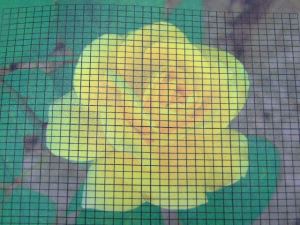
Once that is done, you can print the page, take it to your table and start filling in the squares as you like.

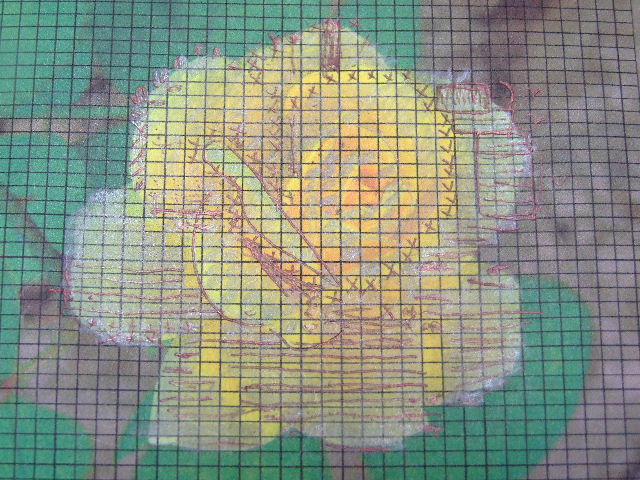
Here you can see some of my pencil marks.  Next I will take it back to my computer, click on the squares I have marked and click the color I want to fill them in with. I chose gray.

Here’s the finished product.  You will notice that I also added orange lines at  intervals.  I do this before I start filling the color, as it helps me keep track of where I am.  When I am pleased with the results, I SAVE it to my Knitting Chart Collection.

Have fun!

Have questions, contact me.

Knit -tweaker

PS.  Another alternative is to purchase a software program called Pattern Maker Pro(PM).  It is a cross stitch program but works well for my knitting projects.  The key is to “size” the fabric with the gauge you want to use.  When you set the stitch and row counts the chart grid changes to rectangles, thus what you see is what you get. Check it out.  I now have PM Professional.   I love it!

Read Full Post »

This probably should have been one of my first posts, but, better late than never.  For about 45 years I was what you would call an average knitter.  I made useful things like, afgans, sweaters, scarves- you know, simple things.  Then one day I picked a Vogue Knitting magazine, and in it was a picture of the lady wearing a knitted lace sweater.  I had to have it.  I went to the local variety store and came home with Knit Crocheen.    It wasn’t long before I was witnessing magic taking place right before my eyes.

This first project in lace, definitely tweaked my sense of creativity.  I loved learning the new stitches, and had great fun with all the needle gymnastics involved in the pattern.  Knitting wasn’t boring anymore.

From there I moved on  to a little more challenging pattern.  This one featured a spider web pattern on the front.

It didn’t have sleeves, but this old lady does not feel comfortable without them.  So.. I made some.  I wear it quite often, changing the color of the tank I wear under it to go with the rest of my attire.

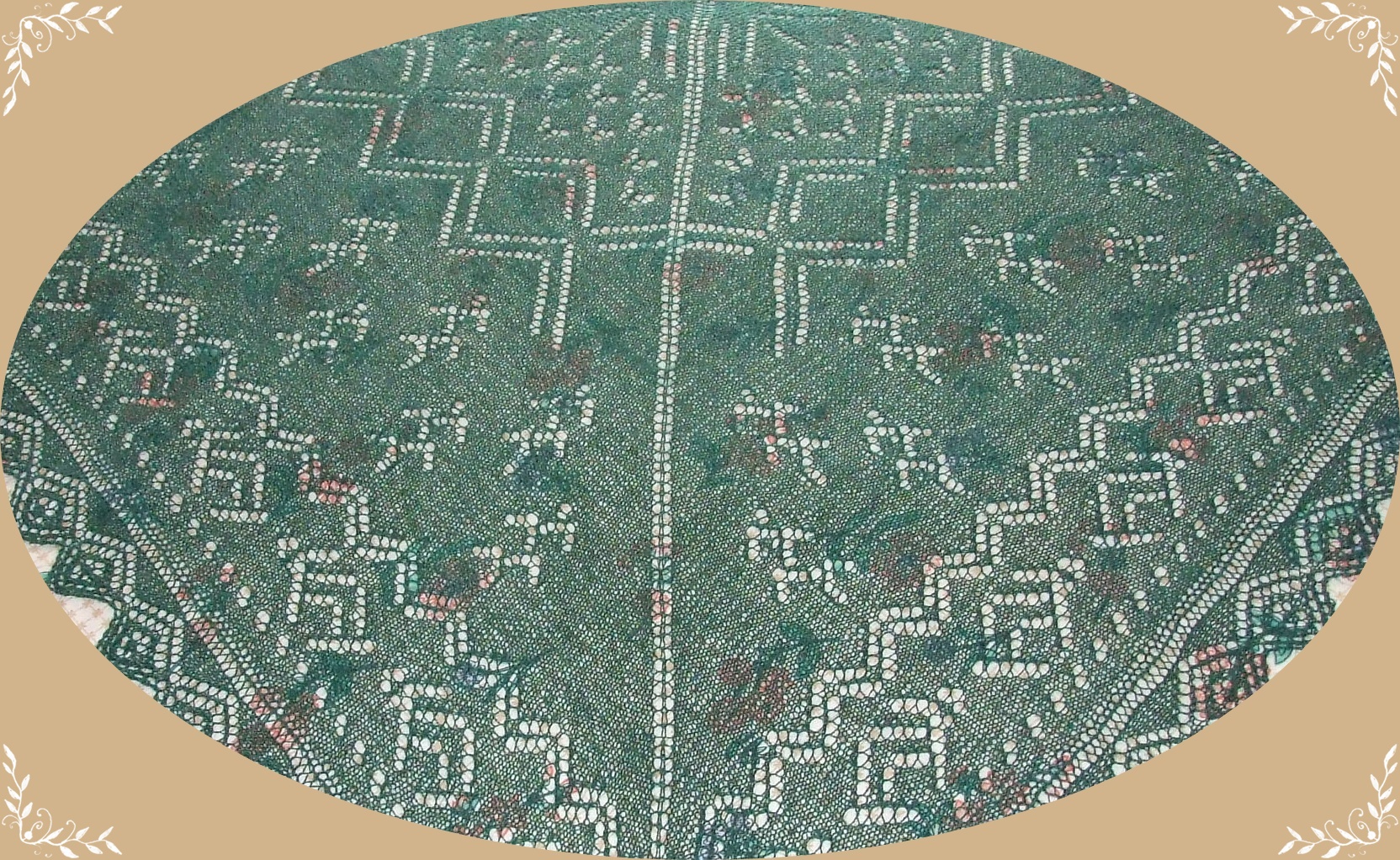
Now I was really on fire to to something intricate.  so I began my first “real” lace shawl with “real lace” yarn.  The Print o Wave shawl  I made for my daughter, was offered aa a free pattern on the web, by Yuny Jang, of Interweave.   I designed the header of my website with it.

Following that, I ventured out to make two more shawls, one for a friend,  and one for my daughter-in-law.  They were followed by a lace scarf for my sister-in -law.

Southwestern Shawl

by Fiber Trends.

Pacific Northwestern Shawl

by Fiber Trends

Maple Leaf Scarf

by Heartstrings Patterns

Next, came my greatest challenge in attempting the “Princess Shawl” from Heirloom-knitting.com

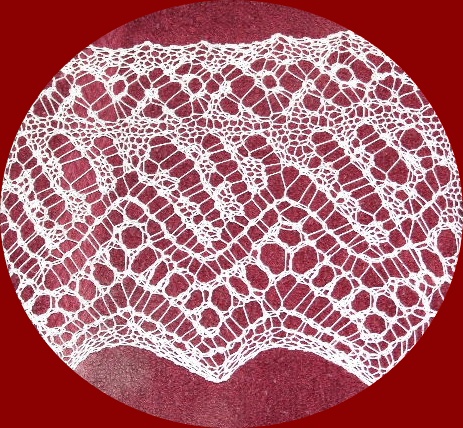
Here is the edging I am still working on. It’s my travel project.

All this is to say, that new adventures in knitting have taught me to be patient, to be willing to take out and redo, practice stitches and new techniques until I get them down smoothly, and most of all, not to be in a hurry to finish.  I have learned to enjoy the process.  I hope you have, too.

Read Full Post »

« Newer Posts - Older Posts »